The Central Bank of Cuba has announced a significant policy shift with the publication of Resolution 74/2026 in the Official Gazette, effectively removing the 5,000-peso cap on cash transactions between economic entities in the country. This decision marks the end of the mandatory banking policy implemented in August 2023, acknowledging its failure.
Signed on July 10 by Juana Lilia Delgado Portal, the president of the Central Bank of Cuba, the regulation comes into effect on Monday, July 20. It effectively nullifies the articles that, for the past three years, required any transaction exceeding this amount to be conducted electronically.
Public Reaction and Skepticism
The Cuban populace took to social media to voice their mixed reactions, characterized by skepticism and dark humor, highlighting a contradiction that speaks volumes about the current situation.
"There are no more limits for cash payments, but the real issue is that there's no cash in the banks," commented one Cuban. Another was more blunt: "Banks are out of money."
One individual summed up the sentiment with sarcasm: "Great joke. Seriously, where can I get cash?"
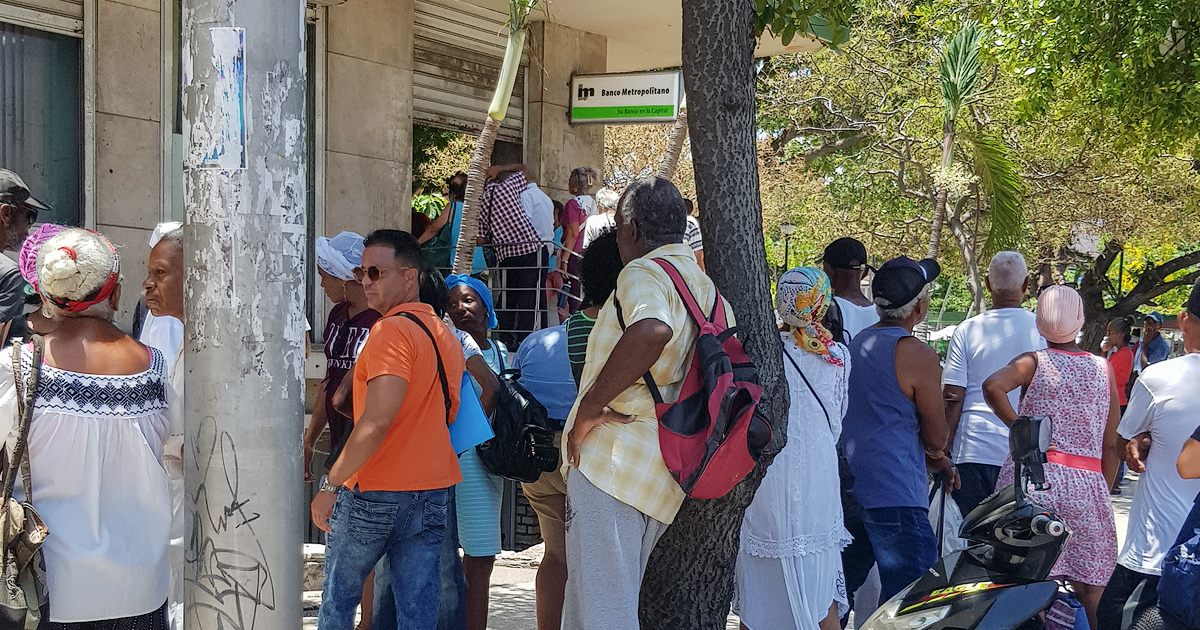
The question is far from rhetorical. Reports from various provinces indicate that the practical reality was already far below the official threshold that has now been lifted.
Challenges Across the Country
In the city of Sancti Spíritus, a resident shared her experience: "For months, the bank gives out 500 pesos, and even then, they issue numbers. The thing is, you get a number just to withdraw 500 pesos. You spend over 15 days trying to get cash, and only once a month."
In Cienfuegos, receiving 1,000 pesos was seen as a privilege. In Maisí, Guantánamo, the actual limit was 1,000 pesos. In San Cristóbal, some banks only dispensed 500 CUP per customer.
The disbelief was unanimous regarding a measure that, in practice, lifted a limit that banks had already unofficially reduced.
Underlying Concerns and Economic Context
"They enact one measure today and another tomorrow, but none solves the problem," another user observed.
Some comments hinted at deeper implications. One person speculated about potential inflationary strategies.
"Brilliant strategy, just the right time to release those 2,000 and 5,000 bills to circulate all that worthless paper and collect all the dollars in circulation. Welcome to the next inflation 'Pro Max' level," they said.
Another summed up the accumulated distrust succinctly: "The bank says one thing, but those on the ground do another."
The context surrounding this decision sheds light on the skepticism. Three years after mandatory banking was introduced, a mere 3.77% of transactions in Cuba are digital, and less than 10% of private businesses routinely accept electronic payments.
The government imposed 15,240 fines and ordered 269 business closures for not accepting electronic payments, failing to achieve its stated goals. In May 2026, over 50% of ATMs in Havana were non-operational.
Resolution 74/2026 cites "approved economic and social transformations" and the need to "more efficiently use the available cash" as reasons for the change, stating that the suspension will remain "until the country's conditions allow."
One commentator captured the essence of the regime's new measure with precision: "This country is a constant experiment."
Understanding Cuba's Economic Challenges
Why did Cuba remove the cash transaction limit?
Cuba removed the cash transaction limit to address the failure of the mandatory banking policy and to adapt to economic and social changes, enabling more efficient use of available cash.
What has been the public response to the removal of the cash limit?
The public response has been largely skeptical, with many Cubans expressing disbelief and frustration on social media, noting that banks already face cash shortages.
What are the broader implications of this policy change?
The policy change may lead to inflationary pressures, as some speculate it could result in the release of higher denomination bills and the collection of dollars in circulation.