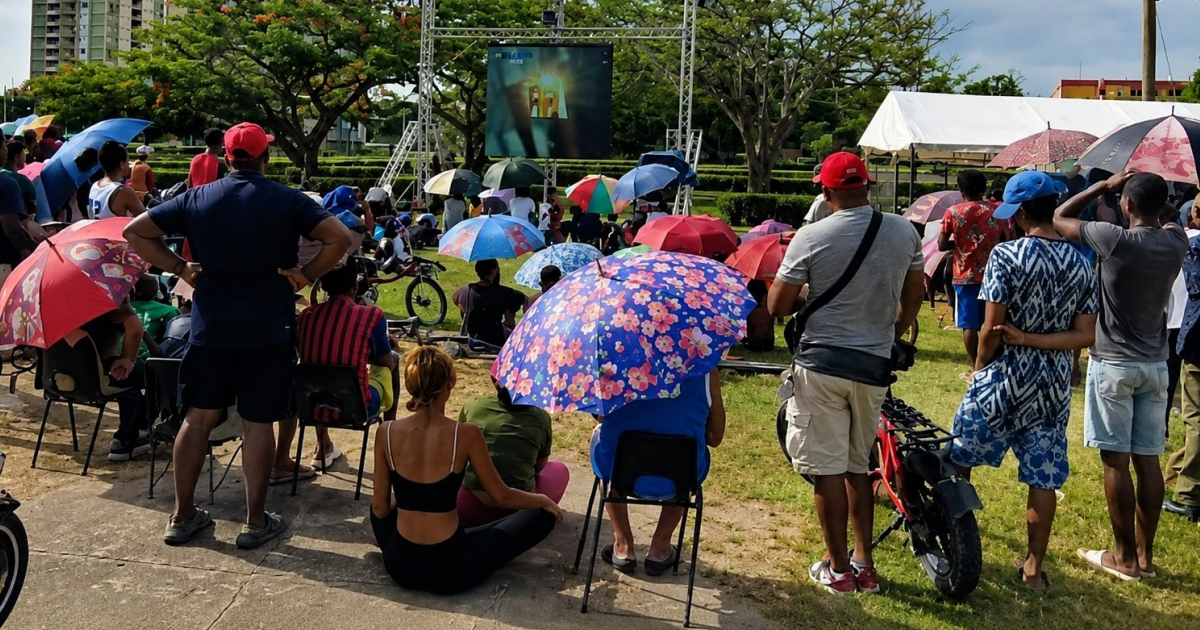
LaSai Dela Vida, a Cuban woman, sparked widespread discussion on Facebook with her post addressing the contradictory reality in Cuba during the Soccer World Cup. As the nation struggles with crippling blackouts and shortages of water, food, and fuel, many Havana men are gathering to cheer for Argentina, celebrating goals while seemingly ignoring the pervasive misery around them.
"For days now, Havana has been echoing with shouts from men who, every other day, see a light bulb in their homes turn on, despite paying for electricity as if it never goes out. These are men who lack water, struggle to find gasoline, food, money, and watch their children sleep on rooftops or doorways. Yet, they don't shout for that—they shout for Argentina, for a goal... and I feel increasingly ashamed," she wrote.
The post, titled "Happy and Prosperous Misery," layers multiple criticisms: it highlights the crisis of basic services, addresses the structural machismo burdening women with domestic responsibilities, and criticizes the political apathy of those who celebrate a goal while ignoring the nation's collapse.
LaSai Dela Vida illustrates how many seek places with electricity to watch matches with beer, while women stay awake all night warding off mosquitos and monitoring the water supply to cook the next day.
She also critiques what she calls the "new man"—an ironic reference to Che Guevara's revolutionary ideal—and questions those whose priority is "gathering daily, at a time, in a place with electricity to drink beer and cheer for soccer."
The most political aspect of her text points directly at the collective inaction against the dictatorship: "Wars have always been led by men, but in this country, the men who have tried to lead have been imprisoned because other men, mostly, have left them alone. These new men have prioritized other things, like cheering for soccer..."
The background of this criticism is Cuba's worst power crisis in recent history: the National Electric System (SEN) has collapsed at least five times this year, marking the tenth collapse in 24 months.
As of July 13, 106 distributed generation plants were shut down due to lack of fuel, and 11 of the country's 16 thermal power plants were out of service.
The regime has blamed the crisis on the oil blockade and the U.S. embargo, without announcing effective structural measures.
Meanwhile, the state channel Tele Rebelde announced the World Cup semifinals as usual, provoking ironic remarks: "The blackout is the champion," "My favorites are Apagonia and no Signalonia," and "Hopefully the SEN will agree with FIFA."
LaSai Dela Vida is not new to this debate: in June, after 20 hours without electricity, she publicly questioned whether it's normal "to live swatting flies, going to bed sweating without water, or yelling at a child asking for food."
The 2026 World Cup final, where Argentina will face Spain on July 19 at the MetLife Stadium in New Jersey, promises to repeat the same paradox for millions of Cubans who will try to follow the match amidst blackouts that the regime has neither been able—nor seems willing—to resolve.
Cuba's Blackout Crisis and Public Reactions
What are the main criticisms expressed by LaSai Dela Vida?
LaSai Dela Vida criticizes the lack of action against the country's hardships, the celebration of soccer over addressing severe shortages, and the societal roles that place the burden of domestic responsibilities on women.
How has the Cuban regime responded to the power crisis?
The Cuban regime has attributed the power crisis to the oil blockade and the U.S. embargo, yet they have not implemented effective structural solutions to address the issue.
How does LaSai Dela Vida's post reflect on the political situation in Cuba?
Her post highlights the political apathy and lack of collective action against the dictatorship, emphasizing how societal priorities have shifted towards trivial celebrations over addressing significant national issues.