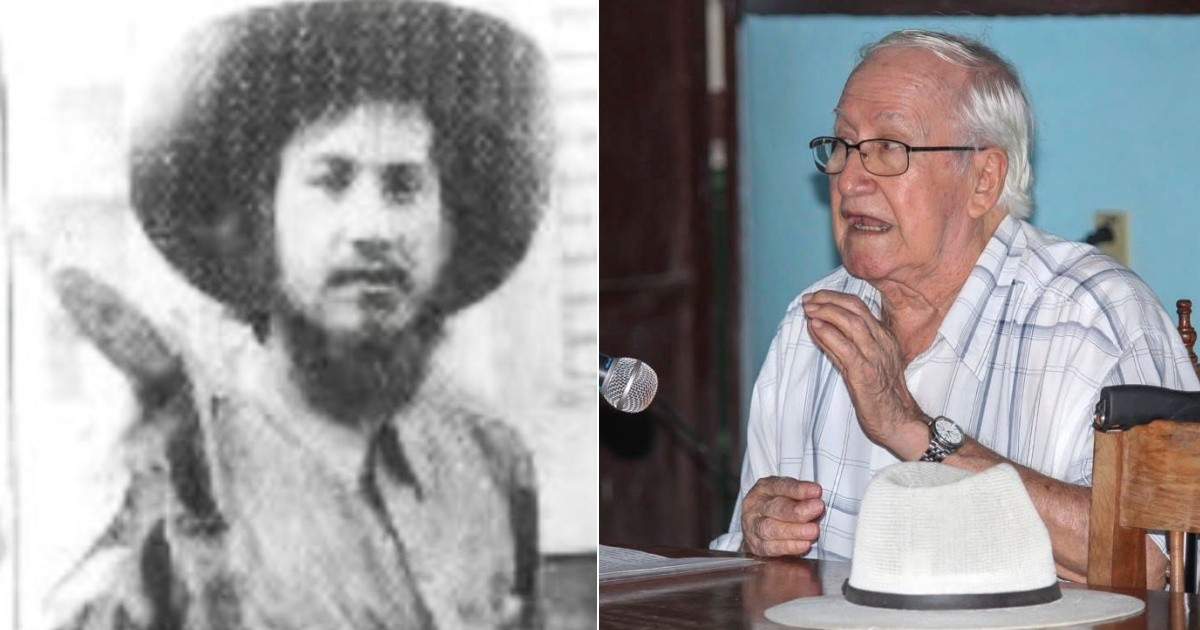
The Ministry of Revolutionary Armed Forces (MINFAR) has announced the passing of reserve Brigadier General William Gálvez Rodríguez. The news was broadcasted through a statement on the National Television Newscast via Canal Caribe.
The official report did not disclose the age or cause of death of Gálvez Rodríguez, following the Cuban regime's consistent practice of withholding such details for high-ranking military figures.
According to EcuRed, Gálvez Rodríguez was born on October 21, 1933, in Holguín, indicating he was 92 at the time of his death.
A Life of Revolutionary Commitment
The MINFAR statement, aired on national TV, focused on outlining the revolutionary career of the deceased, omitting any further information about his passing.
The announcement specified that his body was cremated and the ashes will be placed in the Revolutionary Armed Forces Pantheon on Wednesday, July 22, at 9 a.m., where military honors will be accorded during his funeral.
A Unique Figure: Soldier, Author, and Journalist
Unlike many of his contemporaries, Gálvez Rodríguez stood out in Cuba's military elite. Beyond his military service, he was an accomplished intellectual, engaging as a writer, journalist, and historian.
He graduated in Social Sciences from the Ñico López Superior School of the Communist Party, where he studied between 1974 and 1979. He contributed to publications like Granma, Juventud Rebelde, and the Verde Olivo magazine.
His book "Camilo, Lord of the Vanguard" (1979, 574 pages) is regarded as the definitive biography of Camilo Cienfuegos, with whom he shared a personal friendship since their guerrilla days. In 1995, he won the Casa de las Américas Prize for "Che's African Dream: What Happened in the Congolese Guerrilla?", translated into French and English.
Notably, the few photos of him circulating online show him in civilian attire, a stark contrast to other generals of his era, who were often seen in uniform.
From Anti-Batista Activist to Revolutionary Leader
Gálvez Rodríguez's revolutionary path began when he was expelled from the Holguín Technological Institute for opposing Fulgencio Batista's coup.
He then joined the 26th of July Movement, led the Action and Sabotage Group in Holguín, and participated in the November 30 uprising in Santiago de Cuba.
On January 1, 1958, he reached the Sierra Maestra and reported to Che Guevara, who directed him to Fidel Castro. He became part of Column Number 1 and fought in battles such as Pino del Agua II, Santo Domingo, and Providencia.
Later, he requested to join Camilo Cienfuegos's troops and was appointed head of the second platoon of Column Number 2 "Antonio Maceo," participating in the western invasion as a captain.
After the Revolution's success, he rose to commander, took part in the "Escambray Clean-Up," and fought in the Playa Girón battles.
He served an international mission in Angola from 1982 to 1983 and was a deputy in the National Assembly of People's Power.
The Waning of a Historical Generation
The death of Gálvez Rodríguez is part of a series of losses in 2026 that has significantly reduced the so-called historical generation of the Cuban regime.
In January, Brigadier General José Luis Mesa Delgado and Major General Claro Orlando Almaguel Vidal passed away. Rear Admiral Roberto Eduardo González Luaces died in May.
On June 21, Ramiro Valdés Menéndez, founder of the Ministry of the Interior and architect of the regime's repressive apparatus, died at 94. Brigadier General Alcibíades Wilmer Pérez Rivero, former head of the FAR's Military Intelligence Directorate, passed away on July 4.
With each passing, the foundational core of Cuba's political system shrinks further, leaving Raúl Castro, Guillermo García Frías, and José Ramón Machado Ventura as the remaining visible figures.
Key Questions About William Gálvez Rodríguez's Legacy
What contributions did William Gálvez Rodríguez make to Cuban literature?
Gálvez Rodríguez was a prolific writer, authoring significant works like "Camilo, Lord of the Vanguard" and winning the Casa de las Américas Prize for "Che's African Dream: What Happened in the Congolese Guerrilla?".
How did William Gálvez Rodríguez's military career begin?
His military career started when he joined the 26th of July Movement after being expelled from school for opposing Batista's coup. He later joined the revolutionary forces in the Sierra Maestra.
What role did William Gálvez Rodríguez play in Cuba's international missions?
He participated in an international mission in Angola from 1982 to 1983, showcasing Cuba's military involvement abroad.