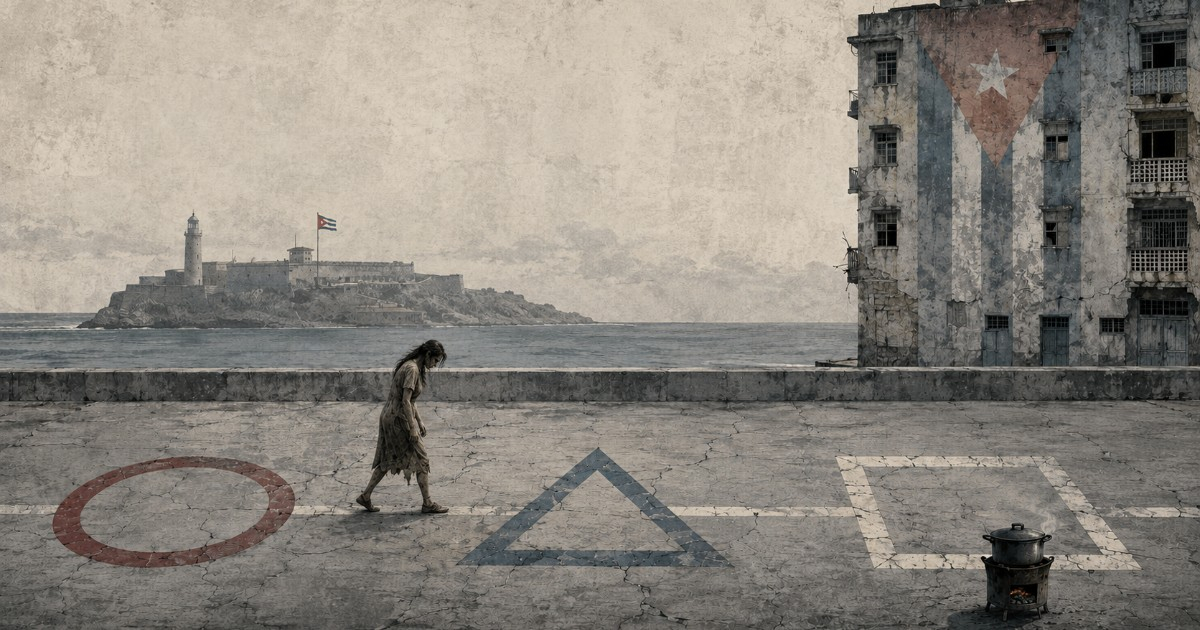
A Cuban woman named Vivian Mendo shared a heart-wrenching account on Facebook, drawing parallels between the harsh realities of life in Cuba and the South Korean series Squid Game, while simultaneously issuing a desperate cry for help.
"I have very little hope...and I say this SINCERELY...the daily grind in this 'SQUID GAME' chips away at the little will we have left...those who believe in God find solace in His word and prayer...but the valley is dark and the temptation to give up is almost unavoidable," Mendo expressed.
Accompanying her words was a photo that encapsulates the island’s turmoil: a makeshift stove crafted from a recycled table fan casing, two pot lids, and a striking addition—an Anxiety character doll from the film Inside Out, symbolizing the emotional exhaustion, constant distress, and uncertainty that many Cubans endure each day.
Daily Struggles Amplify Anxiety
"Who said the zombie apocalypse is in the future? Just step outside and see the blank stares everywhere, only focused on food...it's an epidemic consuming us one by one...thinking anyone remains unaffected is laughable...anxiety is the first symptom: and we ALL have it," she warns in her post.
Mendo vividly describes the stark reality of nights without electricity, exposing what millions of Cubans experience regularly: "Sometimes, in the middle of nights when we sweat through the sheets or when my eyes water lighting my makeshift charcoal stove, I indulge in dreams of a different reality."
Hope for Future Generations
Closing her post, Mendo refrains from seeking solutions for herself: "I no longer think about a cure...it might be too late for many of us...but achieving the great feat of saving those who remain, who still have time, who can later share the tale of THE GREAT PLAGUE, so it doesn't happen again, would be monumental."
Social Media as a Mirror of Distress
In recent years, social media has become a reflection of the anxiety that Cubans endure. Just recently, a mother in Central Havana took to the streets to protest in front of the CTC headquarters over the relentless power outages. Another Cuban woman announced on July 5th that she is selling her house, no longer able to call it a home, cooking with charcoal and without water.
Throughout the island, the creation of handmade stoves from fans, cans, and recycled pots has surged due to the complete disappearance of liquefied gas in many areas, a daily ordeal that numerous Cubans document online.
Alarming Mental Health Statistics
The mental health impact has been scientifically documented. A study published in May 2026 in the journal Social Science & Medicine, based on a survey of 415 Cuban adults, found that 55.4% suffer from extremely severe depression, 66% experience severe anxiety, and 65.8% endure extreme stress.
Researcher Rolando Cartaya described these figures as "unimaginable in any population," comparable only to "war-torn populations."
The United Nations has warned that 4.7 million Cubans are facing severe food insecurity and has requested $94 million in humanitarian aid, while 20,000 tons of food remain stalled, undelivered due to a lack of fuel for transportation.
Understanding Cuba's Daily Challenges
What are some common survival tactics used by Cubans due to the crisis?
Cubans have resorted to creating handmade stoves using recycled materials like fan casings and pot lids due to the scarcity of liquefied gas. Many document these adaptations on social media.
How has the mental health of Cubans been affected by the ongoing crisis?
A study found that over half of Cubans surveyed suffer from extremely severe depression, severe anxiety, and extreme stress, indicating a significant mental health crisis exacerbated by the country's dire conditions.
What actions has the international community taken in response to Cuba's crisis?
The United Nations has highlighted the severe food insecurity affecting millions of Cubans and has requested $94 million in humanitarian aid, though logistical challenges like fuel shortages hinder distribution efforts.