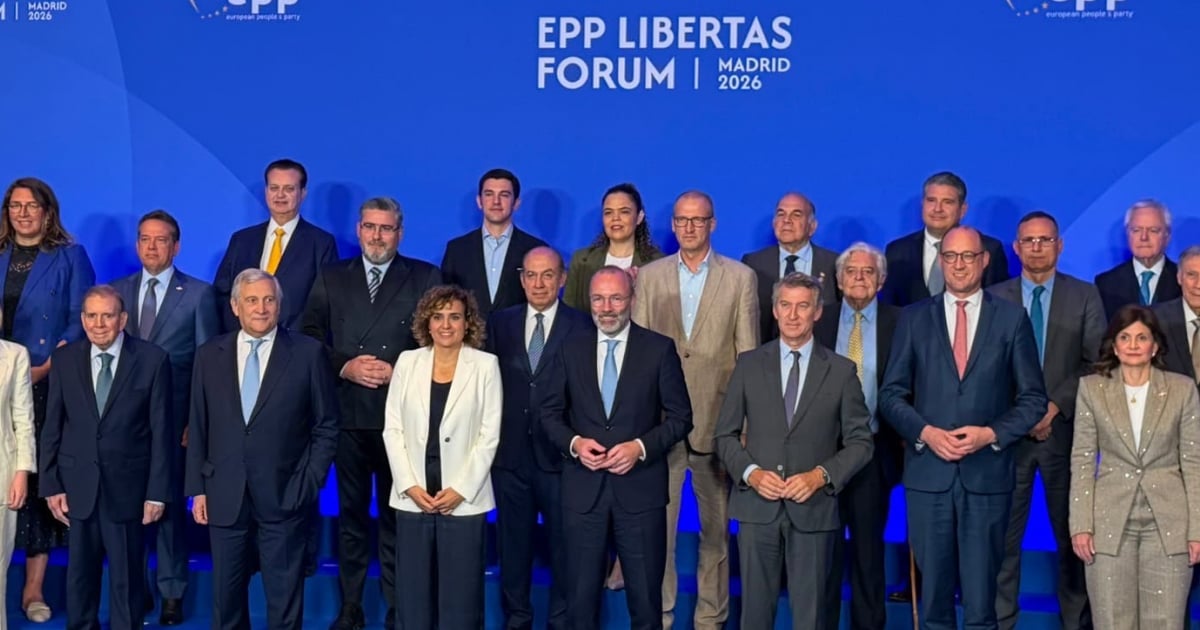
In an era defined by conflicts, geopolitical uncertainty, and a troubling erosion of fundamental freedoms across numerous parts of the globe, the European People's Party (EPP) Forum in Madrid emerged as more than just a gathering of political leaders. It was a profound reaffirmation of the moral and political principles that paved the way for a democratic Europe after the tragedies of the 20th century, and a reminder that freedom should never be taken for granted.
Over two days of intense discussions, European leaders, heads of government, Members of the European Parliament, academics, human rights advocates, and representatives opposing various authoritarian regimes converged on a critical message: liberal democracy remains the system that best safeguards human dignity, and its defense requires determination, coherence, and international solidarity. This encapsulated the essence of Libertas.
The forum underscored that threats to open societies no longer stem solely from terrorism or economic crises. Today, democracy faces a broader challenge: the rise of an authoritarian axis comprised of states that concentrate power, restrict individual freedoms, subordinate justice to political agendas, persecute opposition figures, and wield propaganda and disinformation as tools of control.
Within this context, references to Russia's aggression against Ukraine, the strategic influence of Communist China, and the dictatorships in Cuba, Venezuela, and Nicaragua were not isolated mentions. They were part of a unified reflection on the necessity for democracies to act decisively against those who seek to undermine the international order founded on law, freedom, and the sovereignty of nations.
Speeches from Alberto Núñez Feijóo, Antonio Tajani—Italy's Deputy Prime Minister and Minister of Foreign Affairs—Dolors Montserrat, former President José María Aznar, MEP Antonio López-Istúriz, and various European leaders conveyed a shared conviction: Europe cannot afford indifference towards those imprisoned, persecuted, and exiled for upholding democratic principles.
Distinguishing Democracies from Dictatorships
The forum was not just about condemning dictatorships. It was about asserting what sets democracies apart: the rule of law, separation of powers, free elections, political pluralism, religious freedom, freedom of speech, property rights, private enterprise, and market economies as means to foster prosperity and citizen autonomy against state power.
To those who dismiss these principles as mere theoretical concepts, the Forum reminded a fundamental truth: where judicial independence and economic freedom vanish, political freedoms inevitably follow.
A particularly impactful contribution came from Venezuelan lawyer Tamara Sujú, whose work documenting human rights violations has made her an international authority. Her call to support, highlight, and sponsor political prisoners served as a stark reminder that behind every fabricated legal case by a dictatorship lies a person arbitrarily deprived of freedom, a shattered family, and a society ruled by fear.
Transforming Solidarity into Action
Democracies cannot settle for occasional expressions of solidarity. This solidarity must be transformed into a consistent policy of support, denunciation, and backing for those paying the highest price for defending freedom.
This human dimension took on special significance during the panel "A Shared Horizon for Freedom," where alongside Rosa María Payá, we highlighted the ongoing tragedy in our homeland. We brought to the Forum's heart the everyday struggles of Cubans enduring repression, hunger, power outages, poverty, and the lack of fundamental rights under a political system that prohibits electoral competition, free press, or legal opposition.
The reception we received demonstrated that the cause of Cuban freedom remains a significant concern within Europe's democratic consciousness. It also showed something even more profound: the Cuban struggle is part of a broader fight for the universal defense of human dignity.
The same holds true for the leadership of María Corina Machado and countless Venezuelan democrats battling for democracy's return to their nation; for Juan Sebastián Chamorro and those peacefully resisting the dictatorship of Daniel Ortega and Rosario Murillo in Nicaragua; and for thousands of anonymous citizens worldwide who continue to believe that tyranny is never eternal.
European Obligation to Defend Freedom
The Foro Libertas reiterated that defending freedom is not just an ethical obligation. It is also a strategic necessity for Western democracies. Every dictatorship that consolidates power strengthens international networks of influence, corruption, disinformation, and repressive cooperation, ultimately jeopardizing the security and stability of democratic societies themselves.
Therefore, supporting those who peacefully combat authoritarianism does not mean interfering in other countries' internal affairs. It means upholding the values that underpin international coexistence and protecting an order based on respect for fundamental rights.
Democratic Europe was born from the decision to place individuals at the center of political life. This heritage, deeply influenced by Christian humanism and the liberal democratic tradition, is the best antidote to totalitarian projects that subordinate individuals to the state, a single party, or a leader.
This legacy was fully embodied in Madrid. As the Foro Libertas concluded, those of us from Cuba, Venezuela, and Nicaragua renewed our hopes, assured that our struggle is gaining ever-greater solidarity.
It is a fact that dictatorships thrive when the free world remains silent, but they retreat when democracies speak with one voice, support victims, and translate solidarity into political action.
To EPP President Manfred Weber, Alberto Núñez Feijóo, Antonio Tajani, Dolors Montserrat, and all the leaders, parliamentarians, experts, and participants who made this event possible, we owe heartfelt gratitude. Also, to those who reaffirmed, in various capacities, that defending freedom is a shared responsibility of all democracies.
In Madrid, the Foro Libertas showed that Europe is still willing to act. For millions who remain deprived of freedom, this message represents hope that the democratic world has not abandoned its duty to defend freedom where it is most needed.
Understanding the EPP's Commitment to Freedom
What was the primary focus of the EPP Forum in Madrid?
The EPP Forum in Madrid focused on reaffirming the principles of liberal democracy as a safeguard for human dignity and emphasizing the need for international solidarity in defending these values against authoritarian regimes.
Why is defending freedom strategically important for Western democracies?
Defending freedom is crucial for Western democracies because every authoritarian regime that consolidates power poses a threat to international security through networks of influence, corruption, and repressive cooperation.
How did the forum address the situation in countries like Cuba and Venezuela?
The forum addressed the situations in Cuba, Venezuela, and other authoritarian states by highlighting the ongoing struggles for freedom and emphasizing the importance of international support and solidarity in these battles.