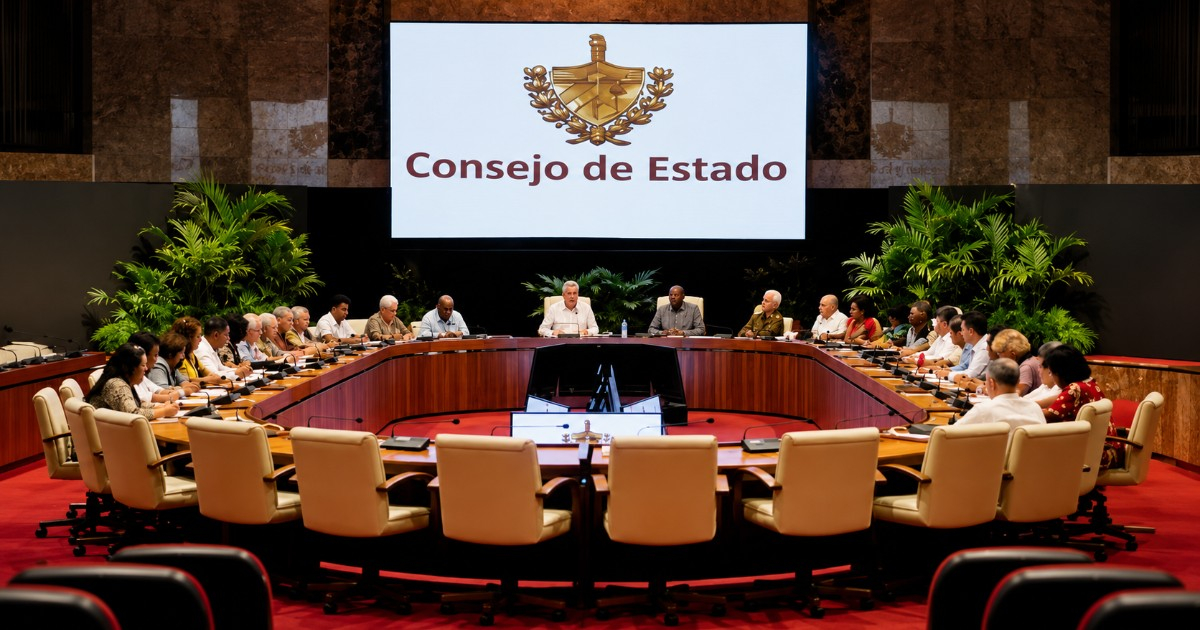
This Thursday, the Cuban State Council, led by Esteban Lazo Hernández, sanctioned two new decrees during an extraordinary meeting. This move is part of the most significant economic reform package seen on the island in decades, as reported by the state-controlled media, Granma.
The approved decrees, titled "On the Cuban State Business System" and "Amendment to Decree Law No. 76 on Agricultural Cooperatives," aim to modernize the regulatory framework governing the state economy. These changes align with the 176 economic and social transformation measures ratified by the National Assembly of People's Power in mid-June.
The initial decree law outlines the overarching principles for organizing and operating the state business system, under the guidance of the National Institute of State-Owned Enterprise Assets (INAEES). This entity was established in June 2026 to centralize control over more than 2,000 state-run enterprises.
Roberto Ricardo Marrero, head of INAEES, noted that the law addresses 16 out of 17 transformations related to the first thematic axis: Management Model Transformations for Economic Actors, specifically concerning the Socialist State Enterprise. It also supports the implementation of 12 transformations across other thematic axes.
Yovana Vega Mato from the Ministry of Economy and Planning described the law as a "platform that empowers the state business system, under INAEES's leadership, to exercise all its powers and pursue all mandated transformations. These efforts are coordinated with a series of legal norms currently under development."
Meanwhile, Esteban Lazo emphasized that the decree reaffirms the socialist state enterprise as the primary economic entity in the nation, enhancing state enterprises' autonomy and outlining their corporate social responsibility.
The second decree revises Decree Law 76 regarding Agricultural Cooperatives, effective since January 2024, updating the rules on the formation, organization, integration, and operation of these entities in line with ongoing reforms.
Both decrees will be published in the Official Gazette for public awareness.
The reforms endorsed in June by the PCC Central Committee's Extraordinary Plenum introduce unprecedented structural changes since 1959. These include the authorization of private banking, the establishment of a digital currency market, lifting the 100-worker limit for micro, small, and medium-sized enterprises, and allowing state enterprises to declare bankruptcy and undergo liquidation if persistently unprofitable.
This process has not been without controversy. Economist Pedro Monreal has voiced concerns that the creation of INAEES might signal a recentralization of economic power, contrary to the official rhetoric promoting enterprise autonomy. Moreover, some citizens worry that the removal of subsidies and the bankruptcy procedures could lead to widespread unemployment and loss of access to essential services.
The 176 approved measures are organized into 23 thematic axes, which also include granting private entities and cooperatives direct access to import and export activities, as well as reducing the number of ministries from 27 to 21.
Key Questions About Cuba's Economic Reforms
What are the main objectives of the new decrees approved by the Cuban State Council?
The decrees aim to modernize the framework governing the state economy by setting principles for state business operations and updating rules for agricultural cooperatives, aligning with the broader set of 176 economic and social transformation measures.
How might the creation of INAEES impact the Cuban economy?
While intended to centralize control over state enterprises, some economists fear INAEES could lead to recentralization of power, contradicting efforts to promote autonomy within state-run businesses.
What structural changes are included in the broader economic reforms?
The reforms introduce private banking, a digital currency market, and allow state enterprises to declare bankruptcy, among other changes, aiming to increase efficiency and modernize the economy.