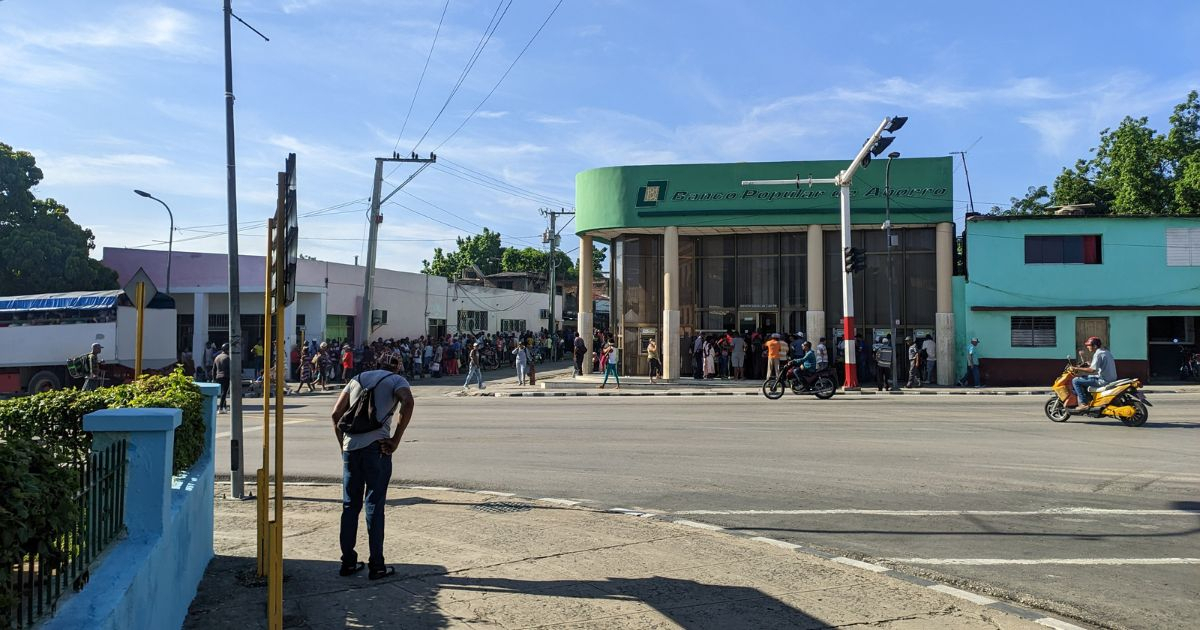
A prominent cultural figure from Santiago de Cuba has taken to Facebook to reveal a shady business operating brazenly near ATMs in the area known as "18 plantas." The scheme involves transferring 1,000 Cuban pesos and receiving only 600 pesos in cash, a staggering 40% commission that occurs daily with seemingly no intervention from authorities.
The exposé was penned by Ericka Castellanos Abad, a poet and physician, in a post titled "Biodescodificación / ¿Quién permite?" She recounts witnessing the transaction firsthand: "I accompanied someone today as a near-guarantor for this daily exploitation occurring next to the outdated bank at 18 plantas in Sande Cuba."
Castellanos doesn't just describe the situation; she uses it as political evidence: "To transfer 1,000 pesos and receive merely 600 in cash is egregious, especially when this happens just blocks from the Provincial Party headquarters. It showcases both shamelessness and the utter disregard for the populace by the national power elite."
Her analysis goes further, pointing fingers at the Communist Party as the main culprit behind the island's chaos, while also acknowledging the role of the U.S. embargo and what she terms a "mismanaged civil society."
She portrays a "silent strike" and a shadow economy that defies state control: "We're living under the law of the jungle, where only fronts for the mafia profit thanks to the pseudo-leadership provided by the country's current administration."
Castellanos also highlights systemic corruption: "Many officials prioritize personal gain over the people's welfare."
She ends with a direct call for internal change: "The people must be the ones to transform the government in Cuba, to initiate reform."
Her closing appeal demands straightforward renewal: "Not crabs, vampires, apostates, or turncoats, but individuals capable of enforcing laws and realizing reforms and transformations."
The exposed operation is located near a BANDEC (Cuban Credit and Commerce Bank) branch on Victoriano Garzón Avenue, just a stone's throw from the Provincial Communist Party Committee headquarters.
This ATM location has been the scene of similar arrests before. In September 2025, the Revolutionary National Police apprehended two men, Leodan and Yunior, who were charging a 15% fee for cashing transfers and confiscated over 250,000 pesos and several magnetic cards from them.
In May of this year, additional arrests in Santiago de Cuba revealed commission rates ranging from 35% to 50%. The 40% rate reported by Castellanos Abad fits squarely within this range.
This phenomenon is a direct result of forced banking policies implemented by the regime in August 2023, which mandated digital payments without ensuring liquidity in the banking system.
The outcome has been a blatant black market for converting digital transfers into physical cash.
The Cuban state media acknowledged this month the failure of the transfer payment system, with 2026 data showing that only 3.77% of transactions in Cuba are digital.
Understanding the Impact of Forced Banking Policies in Cuba
What is the main issue with the money exchange scheme in Santiago de Cuba?
The scheme involves charging a 40% commission on cashing digital transfers, which is considered abusive and occurs near the Communist Party headquarters without apparent intervention from authorities.
Why have these unofficial exchanges become prevalent?
These exchanges have thrived due to the Cuban regime's forced banking measures since August 2023, which mandated digital payments but did not ensure sufficient liquidity in the banking system, leading to a black market for cash conversions.
What has been the government's response to these issues?
The Cuban government has been largely passive, with only sporadic arrests. The state media has recently admitted the failure of the digital payment system, with very low adoption rates across the country.