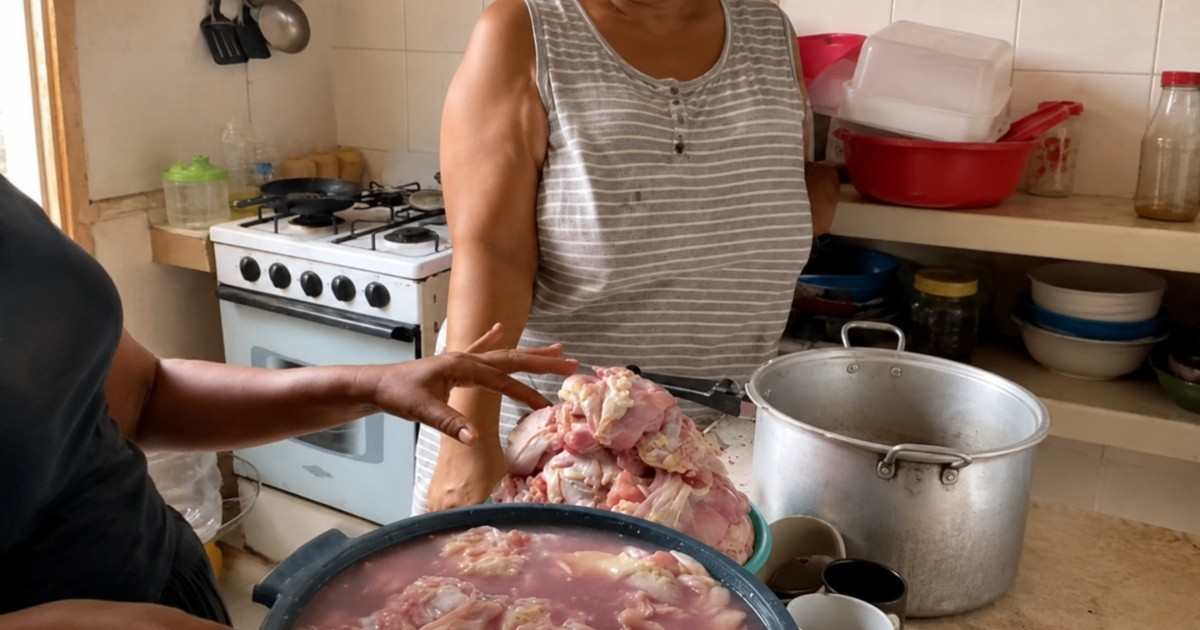
A resident of East Havana, identified as Karla Arelis, shared a video on Facebook this Wednesday, illustrating the lengths her community went to in order to salvage a box of chicken that spoiled due to Cuba's relentless power outages. The video captures their efforts to salvage the meat by deboning and grilling it over charcoal to prevent waste.
The endeavor began at five in the morning, according to the woman, who woke up hoping for electricity to return. "At 5 a.m. I got up to charge the EcoFlow, the refrigerators, and do all the things every woman does when the power is back. But it never came. The whole community was awake at that hour because people can't take it anymore," she expressed in the video, which has garnered over 34,000 views.
Turning Spoiled Goods into a Community Meal
When it became clear the entire box of chicken had gone bad, she decided to debone it, clean it with salt, and cook it over charcoal to share with her neighbors. "I'm deboning a box of chicken that spoiled for my neighbor. I'll debone it, clean it up a bit, and then grill it," she explained while working.
This situation forced her to revisit a task she swore she'd abandon: "I said I'd never touch charcoal again... I loathe it, but if it spoils, we share it among everyone."
Impact on Families and Children
The video also highlights the direct effect on children's nutrition. "All the food went bad. Children are crying out of hunger," she lamented, adding, "If we were wealthy... today we'd eat chicken all day, but who knows what we'll have tomorrow."
Clearly exhausted, she voices a direct complaint: "The one who controls the electricity is ruining all our equipment. If there's no power, don't pretend there is. If you have it, use it properly."
Power Outages Worsen Food Crisis
This testimony follows the fifth total blackout of the year, which occurred on Tuesday, July 14, when the National Electric System completely broke down. In just eight days, there were three national outages: on July 6, 10, and 14. The energy deficit hit a historic high of 2,341 MW on July 8, with only 935 MW available against a demand of 3,100 MW, and 106 distributed generation plants offline.
The spoilage of food due to lack of refrigeration is a documented outcome of this crisis. As of May 2026, 47.59% of Cuban households had lost refrigerated food due to blackouts, with figures surpassing 80% in provinces such as Granma, Matanzas, Pinar del Río, and Sancti Spíritus. Perishable goods become unsafe after just two hours without power, especially in temperatures reaching 38°C.
About 35% of Cuban families resort to charcoal or wood for cooking—the so-called "zero option"—in the absence of liquefied gas. In some areas, gas supplies have been interrupted for three months. The cost of charcoal has soared to 4,000 pesos in Sancti Spíritus, making cooking during blackouts a luxury many cannot afford.
The ongoing food shortage exacerbates the situation. The Minister of Food Industry, Alberto López Díaz, admitted in March 2026 that no chicken had been distributed through the rationed basket all year. A staggering 96.91% of the Cuban population lacks adequate food access, and 33.9% of households reported at least one family member going to bed hungry in the past 30 days.
FAQs on Cuba's Current Food and Energy Crisis
What led to the chicken spoiling in Havana?
The chicken spoiled due to prolonged power outages in Cuba, disrupting refrigeration and leading to food spoilage.
How are Cuban communities coping with food shortages?
Many Cuban families are turning to charcoal or wood for cooking due to the lack of gas and are sharing resources like spoiled chicken to ensure food is not wasted.
How severe is the energy crisis in Cuba?
Cuba has faced multiple national power outages, with energy deficits reaching historic highs, affecting millions and disrupting daily life.