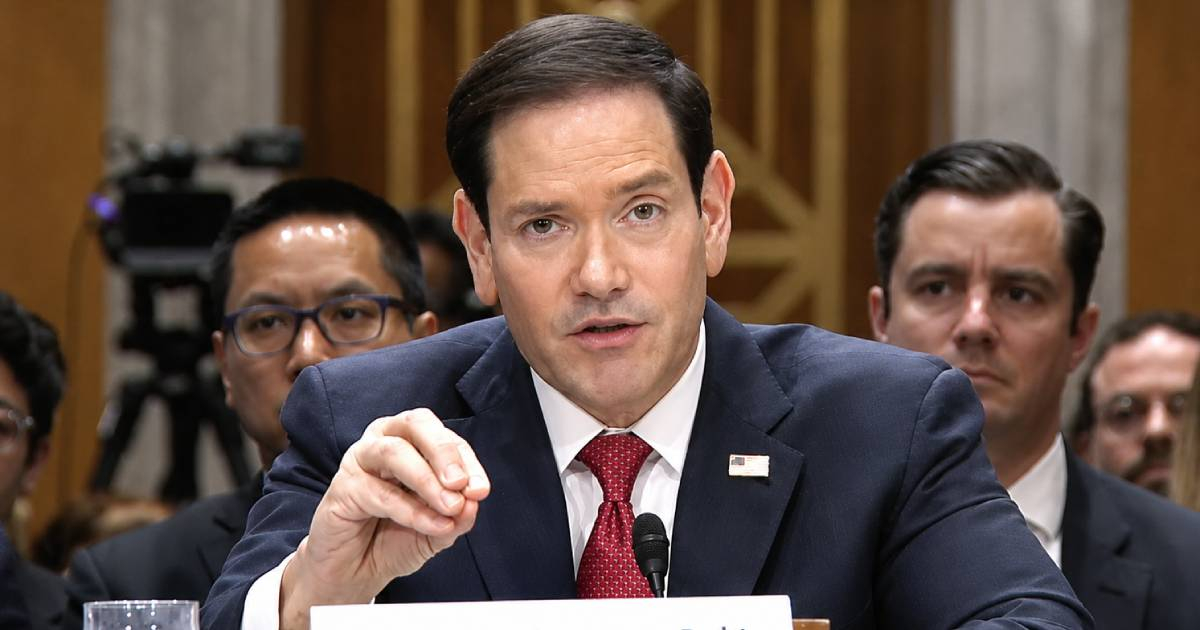
On Thursday, Secretary of State Marco Rubio will spearhead an international ministerial conference organized by the State Department to address what the Trump administration describes as the resurgence of left-wing political terrorism. This announcement was made public on Wednesday.
The event, titled the Ministerial on the Resurgence of Political Terrorism, will bring together delegates from over 70 nations across Europe, Latin America, and Asia. The primary goal is to enhance international coordination, facilitate intelligence sharing, and bolster law enforcement mechanisms to combat this growing threat.
The State Department has emphasized that left-wing terrorism is not a series of isolated incidents but rather a "deliberate, ideologically-driven strategy aimed at destabilizing free societies through violent attacks on our political and economic systems." This includes assaults on civilians, officials, law enforcement, businesses, and critical infrastructure.
Background and Strategy
This conference marks the culmination of an anti-terrorism strategy that the Trump administration began developing in November 2025. At that time, four European groups were designated as Foreign Terrorist Organizations: Antifa Ost (Germany), the Informal Anarchist Federation/International Revolutionary Front (Italy), Armed Proletarian Justice (Greece), and Revolutionary Class Self-Defense (Greece).
Alongside these designations, Washington has offered rewards of up to $10 million for information that could disrupt the financial networks of these groups.
In May 2026, Trump signed a counterterrorism strategy aimed at neutralizing organizations with ideologies deemed "anti-American, radically transgender, or anarchist."
Controversy and Opposition
Cuba plays a significant role in Rubio's discourse on this issue. On June 4, Rubio declared that "Cuba has been the world capital of radical left-wing terrorism for decades" and sanctioned five Cuban entities, including the Ministry of Revolutionary Armed Forces (MINFAR), the Committees for the Defense of the Revolution (CDR), and the Cuban Institute of Friendship with the Peoples (ICAP).
Two days earlier, Rubio testified before the Senate, asserting that Cuba "has sponsored and supported virtually all violent left-wing terrorist groups," explicitly naming the ELN, FARC, and its dissidents.
The Cuban regime condemned the ministerial, labeling it as "McCarthyist" and accusing it of relying on "false arguments to justify actions against progressive forces, leftist organizations, and social movements."
Foreign Minister Bruno Rodríguez responded to Rubio by suggesting he "read history."
The conference also stirred tensions with some European allies. According to the Washington Post, several expressed dissatisfaction because the invitation was extended just a week before the event, with a response deadline of the previous Friday, making attendance unlikely for some ministers.
Within the U.S. government, officials from the Department of Justice and the White House Counsel's Office have voiced concerns about the potential misuse of counterterrorism tools against leftist activists within the country, according to the same report.
Since January 2026, the Trump administration has imposed over 240 sanctions on the Cuban regime, targeting individuals such as Miguel Díaz-Canel, Alejandro Castro Espín, and entities like the business conglomerate GAESA.
Key Questions on U.S. Strategy Against Left-Wing Extremism
What is the primary goal of the Ministerial on the Resurgence of Political Terrorism?
The main objective is to strengthen international collaboration, facilitate intelligence exchange, and enhance law enforcement mechanisms to address the threat of left-wing political terrorism.
Which countries are primarily involved in the conference?
Delegates from over 70 countries across Europe, Latin America, and Asia are expected to participate in the conference.
How has the Cuban government responded to the conference?
The Cuban regime has criticized the conference, describing it as "McCarthyist" and based on "false arguments" to justify actions against progressive and leftist groups.