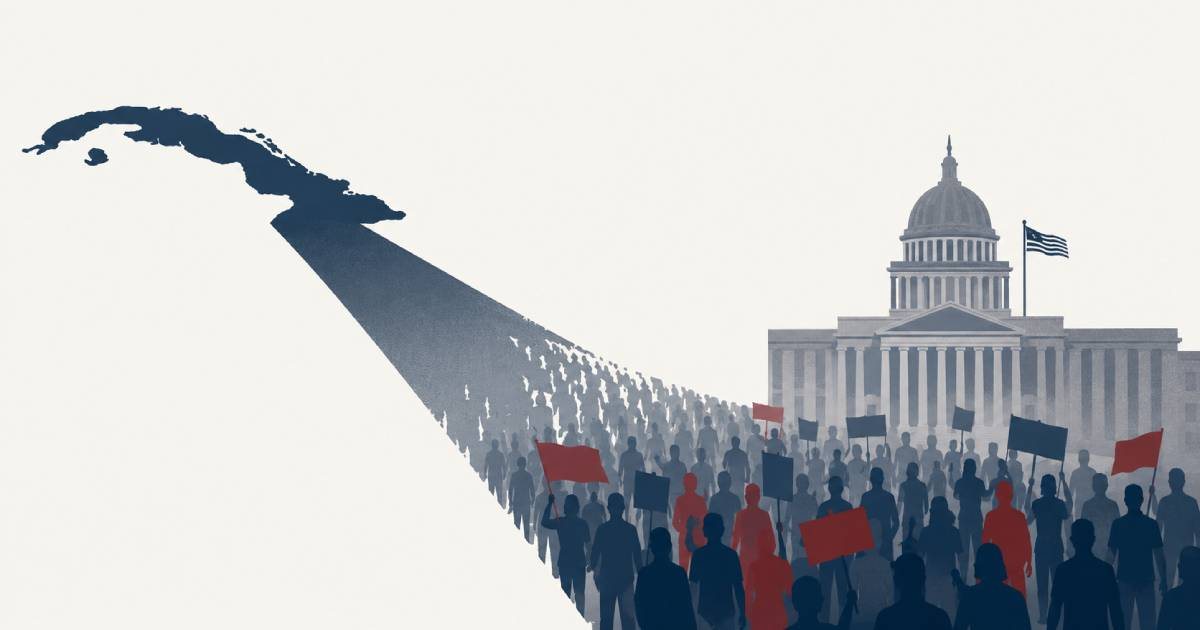
A confidential document acquired by The Washington Examiner discloses that the National Network on Cuba (NNOC) has crafted a "National Rapid Response Plan" to swiftly organize protests across the United States within 24 hours should the U.S. military initiate an operation against Cuba.
Disseminated among supporters of the Washington-based group, the plan aims to impose significant political consequences on the White House in the event of military intervention.
"The goal is to make it politically and materially costly for the U.S. government to declare war on Cuba," the document states.
Mobilizing Major Urban Centers
Activists in key metropolitan areas are instructed to form "broad and extensive coalitions" to stage demonstrations in front of federal buildings and other highly visible public venues, including sports stadiums hosting large events.
Strategic Efforts in Smaller Cities
In smaller municipalities, the strategy involves conducting a "strategic mapping" to pinpoint local targets, distributing banners and pamphlets, and coordinating social media campaigns with shared graphic materials.
Identified protest sites include federal courthouses, military bases, recruitment offices, government agencies, and Immigration and Customs Enforcement (ICE) facilities.
The document argues that protests outside ICE offices could "link solidarity with Cuba to immigrant advocacy and opposition to ICE."
Additionally, organizers are referred to a national map of military installations created by the Black Alliance for Peace to assist with protest planning.
Preemptive Measures and International Connections
The NNOC urges its supporters to establish rapid response teams now, rather than waiting for any military action to occur.
"This is an action that pressures the ruling class. Make it public! Announce it!" the document declares.
According to The Washington Examiner, the NNOC maintains ties with the Cuban Institute of Friendship with the Peoples (ICAP), a Cuban official entity sanctioned in June by the State Department under Executive Order 14404.
Secretary of State Marco Rubio has characterized ICAP as a propaganda tool for the Cuban regime. ICAP's president, Fernando González Llort, served 15 years in a U.S. prison after being convicted of espionage.
As part of this policy, Carlos Antonio Lloga Domínguez, a former ICAP official, was detained for deportation on July 1, along with several family members. Rubio warned that anyone conducting transactions with the organization would face sanctions, prosecution, or deportation.
The report also notes that the NNOC and the Venceremos Brigade are organizing a trip of approximately 150 American citizens to participate in activities in Cuba celebrating the centennial of Fidel Castro's birth.
Heightened Tensions Between Washington and Havana
The document's revelation comes at a time of heightened tension between the United States and the Cuban regime.
On the same Wednesday, CBS News reported that Pentagon military planners have explored various scenarios for a potential operation against Cuba, including an airborne assault led by the 101st Airborne Division. U.S. officials consulted by the network clarified that these exercises are part of routine military planning and do not indicate a decision to intervene militarily.
When asked about the report, acting Pentagon spokesperson Joel Valdez stated, "We do not comment on hypothetical military operations."
Since January 2026, President Donald Trump's administration has significantly hardened its policy toward Havana. Washington has imposed over 240 sanctions against officials, companies, and entities linked to the Cuban regime, filed criminal charges against Raúl Castro for the 1996 shootdown of Brothers to the Rescue planes, and announced a $100 million aid program conditioned on political reforms.
Despite this context, the NNOC document emphasizes that mobilization efforts must continue regardless of whether a military action is imminent.
"Cuba is already under attack. The blockade is an act of war. Even if there are no ground troops tomorrow, we must be proactive," the plan concludes.
Understanding the U.S.-Cuba Tensions
What is the National Rapid Response Plan?
The National Rapid Response Plan is a strategy developed by the National Network on Cuba to swiftly organize protests across the U.S. within 24 hours in response to a potential U.S. military operation against Cuba.
Why is the NNOC connected to ICAP significant?
The NNOC's connection to ICAP, a Cuban entity sanctioned by the U.S. for its role as a propaganda tool, is significant as it highlights the organization's ties to the Cuban regime, potentially influencing its actions and goals.
What recent actions has the U.S. taken against Cuba?
Under President Donald Trump's administration, the U.S. has intensified its policy against Cuba, imposing over 240 sanctions, filing charges against Raúl Castro, and conditioning aid on political reforms.