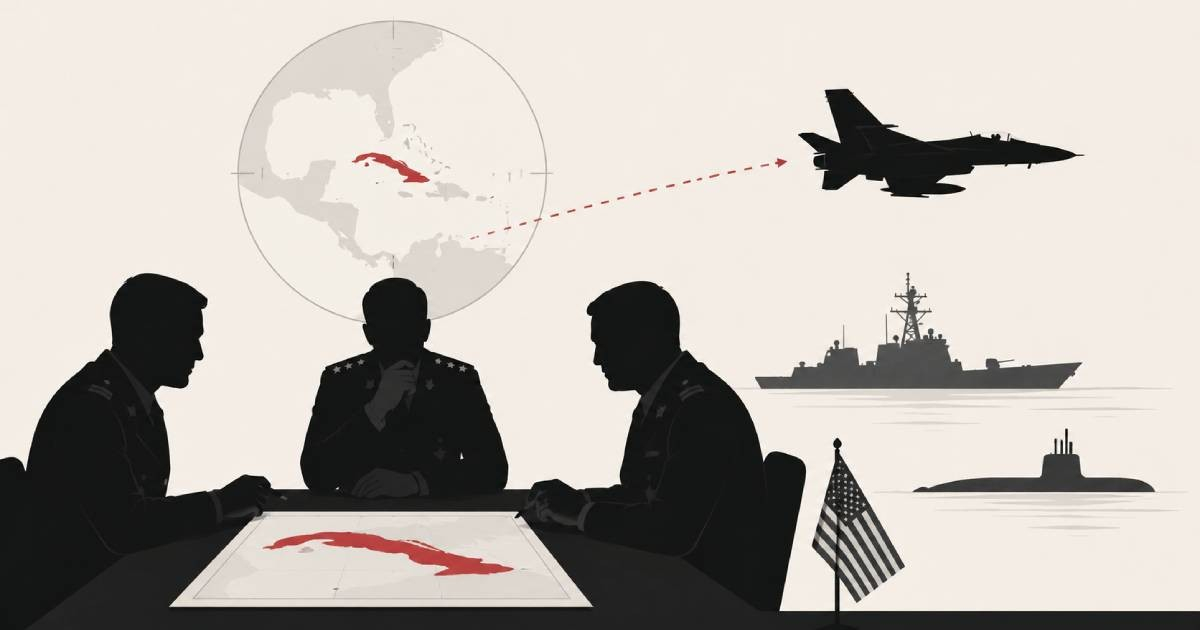
In recent weeks, military planners at the Pentagon have been weighing various scenarios for a potential operation against Cuba. Among these is the possibility of an air assault led by the 101st Airborne Division, the only unit within the U.S. Army specifically designed for such missions, as disclosed by CBS News on Wednesday, citing several anonymous U.S. officials.
Exploring Operational Concepts
According to the report, the Army conducted a planning session in late June to examine operational concepts and possible courses of action that might be implemented on the island. However, the sources emphasized that these exercises are part of routine military planning and do not indicate that President Donald Trump or the Department of Defense has made a decision to initiate an operation.
When asked by the network, the acting Pentagon spokesperson, Joel Valdez, refrained from commenting on the content of these discussions. "We do not comment on hypothetical military operations," he stated.
Political and Economic Pressure Intensifies
While military plans remain in the realm of planning, the Trump administration continues to increase political, economic, and diplomatic pressure on the Cuban regime. Secretary of State Marco Rubio has reiterated that Washington's priority is a peaceful transition to a government led by technocrats willing to implement economic and political reforms.
In a statement on July 11, marking the fifth anniversary of the July 11 protests, Rubio stated that the Cuban leadership and its "corrupt elites" continue to reject any change, maintaining a system based on a "morally corrupt Marxist ideology." The chief U.S. diplomat warned that the island's rulers still have time to choose "real reforms, peace, and prosperity before it's too late."
Escalating Sanctions and Strategic Warnings
Simultaneously, Washington has tightened sanctions against state and military entities that, according to the U.S. government, finance internal repression and economically sustain the regime. The main target is the military conglomerate GAESA, which the U.S. attributes with controlling much of Cuba's economy. The Trump administration asserts that the strengthening of sanctions has limited the regime's financial capacity and significantly reduced its fuel imports, exacerbating the island's energy crisis.
During a visit to the Guantanamo Naval Base on June 10, Secretary of Defense Pete Hegseth issued a public warning. "It would be unwise for the Cuban government to attempt to acquire or access weapons that could reach this base or U.S. territory. They would be provoking a confrontation they neither desire nor could withstand," he stated.
Covert Contacts and Judicial Pressure
In May, CIA Director John Ratcliffe made an unusual trip to Havana to meet with Cuban officials. According to the report, he conveyed that the U.S. would be willing to expand bilateral cooperation if the regime undertook "fundamental changes."
The visit included a gesture interpreted by many as a warning: Ratcliffe was accompanied by one of the agents involved in the capture of Nicolás Maduro in January, whom he introduced to the Cuban authorities. A few days later, the Department of Justice filed criminal charges against Raúl Castro and five others for the 1996 shootdown of the Brothers to the Rescue planes. The decision fueled speculation about a potential operation similar to the one against Maduro, although sources consulted by CBS News indicated that Washington's preferred option remains a negotiated exit leading to the voluntary departure of the Castro family from power.
Cuba's Strategic Position Amid Geopolitical Tensions
Despite the hardening stance towards Havana, the U.S. intelligence community's Annual Threat Assessment for 2026 does not identify Cuba as a direct military threat to the United States. However, the report considers the island a platform of growing strategic interest for Washington's adversaries like China, Russia, and Iran, due to its political, economic, and intelligence cooperation with these governments.
In this context, Hegseth suggested the possibility of a shift in the scenario if a political transformation occurs on the island. "We hope to soon be friends with the leadership of the Cuban government," he affirmed.
U.S.-Cuba Relations: Key Questions and Answers
What scenarios has the Pentagon considered for potential military action against Cuba?
The Pentagon has considered various scenarios, including an air assault led by the 101st Airborne Division, as part of their routine military planning exercises.
Why is military action against Cuba considered unlikely in the short term?
Military action is considered unlikely due to the concentration of U.S. offensive capabilities in the Middle East, where operations against Iran have resumed.
How has the Trump administration increased pressure on the Cuban regime?
The administration has intensified political, economic, and diplomatic pressure, particularly by tightening sanctions on entities believed to support the regime's internal repression.