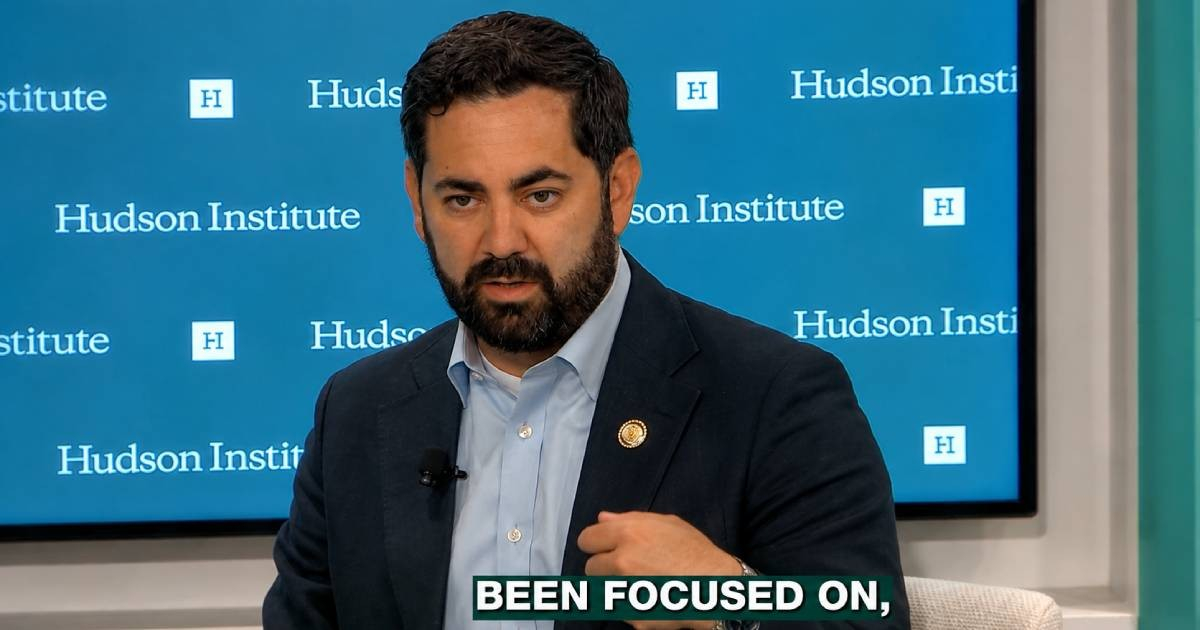
On Wednesday, Republican Congressman Mike Lawler identified Cuba as a member of an "unholy alliance" which also includes Iran, China, Russia, Venezuela, and North Korea. He advocated for increased economic pressure against this bloc during a foreign policy forum hosted by the Hudson Institute.
Lawler, who chairs the House Foreign Affairs Subcommittee on the Middle East and North Africa, argued that the primary challenges facing the United States are deeply interconnected and cannot be tackled in isolation.
"Foreign policy doesn't occur in a vacuum or in silos. Almost everything is linked. So when you look at Iran and the unholy alliance they have with China, with Russia, with Venezuela, with Cuba, with North Korea," the congressman stated.
During his speech, the Republican endorsed the maximum pressure strategy employed by the Trump administration, asserting that economic sanctions are a critical tool to weaken these governments and limit their operational capabilities.
Lawler emphasized that reducing Iran's revenues equates to less funding for allied armed groups, ballistic missile development, drones, and its nuclear program. "The more economic pressure we can wield against them, the less financial resources they will have to fund their terrorist proxies," he explained.
The congressman also highlighted legislative initiatives he has promoted to strengthen sanctions against Tehran. Among these, he mentioned the Iran-China Energy Sanctions Act, part of a foreign aid package approved by the House, and the Enhanced Iran Sanctions Act, which passed in March with bipartisan support from 296 co-sponsors and is still awaiting Senate debate.
Lawler contrasted the current situation with what he described as a period of "inaction and failure" in foreign policy over the past five years. He credited the Trump administration with strategic advances, including the bombing of Iranian nuclear facilities, disrupting oil trade between Iran and China, and cutting off Venezuela from the alliance network.
"Having Venezuela completely severed from them is beneficial," he remarked, referencing the U.S. operation that led to the capture of Nicolás Maduro in January this year.
The congressman's remarks come amidst escalating pressure from Washington on Havana. Since January 2026, the Trump administration has imposed over 240 sanctions on the Cuban regime and returned the island to the list of State Sponsors of Terrorism.
Simultaneously, high-ranking U.S. officials have underscored Cuba's strategic ties with some of the countries Lawler mentioned. Secretary of State Marco Rubio testified before the Senate on June 2 that the island hosts intelligence facilities operated by China and Russia, including at least four Chinese electronic bases and two Russian GLONASS navigation stations. Additionally, Cuba and Iran entered into a strategic alliance in 2025, set to last ten years.
The Trump administration maintains that these relationships pose a threat to U.S. national security and has strengthened sanctions through Executive Order 14404, signed on May 1, which extends measures against individuals and entities linked to the Cuban regime and its repressive apparatus. In this context, the legislative offensive led by Lawler aims to further tighten the economic noose around the countries he describes as an "unholy alliance."
Implications of the "Unholy Alliance" on U.S. Foreign Policy
Why does Congressman Lawler consider the alliance unholy?
Congressman Lawler views the alliance as unholy because it involves countries that pose significant challenges to U.S. interests and security, such as Iran, China, Russia, Venezuela, Cuba, and North Korea.
What is the goal of the U.S. sanctions against these countries?
The goal of the U.S. sanctions is to weaken the governments of these countries by reducing their financial resources, thereby limiting their ability to support activities that threaten U.S. interests, such as terrorism and military expansion.