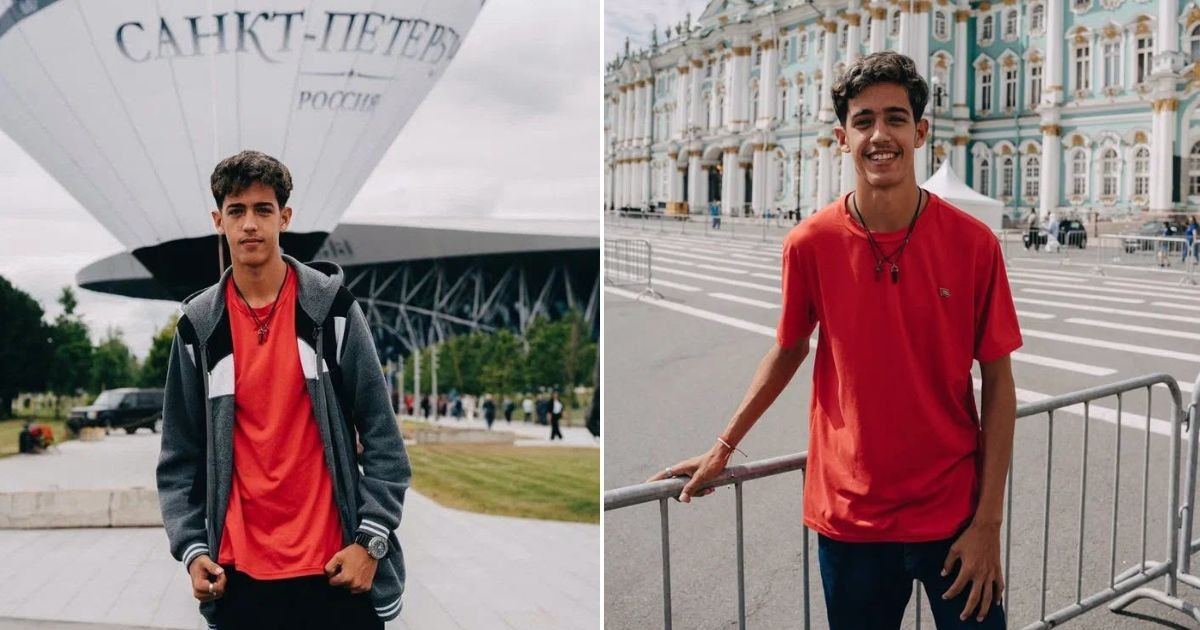
Alexander Gallar Bustillo, recognized as the most outstanding graduate of 2026 from the Pedagogical School "Marta Machado Cuní" in Isla de la Juventud, has returned to Cuba after visiting Saint Petersburg, Russia. This trip was awarded to him in recognition of his exceptional academic performance.
Alexander was part of a select group of the nation's top graduates. They first convened in Havana before embarking on their journey, a practice reminiscent of past "rewards" the communist regime once bestowed on a chosen few, showcasing the ongoing indoctrination that Cuban youth experience.
The young man's first impression of Russia was from the airplane, taking in the cityscape. "Everything fascinated me equally," he remarked, reflecting on the museums, streets, and the people he encountered during his stay.
Engaging Experience in Russia
The group's itinerary was packed from day one: they explored museums — including the Hermitage and the monument to the Bronze Horseman — enjoyed a boat tour, and met with the governor of Saint Petersburg, as well as with guides and interpreters.
During a museum visit, a Spanish teacher introduced them to basic Russian phrases. "She taught us how to greet in Russian, express gratitude, and count to ten," Alexander recounted.
Future Aspirations and Reflections
Aspiring to become a primary school teacher, Alexander believes this experience will greatly benefit his teaching career. He intends to share with his future students the cultural customs, traditions, and "treasures" of Russia, setting an example that academic dedication is acknowledged by the regime.
"I want them to know that with good conduct and diligent study, anyone can achieve great things," he asserted.
Though he wished for a longer stay, Alexander returned home feeling deeply satisfied. "He feels extremely pleased and content for having earned this trip."
Looking ahead, Alexander envisions himself as a primary school educator, committed to working hard with children to ensure they receive quality education and grow into virtuous individuals.
Cuba-Russia Cooperation Program
This trip is part of a collaborative program between the Cuban and Russian governments, which has been intensifying since 2024. The governor of Saint Petersburg, Aleksandr Beglov, announced at the end of that year the revival of a summer program for Cuban graduates, which had been halted for nearly 30 years following the Soviet Union's collapse.
In July 2025, a first group of 25 Cuban children visited the Orliónok camp in the Krasnodar region, marking the renewal of this cooperation. That same summer, another group of Cuban graduates participated in the "Álie Parusá" (Scarlet Sails) festival, a major annual event in Saint Petersburg celebrating high school graduates during the White Nights.
The 2026 festival was held on the night of June 27-28 under the theme "City of Thinkers."
Critics have pointed out that such programs carry a political indoctrination component, within the framework of the alignment between Havana and Moscow.
Simultaneously, approximately 274 Cuban students are enrolled in 25 Russian universities, with 61 of them in Saint Petersburg institutions.
FAQs about the Cuba-Russia Educational Exchange Program
What is the purpose of the Cuba-Russia cooperation program?
The program aims to strengthen educational and cultural ties between Cuba and Russia, offering Cuban students the opportunity to experience Russian culture and education firsthand.
How does the program benefit Cuban students?
Cuban students gain exposure to Russian culture, customs, and educational practices, which can enrich their academic and professional development.
Are there concerns about political indoctrination in these programs?
Yes, some critics argue that these exchange programs serve as a means of political indoctrination, reinforcing the political alignment between Cuba and Russia.