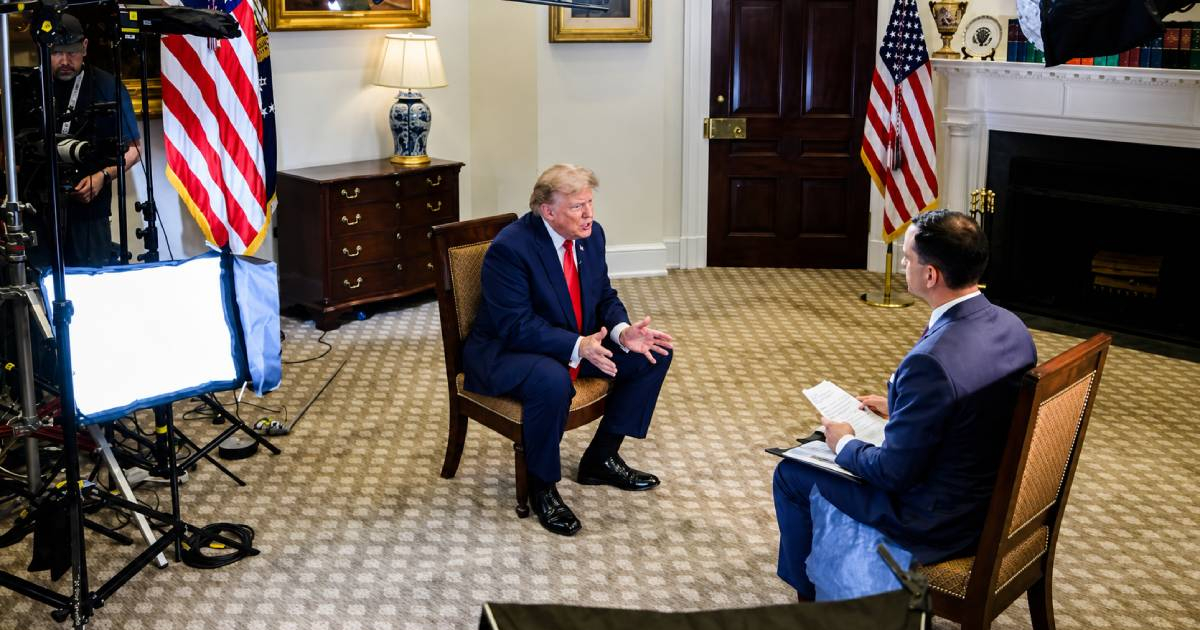
In a bold statement, former President Donald Trump delivered a cautionary message to the leaders of Iran's regime, highlighted in an interview shared by the official White House account on X.
"You better make a deal. There won't be anyone left," Trump remarked on Tuesday night during a discussion with Fox News correspondent Trey Yingst, recorded in one of the formal rooms of the White House.
Although the tone was menacing, Trump also hinted at a potential diplomatic path by mentioning that Iran is "now negotiating" and that there is a "good chance" for an agreement to be reached.
Escalating Tensions Amid Bombings
This warning followed the United States' completion of a third consecutive night of strikes against Iranian targets. The Central Command (CENTCOM) targeted over 300 Iranian military sites within one week, including missile and drone facilities, naval capabilities of the Islamic Revolutionary Guard Corps (IRGC), ammunition depots, and communication networks.
The catalyst for this latest series of attacks was the IRGC's assault on the Cyprus-flagged container ship, GFS Galaxy, on July 12 in the Strait of Hormuz. Ten out of eleven Indian crew members were rescued, but one remains missing.
Diplomatic Breakdown and Naval Blockade
On the prior day, Trump had vowed severe retaliation against Iran, describing the regime as "bad people who have systematically broken every agreement." He reinstated a naval blockade on Iran and imposed a 20% tariff on traffic through the Strait of Hormuz, a move condemned by Tehran as "piracy."
The roots of the dispute trace back to the collapse of the Islamabad Memorandum, signed on June 17 and 18 under the mediation of Pakistan, Qatar, Saudi Arabia, and Turkey. This agreement called for a 60-day ceasefire, the reopening of the Strait, and the start of denuclearization talks, in exchange for the thawing of Iranian assets ranging from $12 billion to $25 billion and access to a $300 billion reconstruction fund.
The agreement fell apart when Iran attacked three commercial ships in the Strait on July 6 and 7. Trump declared the truce "over" on July 8 during the NATO summit in Ankara.
Concerns Over Nuclear Commitments
Previously, CIA Director John Ratcliffe had warned that Iran was unlikely to adhere to its nuclear commitments. The core issue was the duration of the uranium enrichment ban: Washington demanded 20 years, while Tehran offered a period between five and 15 years.
Beyond military pressure, the situation carries an additional layer: on July 10, Israel informed Washington of a purported Iranian plan to target Trump, though Israeli sources clarified these were general discussions rather than an active conspiracy.
CENTCOM stated in a release that the bombings "will continue to exact a high cost on Iranian forces and degrade their ability to target innocent civilians and commercial shipping in the Strait of Hormuz," a critical passage that handles roughly 20% of the world's crude oil trade.
Key Questions About U.S.-Iran Tensions
What prompted the recent U.S. military actions against Iran?
The U.S. military actions were sparked by an IRGC attack on the Cyprus-flagged GFS Galaxy in the Strait of Hormuz.
What are the implications of the Islamabad Memorandum's collapse?
The collapse led to renewed hostilities, as it dismantled agreements on a ceasefire and denuclearization talks, worsening U.S.-Iran relations.
How does the Strait of Hormuz factor into the conflict?
The Strait of Hormuz is a crucial chokepoint for global oil trade, and control over it is strategically significant for both Iran and the U.S.