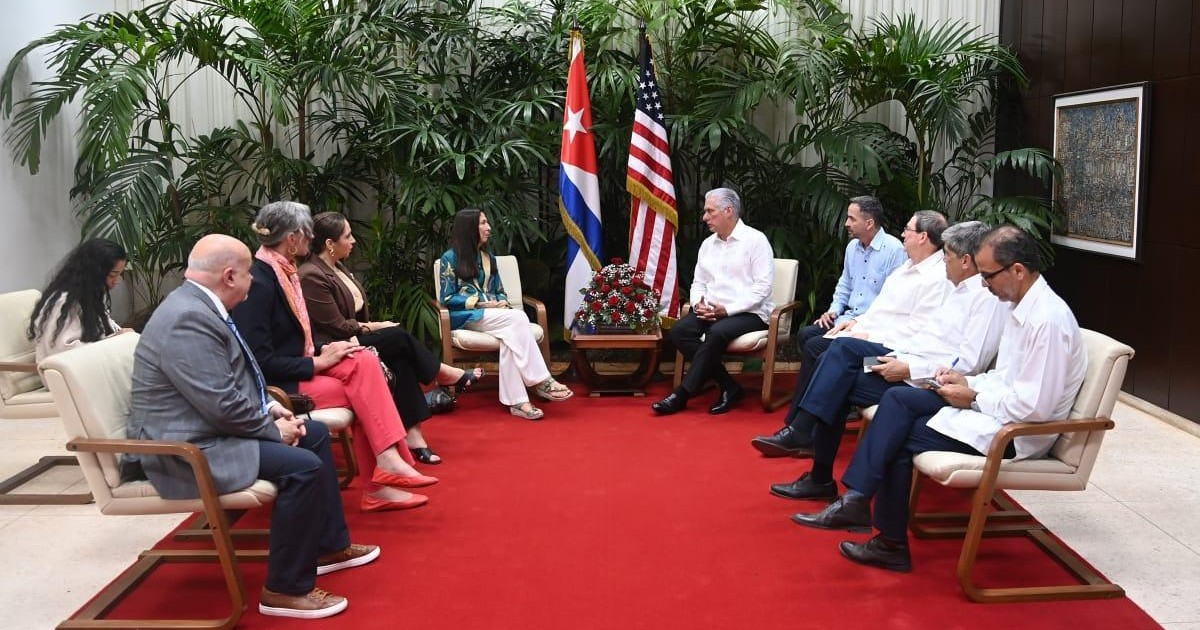
On July 11, Miguel Díaz-Canel welcomed a delegation of four U.S. Democratic lawmakers from the House of Representatives. The Cuban presidency shared details of this meeting on social media this Tuesday.
The group consisted of Teresa Leger Fernández from New Mexico, Delia Catalina Ramírez from Illinois, Maxine Elizabeth Dexter from Oregon, and Mark Pocan from Wisconsin. Their visit to the island, occurring from July 9 to July 13, was primarily investigative.
Díaz-Canel was joined by Bruno Rodríguez Parrilla, the Cuban Minister of Foreign Affairs, and Carlos Fernández de Cossío, the Deputy Minister of Foreign Affairs.
Exploring Havana and Engaging with Society
According to the official account of the Cuban Presidency, the lawmakers toured various locations in Havana and engaged with different sectors of the community. This experience, as stated by the regime, allowed them to "witness the detrimental effects of the economic blockade"—the term used by Cuban authorities to describe the U.S. embargo—and discussions touched on the potential for a respectful bilateral relationship.
Upon returning to Washington on July 13, the four members of Congress released a statement likening Cuba's situation to a "silent Gaza," a metaphor that Pocan attributed to a local Cuban, referencing the extensive daily power outages affecting much of the nation.
Call for Policy Change
The statement criticized the Trump administration's maximum pressure policies for exacerbating the hardships faced by Cuba's most vulnerable citizens. They urged Washington to start serious negotiations, lift sanctions, and permit the entry of medical supplies and equipment.
This marks the second visit by Democratic representatives to Cuba in under four months. In April, Díaz-Canel met with Congress members Pramila Jayapal and Jonathan Jackson, who described the energy sanctions as an "economic bombardment."
Energy Crisis Intensifying
The July visit occurred amidst a severe energy crisis. Just days before the delegation's arrival, Cuba experienced its third nationwide blackout of the year, with power generation meeting just a third of demand.
Since January 2026, the Trump administration has enacted over 240 sanctions against Cuba, including Executive Order 14380, which declared the island an "unusual and extraordinary threat."
Mark Pocan has a history of engaging in political diplomacy. In December 2022, he visited Cuba alongside James McGovern and Troy Carter. They met with Díaz-Canel, spoke with families of the July 11 protest detainees, and advocated for the release of non-violent demonstrators.
Meanwhile, Delia Ramírez led a May 2026 letter, signed by 32 Democratic lawmakers, addressed to secretaries Hegseth, Rubio, and Mullin, demanding a shift in Washington's approach to Havana.
Key Questions on U.S. and Cuba Relations
What was the purpose of the Democratic lawmakers' visit to Cuba?
The visit was part of a fact-finding mission to understand the current conditions in Cuba and engage with various sectors of the society.
What issues were highlighted by the lawmakers in their statement?
The lawmakers highlighted the severe impact of U.S. sanctions on Cuba, describing the situation as akin to a "silent Gaza" due to extensive power outages.
What actions have the lawmakers urged the U.S. government to take?
They have called for serious negotiations, lifting of sanctions, and allowing the entry of medical supplies and equipment into Cuba.