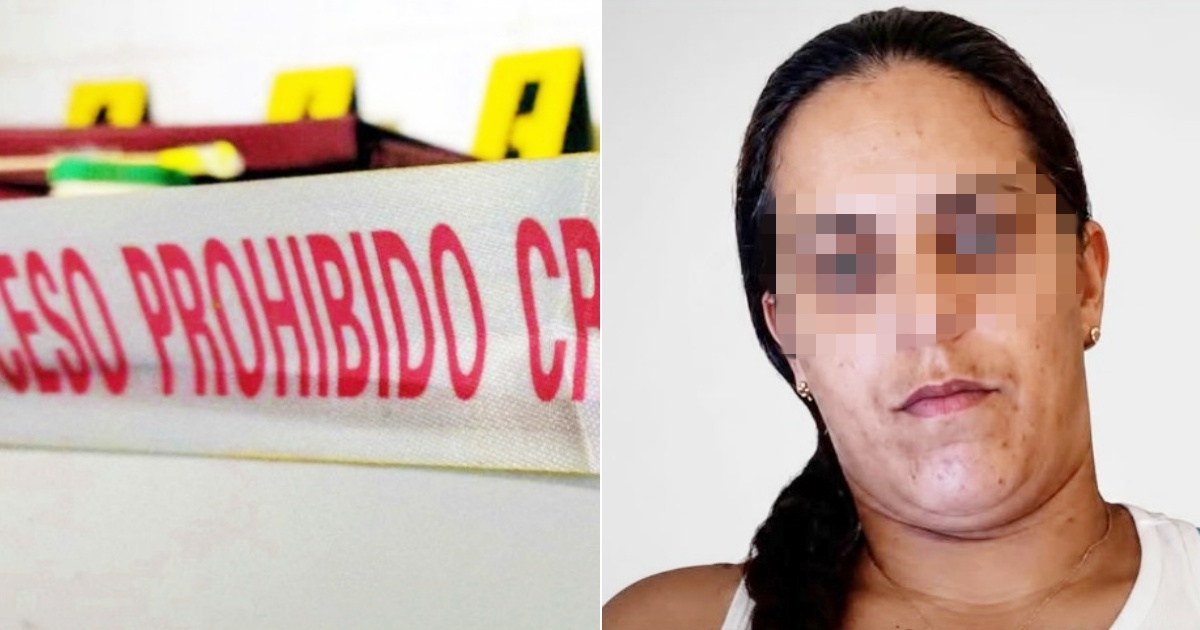
A tragic event unfolded on Sunday night in the town of Güines, located in Mayabeque province, where a Cuban woman was brutally murdered in the street with a knife. This was confirmed on Tuesday by the Observatory of Gender at Alas Tensas (OGAT).
The victim, identified as Yesneidy López Hernández, was attacked by her ex-partner on 103rd Street in the mentioned town.
Adding to the tragedy, the horrific act of violence occurred in the presence of Yesneidy's teenage daughter.
The 15-year-old attempted to protect her mother and was also injured in the process.
The alleged assailant, known as Osmany Jay Montero and identified as the victim's former partner, fled the scene and remains at large.
OGAT emphasized that the perpetrator had a history of repeated assaults against the victim and described the attack as a treacherous act.
Independent sources suggest the crime was driven by jealousy and took place near the home of a friend of Yesneidy's daughter.
Reports indicate that Yesneidy suffered approximately 16 stab wounds during the assault.
Her daughter, who tried to intervene, was wounded but is not in life-threatening condition.
Both were urgently transported to a hospital, but Yesneidy succumbed to her injuries; her daughter survived.
The National Revolutionary Police (PNR) has fully identified the suspect and is conducting a search operation. Authorities are requesting assistance from anyone with information that could lead to his capture.
Residents of Güines remember Yesneidy as a hardworking woman, a good person, and a devoted mother. A local from 103rd Street remarked, "We cannot normalize a woman dying at the hands of a violent man."
Alarming Rise in Femicide Cases
This incident marks the 41st femicide recorded in Cuba in 2026, according to OGAT.
The independent feminist organization expressed sorrow over the ongoing violence with a poignant statement: "They are killing us."
This case follows closely after the 40th confirmed femicide of the year, involving 43-year-old Yunierkis Gómez Lozano in Cumanayagua, Cienfuegos.
July has been particularly grim for gender-based violence in Cuba, with four femicides reported in just 13 days across different provinces.
On July 1, 26-year-old Dayana Borges was murdered in Centro Habana.
Then, on July 5, Yolexis Virgen Arias Oroceno, aged 54, was fatally stabbed by her partner in Camagüey.
The 41 femicides confirmed by July 13 represent a staggering 112.5% increase compared to 18 cases during the same period in 2025. OGAT continues to document these crimes monthly amidst the regime's silence, which rarely publishes official statistics on gender violence, and state media seldom cover these crimes.
A Repeated Pattern Without Legal Repercussions
The case of Yesneidy mirrors the most common pattern seen in Cuban femicides: a perpetrator with a history of violence, linked to the victim through a current or former relationship, and the use of a knife.
According to OGAT data, 83.3% of femicides in Cuba are committed by partners or ex-partners, 64.6% involve knives, and 62.5% occur in the victim's home.
From 2019 to June 2026, independent observatories have documented 350 femicides in Cuba, with a record high of 90 cases in 2023.
Despite these alarming figures, Cuba lacks a comprehensive gender violence law.
Femicide is not recognized as an independent crime in the current Penal Code; it is only considered an aggravating factor in homicide, and in 2022, the National Assembly rejected an amendment to classify it as a separate crime.
OGAT remains the sole independent observatory active on the island since April 2026, following the closure of Yo Sí Te Creo en Cuba due to lack of resources.
The organization reminds the public: "Reporting these crimes is not a crime," and encourages anonymous reporting through their online form.
Frequently Asked Questions About Femicide in Cuba
What is the current legal status of femicide in Cuba?
In Cuba, femicide is not recognized as an independent crime within the Penal Code. It is only considered an aggravating factor in cases of homicide.
How does Cuba compare with other countries in terms of addressing gender violence?
Cuba lags behind many countries in addressing gender violence, as it lacks comprehensive legal measures specifically targeting femicide and broader gender-based violence.
How can citizens report gender-based violence in Cuba?
Citizens are encouraged to report cases of gender-based violence anonymously through online forms provided by organizations like OGAT.