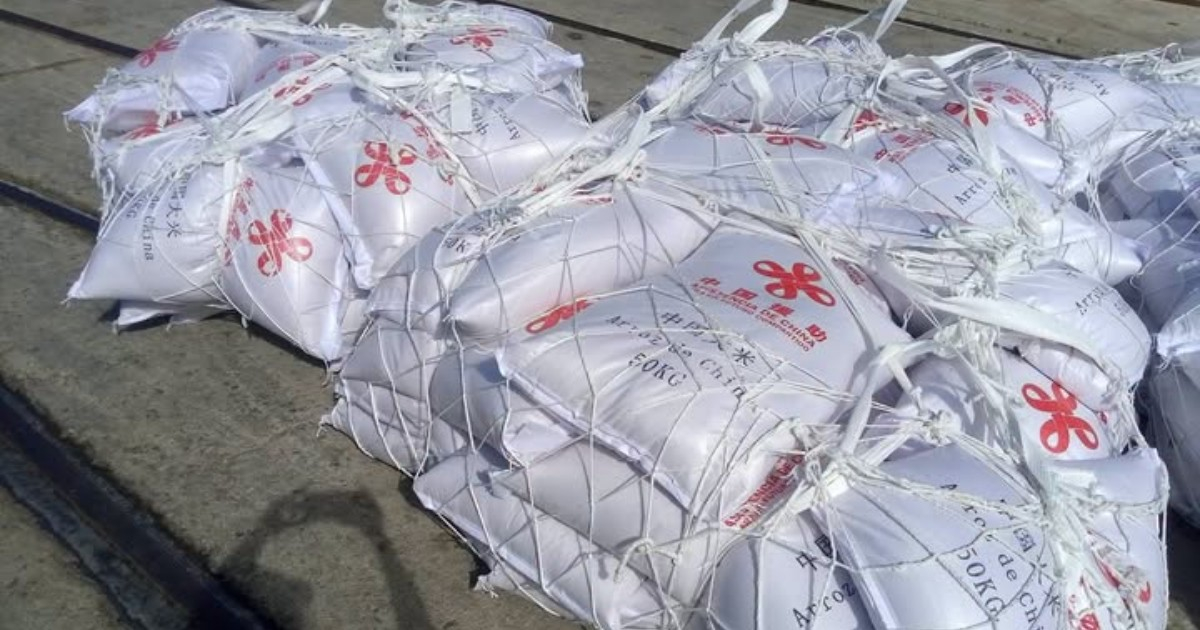
This Monday, the Cuban Ministry of Domestic Trade (MINCIN) announced on its Facebook page that it plans to distribute rationed rice in July across seven provinces. The distribution will range from eight pounds per person in Las Tunas, Holguín, and Granma, to five pounds in Santiago de Cuba and Guantánamo, and a mere three pounds in Havana and the Isle of Youth.
The state agency cautioned that the distribution will occur "gradually depending on fuel availability" and directed citizens to provincial Telegram channels for further information. The rice in question is part of humanitarian aid from China —the 50-kilogram bags prominently display "Rice from China" and the Chinese government's humanitarian aid emblem—, a segment of a package approved by Xi Jinping in January 2026, which includes up to 90,000 tons for this year.
The announcement was met with widespread skepticism and open frustration from the public. Comments on the post reflected disbelief, with remarks such as "I'll believe it when I see it" and "I'll believe the 8 lbs when they arrive." This distrust is not unfounded as the promised Chinese rice has yet to reach many provinces weeks after each official announcement.
One common grievance was the exclusion of entire provinces from the distribution list. Residents of Matanzas, Villa Clara, Cienfuegos, Camagüey, Sancti Spíritus, Ciego de Ávila, Pinar del Río, Artemisa, and Mayabeque expressed their dissatisfaction, noting their territories were left out. A commenter summarized the sentiment: "They must have forgotten that we all need to eat daily regardless of geographic location; we all have stomachs in the same place."
In Guantánamo, several Cubans contested the official statement directly: "Why do they keep lying about the 5 lbs in Gtmo? Only 3 lbs were distributed, and they were sold, not donated; everything here in this province is a deception," one individual denounced. Another pointed out that the promised pounds from previous distributions had yet to reach their local store.
Complaints about unfulfilled past distributions were frequent. An Artemisa resident sarcastically remarked, "The previous three pounds to Mariel still haven't arrived, so these will probably show up in December." From Holguín, someone noted that "in the municipalities, especially Freyre, their neighborhoods have never received anything," and another accused that "the last I heard of a donation was that it was stolen from the Freyre warehouse in Holguín; it never reached the people."
The official explanation regarding fuel didn't convince everyone. "Too gradually. Today is the 13th, and while we wait, we have to pay over 300 per pound," a Cuban commented, referencing the price of rice on the informal market, where it ranges between 300 and 340 Cuban pesos compared to the official cap of 155 CUP. Another questioned, "When? Because there's fuel for rallies and marches."
There were also concerns about the quality of the product eventually reaching the stores. "That rice comes in small bags. I don't expect to receive it in bulk; they'll give me rice that's not the Chinese donation and of terrible quality," warned a commenter.
The backdrop to this announcement is the collapse of Cuba's ration book system, publicly acknowledged by regime officials in May 2026. Domestic rice production covers less than 6% of internal consumption, leaving the country wholly reliant on imports and donations. An April 2026 report identified five provinces in critical levels of food insecurity: Havana, Matanzas, Cienfuegos, Guantánamo, and Santiago de Cuba.
"It's already July 15, and nothing... maybe by the 26th, but we're not sure, and it's been a while since we've had rice... or sugar... or oil or anything," wrote a 64-year-old woman, succinctly summarizing what the official announcement fails to convey.
Understanding Cuba's Rice Distribution Challenges
Why is there skepticism about the rice distribution in Cuba?
Cubans are skeptical because previous announcements about rice distribution have not been fulfilled, with promised rice failing to reach many provinces.
What is the source of the rice being distributed in Cuba?
The rice being distributed comes from donations by China, part of a humanitarian aid package approved by Xi Jinping for the year 2026.
How does the fuel crisis affect rice distribution in Cuba?
The distribution of rice in Cuba is dependent on fuel availability, leading to delays and gradual distribution across the provinces.