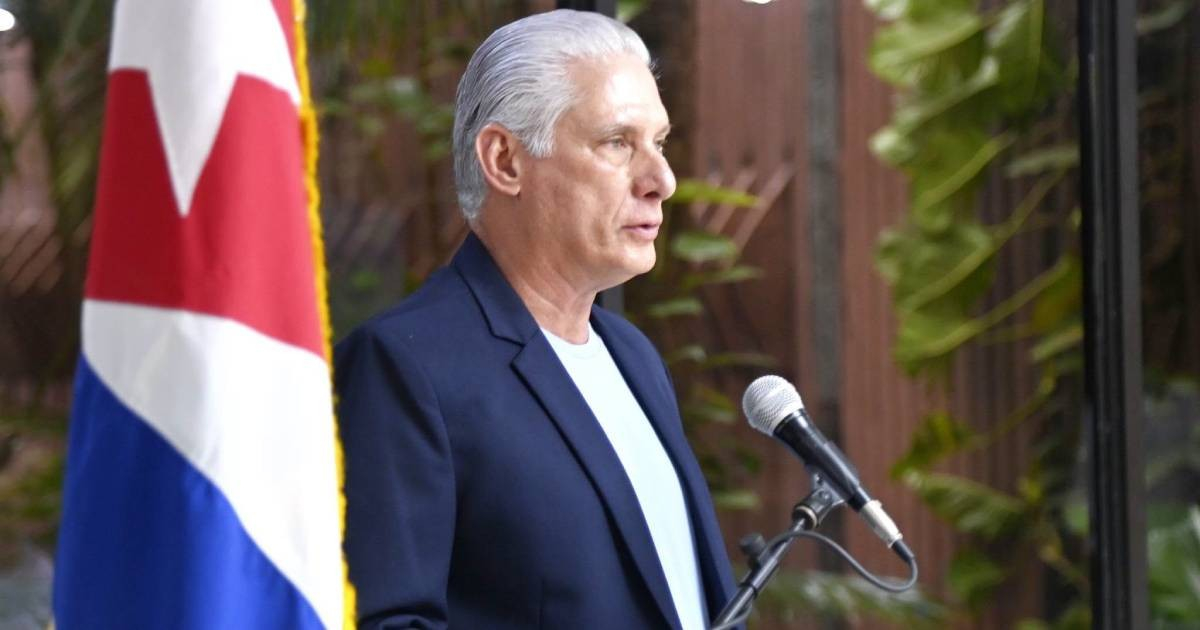
Miguel Díaz-Canel, the Cuban leader, has fiercely criticized the United States following its latest round of sanctions targeting state-run entities on the island. He accused former President Donald Trump's administration of escalating efforts to choke Cuba's economy.
In a post on his X account, Díaz-Canel described the measures as a deliberate attack on the Cuban populace.
"Another week, another list of 'sanctions' against Cuba. It’s the U.S. waging war to strangle our economy, intensifying aggression to inflict greater harm on our people. We are facing a genocidal blueprint that was denounced at the UN less than a week ago," the leader stated.
The response came shortly after the U.S. Department of the Treasury, through the Office of Foreign Assets Control (OFAC), added ten Cuban entities to the Specially Designated Nationals (SDN) list.
Among those sanctioned is, for the first time, a complete ministry: the Cuban Ministry of Tourism (MINTUR). Other affected entities include GEMAR, GECOMEX, COREYDAN S.A., ENETEC S.A., ANTEX S.A., OSDE Caudal S.A., the Territorial Troops Militia (MTT), the Association of Combatants of the Cuban Revolution (ACRC), and the Rapid Response Brigades.
UN Assembly Reaction
In his message, Díaz-Canel referenced the extraordinary session of the UN General Assembly held on July 7, initiated by Cuba to protest the tightening of U.S. sanctions.
During the debate, Cuba's Foreign Minister, Bruno Rodríguez Parrilla, branded the U.S. measures as "acts of genocide" and a "collective punishment" against the Cuban people.
The General Assembly approved the session with 136 votes in favor, nine against—including the U.S., Argentina, and Israel—and 40 abstentions.
Representing Washington, Jeffrey Bartos dismissed the Cuban government’s allegations, asserting that "there is no U.S. blockade; the only embargo is the guillotine the regime hangs over its people," while also condemning the political prisoner situation on the island.
Continuing U.S. Pressure
This latest batch of sanctions is part of a broader pressure strategy implemented by the Trump administration since early 2026.
In recent months, the U.S. has sanctioned entities such as GAESA, the Ministry of the Interior (MININT), the Ministry of the Revolutionary Armed Forces (MINFAR), CUPET, the Committees for the Defense of the Revolution (CDR), and even Díaz-Canel himself, viewing these as financial sources or tools of regime repression.
The measures arrive amidst a severe economic crisis in Cuba, characterized by prolonged power outages, fuel shortages, a decline in tourism, and continuous economic contraction. While Havana attributes the decline primarily to the tightened U.S. sanctions, Washington blames the island's economic and political model.
Understanding U.S. Sanctions on Cuba
What prompted the latest U.S. sanctions against Cuba?
The U.S. imposed new sanctions in response to its policy of increasing economic pressure on Cuba, targeting entities believed to support the Cuban government's oppressive practices.
How has Cuba responded to these sanctions?
Cuban leader Miguel Díaz-Canel condemned the sanctions as a deliberate attack on the Cuban people, describing them as part of a "genocidal blueprint" and criticizing the U.S. at the UN.
How do these sanctions affect Cuba's economy?
The sanctions exacerbate Cuba's economic challenges, contributing to issues like power outages, fuel shortages, and a declining tourism sector, further straining the island's economy.