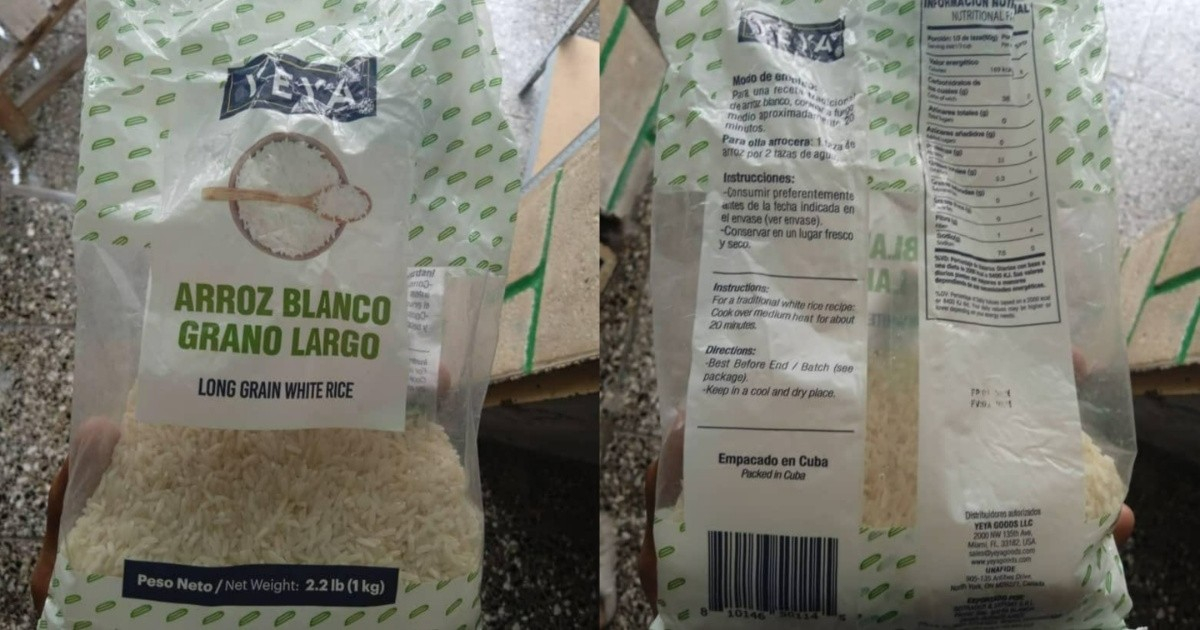
A Cuban woman took to Facebook to expose rice she purchased from a Mipyme for 700 Cuban pesos per kilogram, reporting an unusual taste and smell. Her post sparked a wave of similar complaints from other consumers.
Zobeidy Lamata Sosa shared her experience on her Facebook profile, including photos of the packaging. She described her initial skepticism that turned into certainty, urging others to be aware: "This rice has a taste and smell I can't quite describe; it's unlike anything I've ever tried before."
Initially, Lamata Sosa thought the issue might have been caused by the beans she cooked alongside the rice. However, the following day, she prepared the rice as yellow rice and encountered the same unpleasant taste and odor. "I cooked it, and it had the same bad taste and smell, so we didn't eat it," she noted.
Upon closer inspection of the packaging, she discovered a detail that raised more questions: "The rice is packaged in Cuba. You can imagine the rest of the questions that came to my mind," she remarked with irony.
The rice in question is long-grain white rice, weighing 2.2 pounds (1 kg), marketed under the brands JETA and YEYA. According to the packaging, it is distributed by YEYA GOODS LLC, based in Miami, Florida, and exported from Argentina by SOTRADER & EXPORT S.R.L., located in Bahía Blanca, Buenos Aires. The production and expiration dates, April 2026 and April 2028 respectively, indicate the product was not expired at the time of the complaint.
This distribution chain—originating in Argentina, distributed from Miami, and packaged in Cuba—raises significant questions about the quality control measures in place during the local packaging process.
The post garnered responses from other users sharing similar experiences. Yadniel Hernandez commented: "You can't eat that rice; it smells like fertilizer that won't go away, and it releases a grease. It's enough to make you sick." Meanwhile, Anyi Martínez Cuenca stated: "It had a sea, seafood smell, like salty water. I cooked it, and it was even worse, in short... it's inedible."
This incident adds to a series of complaints regarding the quality of rice found in both state-owned and private sector stores. In December 2025, a woman from Bayamo reported moldy, greenish-spotted rice from the basic ration. In March 2026, a resident of Camagüey complained about foul-smelling rice from a bodega, attributed to long-term storage in poor conditions.
Since their legalization in 2021, Mipymes have become a primary food source for those who can afford them, amidst the collapse of the state distribution system. However, they have also faced numerous complaints about spoiled products, including rancid cookies, chocolates, and sorbets. In June 2026, several Mipymes were evicted from the "Los Chinos" informal market in Holguín due to unsanitary conditions and foul odors.
Even the Minister of Domestic Trade, Betsy Díaz Velázquez, admitted that the state is unable to ensure the supply of basic products like rice, leaving the population caught between a failing state system and a private market that doesn't always guarantee quality.
Understanding the Quality Issues with Cuban Rice
What are the reported issues with the rice packaged in Cuba?
Consumers have reported an unusual taste and smell in the rice, which some describe as similar to fertilizer or seafood. These complaints suggest a potential issue with the rice's quality control during packaging in Cuba.
Who is responsible for distributing the rice in question?
The rice is distributed by YEYA GOODS LLC, a company based in Miami, Florida, and is exported from Argentina by SOTRADER & EXPORT S.R.L., located in Bahía Blanca, Buenos Aires.
What has been the response from other consumers?
Multiple consumers have shared similar experiences, noting the rice's inedibility due to its strange aroma and taste. This has led to a broader discussion about product quality in Cuban markets.