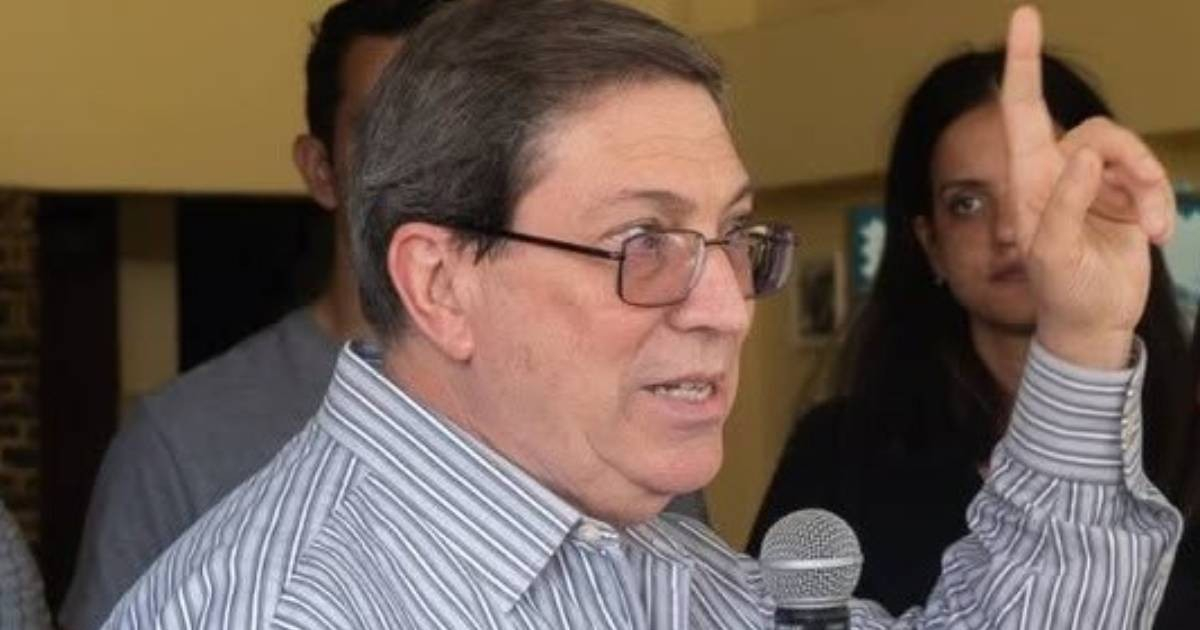
Cuba's Foreign Minister, Bruno Rodríguez Parrilla, vehemently criticized the latest sanctions announced by the United States on Monday, targeting Cuban state entities. He accused former President Donald Trump's administration of escalating its policy of pressure on the island.
In a statement shared on social media platform X, Rodríguez asserted that "the U.S. government continues to intensify its war against the Cuban people, affecting their living conditions and sources of livelihood."
He further described the new measures as a "clear demonstration of the criminal and genocidal intent with which U.S. leaders seek to punish the entire population of the country."
The message concluded with the hashtag #CubaNoEsUnaAmenaza, paired with the phrase "The embargo is," referencing the longstanding sanctions policy that the Cuban government has condemned for decades.
Rodríguez's response came shortly after the U.S. Department of State and the Office of Foreign Assets Control (OFAC) revealed a fresh wave of sanctions. These targeted several Cuban entities, including the Rapid Response Brigades, Territorial Troop Militias (MTT), the Association of Combatants of the Cuban Revolution (ACRC), the Ministry of Tourism (MINTUR), and companies COREYDAN S.A. and ENETEC S.A., among other entities linked to the regime's economic framework.
His remarks align with the Cuban government's consistent narrative in response to each new round of sanctions imposed by Washington throughout 2026.
Following the June 23 announcement of measures against five entities associated with GAESA, Rodríguez labeled the move an "act of war" and criticized Secretary of State Marco Rubio as "dishonest and deceitful."
Days later, he declared, "We are not interested in the opinion of the United States," and on July 7, he engaged in a United Nations session convened by Cuba to denounce U.S. policy.
The sanctions were announced just two days after the fifth anniversary of the July 11, 2021, protests. On that date, Secretary of State Marco Rubio reiterated Washington's support for the Cuban people and warned that the Trump administration would maintain pressure on the regime. That same day, the U.S. Senate introduced a resolution with eight demands directed at the Havana government.
Since early 2026, the Trump administration has enacted over 240 restrictive measures against the Cuban regime as part of its maximum pressure strategy. These include sanctions against GAESA, MININT, MINFAR, the Committees for the Defense of the Revolution (CDR), Miguel Díaz-Canel, CUPET, and other state entities related to security, defense, energy, and tourism sectors.
This tightening of sanctions coincides with a severe economic and energy crisis on the island. Persistent power outages and deteriorating living conditions have fueled social discontent, while human rights organizations report that, five years after the July 11 protests, 1,281 political prisoners remain incarcerated, 338 of whom were sentenced for participating in those demonstrations.
Understanding the Impact of U.S. Sanctions on Cuba
What entities were targeted by the latest U.S. sanctions against Cuba?
The recent U.S. sanctions target multiple Cuban entities, including the Rapid Response Brigades, Territorial Troop Militias (MTT), Association of Combatants of the Cuban Revolution (ACRC), Ministry of Tourism (MINTUR), and companies like COREYDAN S.A. and ENETEC S.A.
How has Cuba's foreign minister responded to the U.S. sanctions?
Cuba's Foreign Minister, Bruno Rodríguez, condemned the sanctions as "criminal and genocidal," accusing the U.S. of intensifying its pressure on the Cuban population and their livelihoods.
What is the significance of the July 11 anniversary in Cuba?
The July 11 anniversary marks the date of widespread protests in Cuba in 2021. It is significant as it represents a moment of notable civil unrest against the Cuban government, which continues to face criticism and sanctions from the U.S.