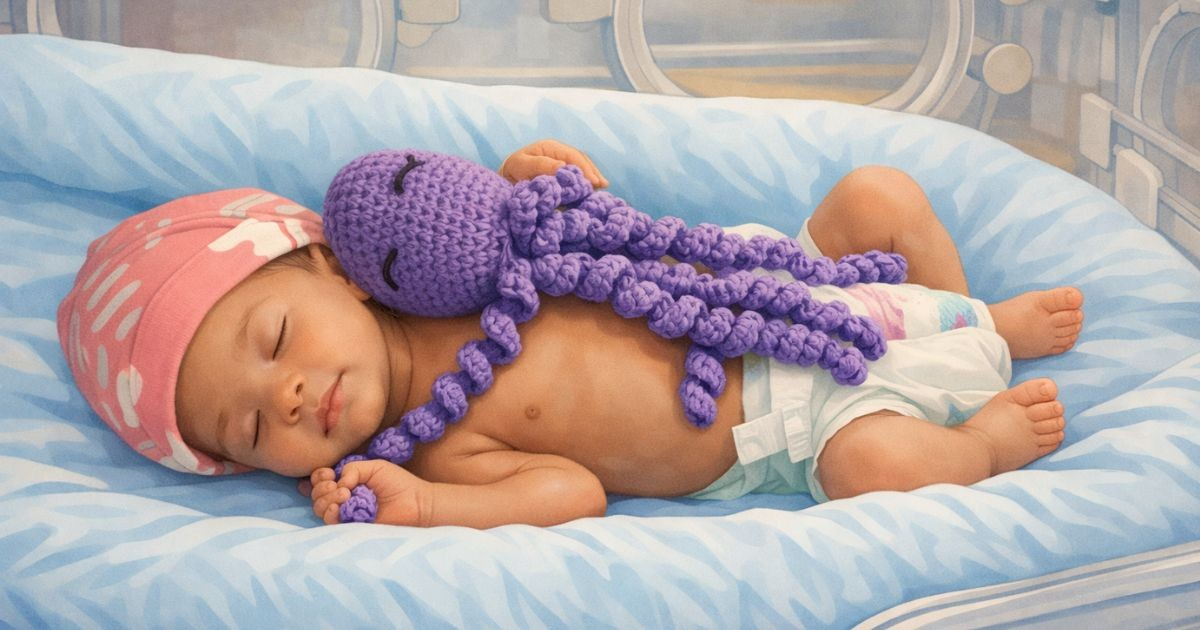
In a pioneering move for Cuba, the Abel Santamaría Cuadrado Hospital in Pinar del Río has introduced comfort octopuses in its neonatal intensive care unit, making it one of the country's first medical facilities to adopt this practice already popular in numerous countries. This development was reported on Saturday by the province's official newspaper, Periódico Guerrillero, with insights from the head of the provincial Neonatology service.
These neonatal octopuses are small crocheted toys whose tentacles mimic the umbilical cord, offering newborns a familiar sensation akin to the womb environment.
Dr. Yamila Salgado Caraballo, head of the Neonatology service at Abel Santamaría Cuadrado, shared with the Cuban News Agency that, "Their tentacles simulate the umbilical cord, helping babies feel as though they are in a similar environment to the womb."
According to Dr. Salgado Caraballo, the clinical benefits are numerous: "They provide greater security for the patients, regulate heart and respiratory rates, and prevent infants from pulling on medical tubes or lines."
She further emphasized that these toys "ensure deeper and better-quality sleep, thereby promoting weight gain and improved neurodevelopment in newborns. They also help reduce stress in babies subjected to invasive procedures and bright lights."
Highlighting the Cuban healthcare system's shortcomings, Dr. Salgado Caraballo candidly mentioned the origin of the first octopus toys: "The first ones were crocheted by one of our nurses because there isn't a place to acquire them." Subsequently, the Renacer a la Vida project reached out to the hospital and began donating these toys to the service.
Technical Specifications and International Support
The octopuses must adhere to strict technical specifications to ensure the neonates' safety. As per Dr. Salgado Caraballo, "The head should measure between seven and nine centimeters, filled with high-temperature-resistant synthetic material; tentacles should not exceed 22 centimeters; and the yarn must be 100% cotton." Additionally, "they are sent in individual bags to the sterilization center before being placed in incubators."
This initiative was introduced to the province through exchanges with the national Neonatology group in Havana. Dr. Salgado Caraballo noted that these meetings included "members of UNICEF," providing international institutional support for the practice.
The Origin and Global Expansion of Comfort Octopuses
Comfort octopuses originated in Denmark in 2012 when volunteer crocheter Josefine Hagen Solgaard crafted the first one for a premature baby. This led to the creation of the Danish Octo Project (Spruttegruppen DK) in 2013, a solidarity initiative that began supplying these crocheted octopuses to Danish hospitals for free, and soon spread across Europe, Latin America, and other continents.
In Spain, the NGO NOUPOPS "Hilo para la Vida" was established in February 2017 to officially implement the project in the country. According to recent data from the organization, the original Danish project has distributed over 60,000 octopuses to participating hospitals.
Impact on Infant Mortality and Healthcare Challenges in Cuba
The Neonatology service at Abel Santamaría Cuadrado Hospital plays a crucial role in the Maternal and Child Care Program in Pinar del Río. In 2025, this area recorded the country's lowest infant mortality rate: 4.7 per 1,000 live births, compared to a national average of 9.9, as reported by the Ministry of Public Health. The service also boasted a 99% survival rate that year, achievements that led Pinar del Río to host the national event on July 26, 2026.
This stark contrast between Pinar del Río's statistics and the national average underscores a broader reality: Cuba's infant mortality rate nearly doubled between 2018, when it was 4.0 per thousand, and 2025. While the regime attributes this decline to the economic crisis and the U.S. embargo, experts and independent organizations also link it to the structural collapse of the healthcare system after decades of centralized management and chronic shortages of medical supplies.
Understanding the Use of Comfort Octopuses in Neonatal Care
What are comfort octopuses used for in neonatal care?
Comfort octopuses are used in neonatal care to replicate the feeling of the womb, helping to soothe and stabilize newborns by imitating the umbilical cord with their tentacles.
What are the benefits of using comfort octopuses for premature babies?
They help regulate heart and respiratory rates, provide a sense of security, prevent infants from pulling on medical tubes, and support better sleep, weight gain, and neurodevelopment.
How did the comfort octopus initiative start?
The initiative began in Denmark in 2012, when volunteer crocheter Josefine Hagen Solgaard made the first octopus for a premature baby, leading to the creation of the Danish Octo Project in 2013.