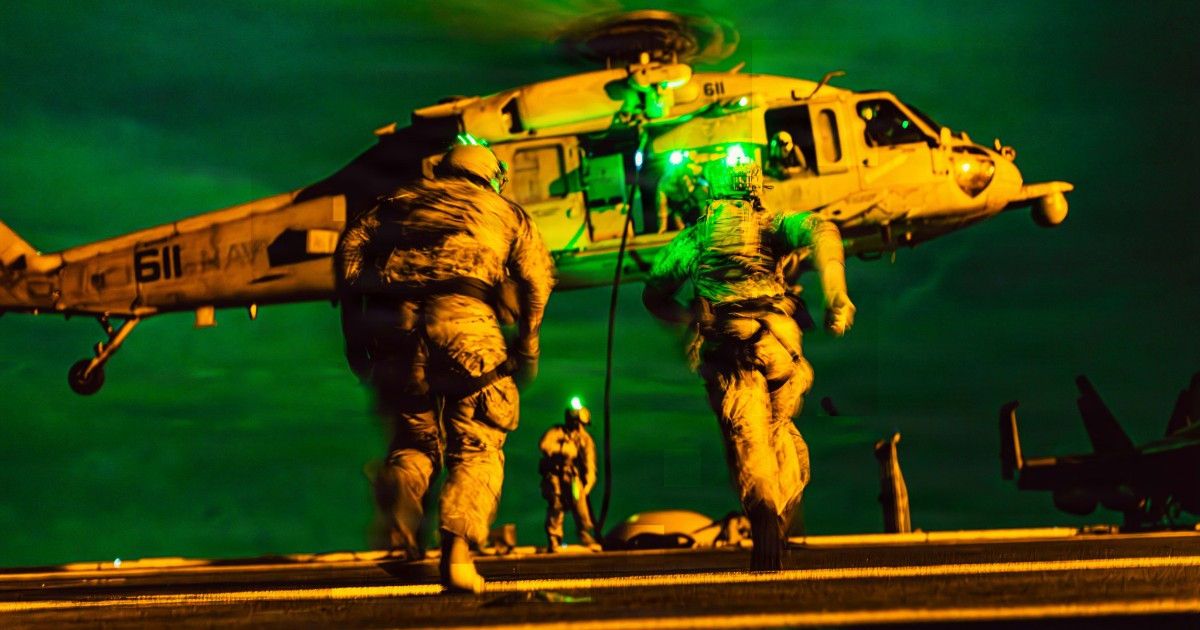
The United States Central Command (CENTCOM) launched another wave of military strikes against Iran this Sunday at 5 p.m. Eastern Time, following a direct order from President Donald Trump. The declared aim of these operations is to diminish Iran's capacity to threaten civilian sailors and commercial vessels navigating the Strait of Hormuz.
An official statement from CENTCOM, posted on X, noted, "U.S. Central Command forces have initiated further attacks on Iran to continue undermining their ability to target civilian sailors and commercial ships freely passing through the Strait of Hormuz. The Commander in Chief has directed these strikes to hold Iranian forces accountable."
This marks the third set of strikes carried out by Washington in less than a week.
The previous round concluded on Saturday, July 11, when U.S. forces hit approximately 140 military targets within Iranian territory.
In total, these three waves of attacks have targeted over 300 objectives, including missile and drone facilities, naval capabilities, ammunition depots, communication networks, and coastal surveillance posts.
Escalation Triggered by Ceasefire Violations
The latest escalation was provoked by Iran's breach of a ceasefire agreement signed in June 2026, which encompassed reopening the strait and initiating denuclearization talks.
Iran attacked commercial vessels between July 6 and 7, including a tanker that caught fire on July 7 after being struck by an Iranian projectile. Trump declared the ceasefire "over" on July 8 and commanded massive bombings on over 80 targets on July 9.
In retaliation, Iran launched missiles and drones targeting U.S. facilities in Qatar, Kuwait, Bahrain, the United Arab Emirates, Oman, and Jordan.
Strait of Hormuz: A Critical Passage
On Sunday, the Islamic Revolutionary Guard Corps (IRGC) announced the closure of the Strait of Hormuz "until further notice," a move that directly opposes Washington's stance.
CENTCOM countered this with an official infographic, asserting, "The Strait of Hormuz is open to all legally transiting vessels. Iran does not control the strait. Traffic continues to flow."
The Central Command reported facilitating the passage of over 800 ships and 400 million barrels of crude oil in the past two months, with more than 140 vessels crossing the strait in the past week.
Additionally, CENTCOM debunked Iranian propaganda claims that three U.S. soldiers were killed in Kuwait as a result of counterattacks.
"There are zero reports of deaths or injuries among U.S. personnel in the region. All personnel are accounted for," stated the Central Command.
Security Alerts and Historical Context
The escalation is further complicated by a high-level security alert: on July 10, Israel warned the U.S. of an alleged Iranian plot to assassinate Trump, a threat the president publicly acknowledged. "They want to eliminate the leader of the United States, which is me. I'm on any list," Trump declared on July 8.
This conflict traces back to Operation Epic Fury, initiated on February 28, 2026, by joint U.S. and Israeli forces, which resulted in the elimination of Iran's Supreme Leader Ali Khamenei and the destruction of 90% of Iran's missile arsenal and 95% of its drones.
Despite the rising tensions, Washington and Tehran were engaged in technical discussions aimed at reaching a nuclear agreement by mid-August 2026, according to sources close to the conflict.
Understanding the Current U.S.-Iran Tensions
What prompted the recent U.S. airstrikes on Iran?
The airstrikes were prompted by Iran's violation of a ceasefire agreement, which included attacks on commercial vessels in the Strait of Hormuz.
What is the significance of the Strait of Hormuz?
The Strait of Hormuz is a critical passage for global oil transportation, with a significant portion of the world's oil supply passing through it.
How has Iran responded to the U.S. military actions?
Iran has retaliated by launching missiles and drones at U.S. facilities in several Middle Eastern countries.
What are the roots of the current conflict between the U.S. and Iran?
The conflict stems from Operation Epic Fury in 2026, which saw U.S. and Israeli forces eliminate Iran's Supreme Leader and significantly reduce its military capabilities.