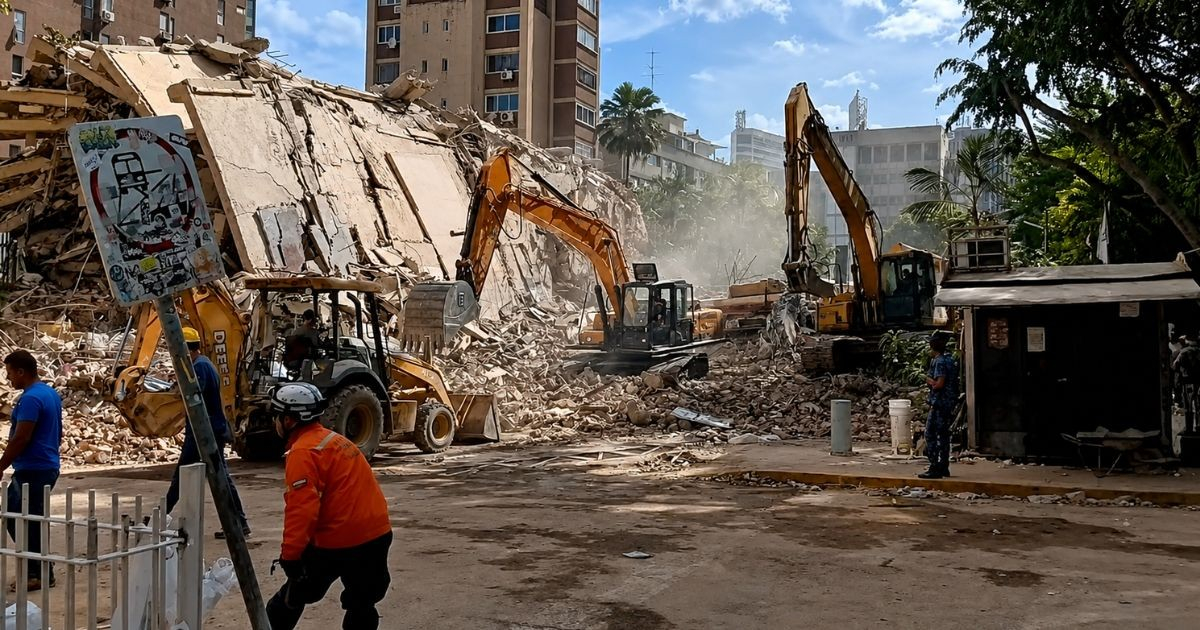
The death toll from the catastrophic earthquakes that struck Venezuela on June 24 continues to climb. On Sunday, Jorge Rodríguez, the president of the National Assembly, updated the official count to 4,490 fatalities, as reported on his Telegram channel.
In addition to the fatalities, the report highlights 16,740 injuries and 6,462 individuals rescued alive. Meanwhile, 17,907 people are left homeless and are currently residing in 89 temporary camps set up by authorities.
The number of deaths has seen a steady increase since the quakes first hit: 188 confirmed by June 25, rising to 920 by June 26, 1,719 by June 28, 3,535 by July 5, 4,118 by July 10, and 4,333 by July 11.
Historic Seismic Disaster
This Sunday's figures make the catastrophe the deadliest earthquake in Venezuela's modern history.
The seismic events, registering magnitudes of 7.2 and 7.5 on the moment magnitude scale, occurred at 6:04 PM local time, with just 39 seconds separating the two quakes.
The epicenter was near Yumare in the state of Yaracuy, and the tremors shook a densely populated area encompassing Caracas and the coastal state of La Guaira.
Widespread Destruction
This region bore the brunt of the devastation: 158 of the 190 completely collapsed buildings nationwide were located here.
Analysis of European Sentinel-1 satellite imagery, processed by NASA, revealed that over half of the structures in towns such as Caraballeda, Macuto, Naiguatá, and Catia la Mar had a damage probability exceeding 75%. Ohio State University estimated around 59,000 structures were damaged across the nation.
Geophysicist Michael Schmitz explained to El Nacional that the scale of destruction wasn’t solely due to the earthquakes' strength but was also influenced by the simultaneous displacement of two geological faults, ground characteristics amplifying wave effects, and the deterioration of the building stock.
“Unlike Chile or Japan, where major earthquakes occur more frequently, seismic considerations here have been neglected,” Schmitz noted.
Ongoing Search and Rescue Efforts
As rescue operations now focus on recovering bodies, Delcy Rodríguez's government has yet to release official figures on the missing.
The UN estimates that up to 50,000 people remain unaccounted for, and the citizen platform "Encuéntralos" documented more than 71,000 missing by June 29. The government's lack of transparency has sparked public outcry among Venezuelans.
Adding to the frustration, victims' families claim military personnel have obstructed their search efforts.
"We demand that we be allowed to work. The national armed forces have not let us work," a volunteer told Infobae.
The United Nations Development Program estimated material damages at approximately $6.7 billion, equating to 6% of Venezuela’s Gross Domestic Product.
The World Food Program has issued a $50 million appeal to provide food for three months to half a million people, and over 3,000 foreign rescuers have been deployed to the region.
This disaster follows the region's previous worst event, the Vargas Tragedy of December 1999, when mudslides and rockslides claimed between 10,000 and 30,000 lives.
With over 1,100 aftershocks recorded since June 24 and thousands of families in temporary shelters, Venezuela faces a long and challenging reconstruction in a region devastated twice in less than three decades.
Key Questions About Venezuela's Earthquake Aftermath
How many people were injured in the Venezuela earthquakes?
A total of 16,740 people were reported injured following the devastating earthquakes in Venezuela.
What is the estimated cost of the material damages caused by the earthquakes?
The United Nations Development Program estimated the material damages to be around $6.7 billion, which is approximately 6% of Venezuela's GDP.
What actions have been taken to assist those affected by the earthquake?
The World Food Program has launched a $50 million appeal to provide food for affected individuals, and over 3,000 international rescuers have been deployed to Venezuela.