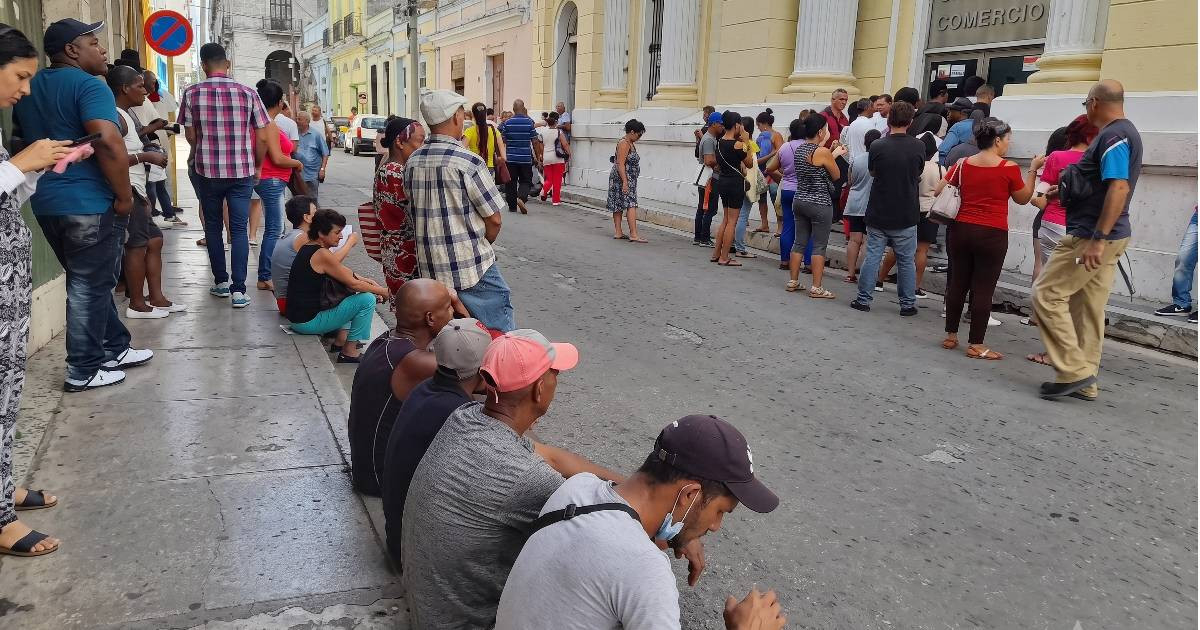
As each month begins, countless residents of Matanzas, Cuba, find themselves desperately moving from store to store with their phones in hand and cards in their pockets, begging for someone to accept a transfer so they can buy food. This stark reality was highlighted on Thursday by the official newspaper Girón, in a report criticizing the failed banking system reforms.
“Do you accept transfers, miss?” she whispers, resigned to the pitying look and the inevitable refusal. With her phone clutched tightly and her card buried in her bag, she walks away, feeling the bitter sting of having to plead after working tirelessly just to purchase basic necessities for herself and her children, the report "Banking Amidst Pleas" describes.
What the regime hailed in August 2023 as a financial modernization—the mandate to accept electronic payments through platforms like Transfermóvil and Enzona—has instead trapped citizens in a dead-end.
Three years later, a mere 3.77% of transactions in Cuba are digital, despite identifying over 26,500 deficiencies, issuing 15,240 fines, and closing 269 businesses.
The Structural Collapse of Cuba’s Banking System
The failure is profound. Private enterprises can't accept transfers because their suppliers demand cash for restocking or purchasing dollars in the black market. Meanwhile, banks lack the liquidity to dispense cash to businesses and workers alike.
In Matanzas, a few stores might accept up to 1,000 or 2,000 pesos via transfer; others impose a surcharge of 10% to 30% on digital payments; and only a small number agree to full transfers, the article noted.
Ian Pedro Carbonell Karel, Director of Macroeconomic Policies at the Central Bank of Cuba, acknowledged in May that "if electronic payment isn’t easier or faster than paying with cash, it’s not going to catch on."
Impact on Vulnerable Populations
The crisis is especially harsh on the most vulnerable. Retired journalist Arturo Chang, aged 74, experienced rejection in early July at a private business in Santa Clara when he attempted to pay for 10 loaves of bread with 100 five-peso bills—money provided by the state bank as his pension.
"Undoubtedly, it’s a chain where the weakest link always breaks: the customers, particularly the elderly," Chang wrote in the newspaper Trabajadores. His maximum pension is 3,653 Cuban pesos per month, less than $10 USD.
A woman from Granma province reported that the bank only allows her to withdraw 500 pesos in cash once a week, an amount insufficient even for basic medication.
The government admitted in June it lacked 400 million pesos to pay the pensions of over 111,000 retirees.
Financial Crisis and International Sanctions
Cash withdrawal “at a percentage,” with fees between 35% and 50%, has become normalized as the sole liquidity option.
In Santiago de Cuba, police detained individuals running this scheme in May. Meanwhile, more than half of Havana’s ATMs were non-functional, and Banco Metropolitano reduced withdrawal limits from 5,000 to 3,000 pesos per transaction, below the legal maximum.
The situation worsened in June when Fincimex suspended operations with Visa and Mastercard due to U.S. sanctions against GAESA, the Cuban military-business elite’s conglomerate, cutting the island off from major international payment networks.
On June 19, the regime approved 176 measures, including, for the first time since 1959, the authorization of private banks and lifting withdrawal limits. However, these reforms came too late as the system was already collapsing. The official newspaper Venceremos of Guantánamo acknowledged on July 3 that the crisis "has evolved from a banking issue to a social problem."
While emergency measures are announced with no clear implementation date, Cubans continue to organize through WhatsApp channels to find out which establishments might accept at least some form of transfer that day.
Understanding the Banking Crisis in Cuba
Why is the electronic payment system in Cuba failing?
The electronic payment system is failing because private businesses cannot accept transfers as their suppliers require cash, and banks lack the liquidity to provide cash to both businesses and workers.
How have international sanctions affected Cuba's banking system?
International sanctions, specifically those from the U.S. against GAESA, have led to the suspension of Visa and Mastercard operations, isolating Cuba from major international payment networks and worsening the banking crisis.
What measures has the Cuban government taken to address the crisis?
The Cuban government approved a package of 176 measures, including allowing private banking for the first time since 1959 and removing limits on cash withdrawals, though these reforms have yet to take effect.