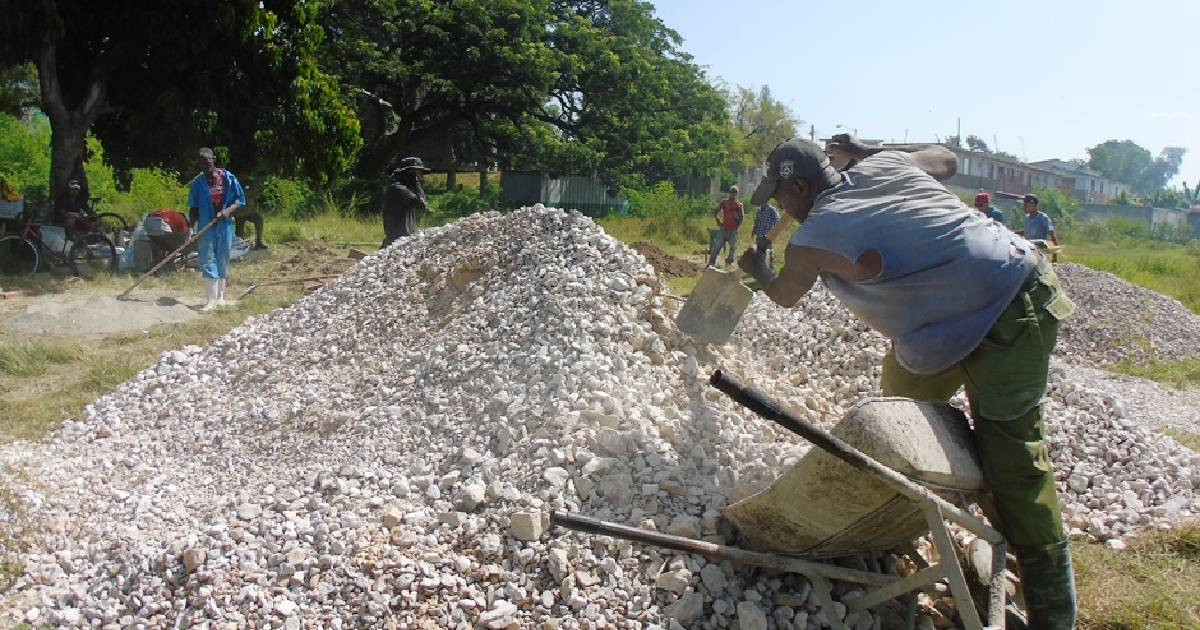
This week, the Cuban government, with the backing of the United Nations Development Program (UNDP), is hosting a hands-on workshop in Guantánamo Province. This workshop focuses on traditional building techniques, featuring the construction of adobe homes—a method using sun-dried bricks made from clayey soil and straw—as a substitute for the scarce resources of cement and rebar.
Taking place at the Mariano Cabin area until July 17, the workshop is creating a demonstration site with three different types of structures: a brick vault house, an adobe house, and a maritime container home, according to the official newspaper Venceremos.
The initiative is spearheaded by Mexican architect Ramón Aguirre Morales from the Ibero-American Network of Architecture and Construction with Earth (ProTerra). He leads a team of eight experts from Mexico, Chile, El Salvador, and Colombia.
Aguirre emphasized "the significance of practical training that, through the 'learning by doing' approach, enables the use of these techniques to build homes without relying heavily on steel and cement."
Cuban participants include the provincial construction company Epcons, the construction materials firm Epmalco, and the Food Construction Brigade.
Alternative Building Solutions Amidst Industry Collapse
The Guantánamo experiment is not an isolated case but the latest in a series of similar initiatives the government has launched in response to the collapse of its construction industry.
Back in July 2025, Mexican specialists taught earth construction techniques in Pinar del Río, also supported by the UNDP. That same month, the Villa Clara government announced two experimental homes without cement or steel in Santa Clara and Remedios.
Following Hurricane Melissa, which damaged 137,000 homes in Santiago de Cuba, authorities also assessed cement-free house prototypes for those affected in the Segundo Frente municipality.
A Housing Crisis of Historic Proportions
These experiments are underscored by a housing crisis of epic proportions. The official deficit exceeds 929,000 homes, with 35% of the housing stock—equating to around 4.1 million units—classified as in fair or poor condition.
Cement production is severely hampered, operating at just 10% of its capacity due to energy deficits and outdated industrial facilities. The state construction plan for 2025 fell short by 78%, with only 2,382 homes completed out of the 10,795 planned.
Economist Pedro Monreal highlighted that in 2024, the number of homes built was 5.5 times less than in 1984 and 15 times fewer than in 2006, based on official data analysis.
Exploring Container Homes
The regime has also turned to maritime container homes, though with limited success. Despite plans to convert over 3,500 units, only 133 had been delivered across the country by April 2026.
Abel Tablada, an architect from the Technological University of Havana, cautioned that these solutions should be seen as temporary and emergency measures, rather than a long-term housing program. Tablada also warned that containers could become unbearably hot in tropical climates, a concern particularly relevant in Guantánamo, one of Cuba's hottest provinces.
Understanding Cuba's Housing Challenges
Why is Cuba turning to adobe homes?
Cuba is exploring adobe homes due to severe shortages of cement and steel. These traditional techniques offer a viable alternative to construct homes without these materials.
Who is leading the adobe home initiative in Guantánamo?
The adobe home initiative in Guantánamo is led by Mexican architect Ramón Aguirre Morales, under the Ibero-American Network of Architecture and Construction with Earth (ProTerra).
What are the challenges with using shipping containers as homes in Cuba?
Shipping containers can become very hot in tropical conditions, making them uncomfortable for living. They are also considered a temporary solution rather than a permanent housing strategy.