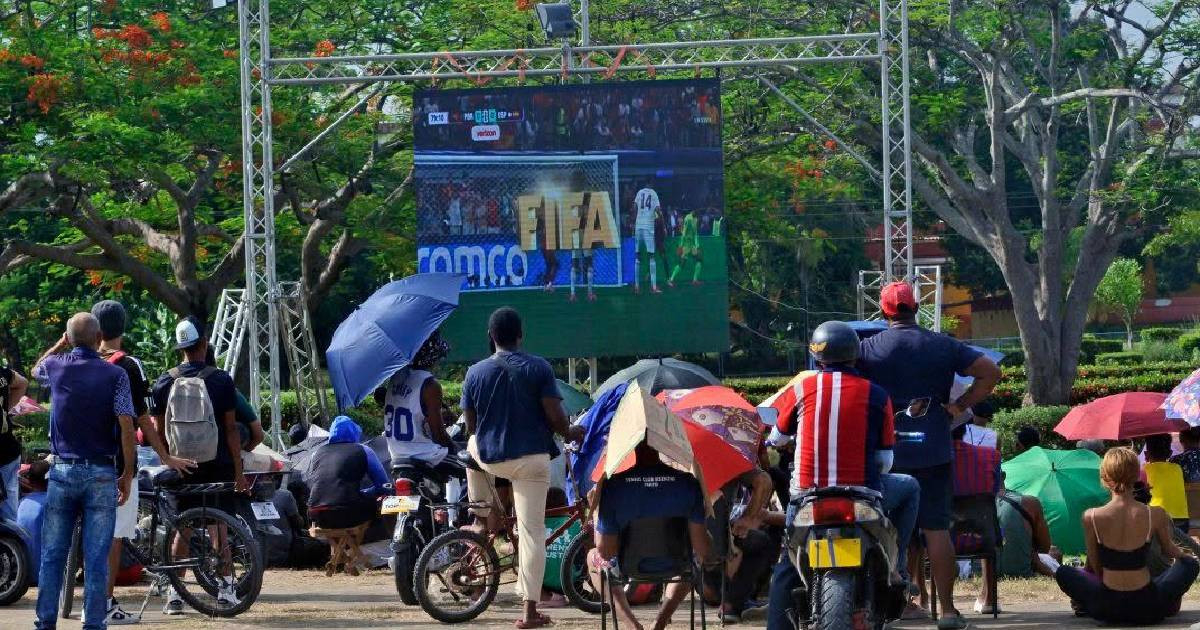
Facing an ongoing inability to provide consistent electricity in homes, Guantánamo's authorities have set up over 60 audiovisual centers in public squares and spaces as part of the summer program "Summer with My People." This initiative serves as a makeshift solution to the energy crisis that leaves Cubans without power for most of the day.
"These centers emerge as an alternative to the country's current energy challenges—attributed to the fuel blockade enforced by the United States government—to give people access to television and other audiovisual content," stated Richard Cruz Alcedo, the local Sports Director, according to the official newspaper Venceremos.
The locations include state-run spaces like the Mariana Grajales Revolution Square and the Rafael Castiello Sports Hall, as well as non-state venues such as La Majagua and the Huambo Cinema.
The most frequented site is the Revolution Square, operating thanks to the collaboration between the Marcapaso microenterprise, the Electric Company, Etecsa, the Sports Directorate, and the Provincial Government.
The programming lineup features the Soccer World Cup, upcoming Central American and Caribbean Games, the main news broadcast, Cuban films, and animated features.
The Origins of Collective TV Viewing
This initiative is neither novel nor spontaneous. Back in October 2025, Vice Prime Minister Inés María Chapman suggested setting up televisions powered by generators on the streets so that residents could view government briefings during blackouts.
In December of that year, as neighborhoods in Havana protested against power cuts lasting over 10 hours, the government screened movies on giant screens in Vedado during the New Latin American Cinema Festival.
Guantánamo's Struggle with Power Supply
Guantánamo has been among the hardest-hit provinces by the energy breakdown. In April, locals staged pot-banging protests, voicing frustrations over receiving electricity for only 45 minutes to an hour daily.
In June, a malfunction in the 110 kV line connecting the province with Santiago de Cuba left residents without power for up to 33 hours, with eight transformers damaged and no spare parts available.
National Energy Crisis Deepens
The national context is one of historical collapse. On Friday, Cuba experienced its fourth total blackout of the year when the National Electric System disconnected at 4:30 PM.
This past Sunday, the Electric Union announced that the system was reconnected across Cuba by 6:30 AM, albeit without a guarantee of stable supply for households.
While the regime turns public squares into communal TV rooms, the government's response to the crisis remains largely rhetorical. Leader Miguel Díaz-Canel called for better "organization" of the blackouts, and Energy and Mines Minister Vicente De la O Levy stated after the most recent system collapse that "nobody gives up here," yet failed to introduce any structural measures to boost power generation.
Power Outages and Public Solutions in Cuba
What measures has the Cuban government taken to address the energy crisis?
The government has set up audiovisual centers in public spaces to provide access to television and entertainment, although it has not introduced structural measures to increase electricity generation.
How are Guantánamo residents coping with power outages?
Residents rely on newly established audiovisual centers in public squares to access television and other content, as they face electricity shortages at home.
Which public spaces have been transformed into viewing centers?
Locations include the Mariana Grajales Revolution Square, Rafael Castiello Sports Hall, La Majagua, and the Huambo Cinema, among others.