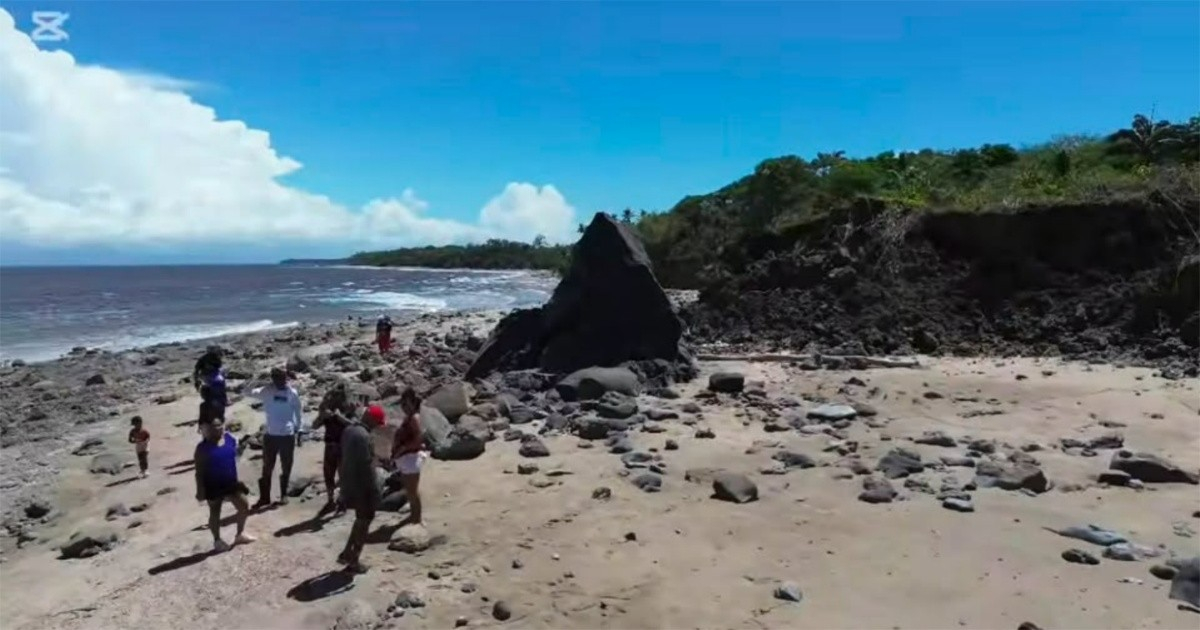
An unexpected mud volcano has surfaced off the southern coast of Trinidad and Tobago, attributed to the powerful earthquakes that struck northern Venezuela on June 24, 2026. Geoscientist Xavier Moonan confirmed this development to EFE in an exclusive interview on Sunday.
This geological event is situated roughly 2.5 kilometers east of Beach Camp in Palo Seco and about 3.3 kilometers east of the Anglais Point Mud Volcano, a region known for its history of underwater volcanic activity.
The structure rises approximately four meters above the seabed and is primarily composed of soft clay expelled from beneath the ocean floor, embedded with rock fragments and large calcite-rich boulders resembling coral in some areas.
Moonan emphasized the cause of this occurrence, stating, "It is highly likely that this mud extrusion was triggered by the recent earthquakes in Venezuela."
Threat of Erosion Looms Over New Island
However, the newly formed island faces an immediate threat: rapid erosion from the sea waves. "Initial images suggest that about one-third of the island has already been washed away by the waves," cautioned the geoscientist.
Neil Sookram, of the Southwest Adventures group, reportedly the first to spot the formation, noted that erosion has been persistent over the past two days. He mentioned that the top remains intact and the clay is starting to harden.
Scientific Analysis Underway
The University of the West Indies Seismic Research Center, the Institute of Marine Affairs, and consultancy ResiLog Limited are examining samples of the mud collected on-site to determine the material's age and origin.
Moonan clarified that this mud volcano represents a different geological process than the one recorded at Galfa Point. There, the same earthquakes caused a six-meter coastal uplift, pushing part of the seabed above the water. "The nearby beach and cliffs show no signs of damage, uplift, or any movement. Thus, this event, although triggered by the same earthquakes, is not a landslide phenomenon like at Galfa or Los Iros," he explained.
Widespread Impact of Venezuelan Earthquakes
In Los Iros, approximately 50 acres of farmland were damaged, ponds drained due to ground cracks, and roads and coastal infrastructure suffered significant harm.
The June 24 earthquakes—deemed the most severe in Venezuela in over 125 years, with magnitudes of 7.2 and 7.5 occurring just 39 seconds apart—have resulted in a massive humanitarian disaster. The Chavista regime reported on Sunday that the official death toll has risen to 4,333, with 16,740 injured and 6,462 people rescued alive.
NASA estimates that nearly 58,870 buildings were damaged or destroyed, while the United Nations Development Program calculates direct damages at $6.7 billion, equivalent to 6% of Venezuela's GDP, with a potential total impact of up to $20.1 billion.
Venezuela anticipates needing 25,000 homes to accommodate those affected and plans to deliver the first 200 houses in the coming days, according to Jorge Rodríguez, president of the National Assembly.
Understanding the Mud Volcano Phenomenon
What caused the mud volcano to appear near Trinidad?
The mud volcano is believed to have been triggered by the recent powerful earthquakes in northern Venezuela.
How is the new mud volcano affecting the surrounding area?
The newly formed island is facing rapid erosion due to sea waves, with significant portions already washed away.
What is being done to study the mud volcano?
Research is being conducted by the University of the West Indies Seismic Research Center, the Institute of Marine Affairs, and ResiLog Limited to analyze the material and understand its origins.