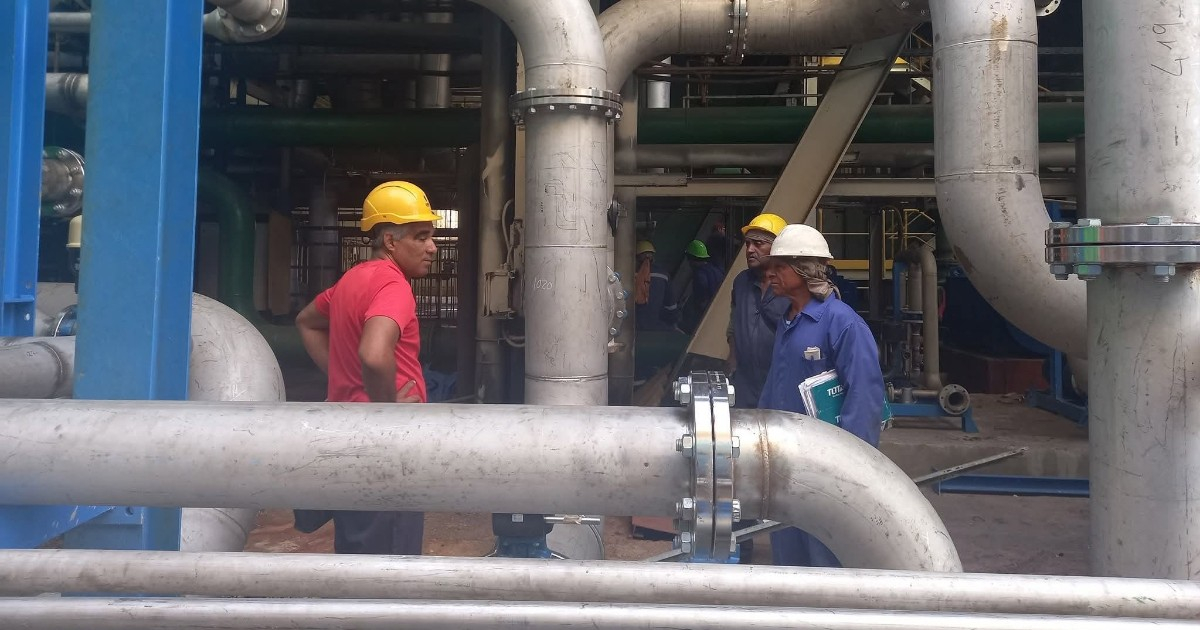
On Sunday morning, the Cuban Electric Union (UNE) announced that by 6:30 a.m., the National Electric System (SEN) had been fully reconnected across Cuba. This comes two days after the fourth nationwide blackout of the year.
According to an official post on Facebook, the Carlos Manuel de Céspedes thermoelectric plant's units 3 and 4 in Cienfuegos, and unit 1 of the Lidio Ramón Pérez (Felton) plant in Holguín were operational at the time of the announcement.
The reconnection process had progressed in phases throughout the night.
At 12:13 a.m., the Antonio Guiteras plant in Matanzas was synchronized with the national grid. Earlier, unit 1 of the Felton plant and unit 6 of the Diez de Octubre plant in Nuevitas (Camagüey) were integrated, connecting the system from Pinar del Río to Holguín, as reported by the UNE.
Nonetheless, this interconnection does not ensure a stable power supply nor does it address the underlying crisis.
The collapse occurred on Friday, July 10, at 3:55 p.m., when a failure in the 220 kV transmission line between Santa Clara and Sancti Spíritus triggered a cascading disconnection, leaving nearly 10 million people without power in just 35 minutes.
At that point, the system was operating under extremely precarious conditions: only 935 MW were available to meet a demand of 3,100 MW, with 11 thermoelectric units offline and 106 distributed generation plants paralyzed due to fuel shortages.
The recovery process was particularly grueling. A new voltage collapse in the western microsystem occurred in the early hours of Saturday, July 11, necessitating a complete restart of the protocol.
Félix Estrada Rodríguez, director of the National Load Dispatch, acknowledged the recovery was progressing "with the fuel limitations we have" and emphasized the need to create provincial "islands" to ensure power for hospitals and water pumping stations.
This marks the eighth total blackout of the SEN in roughly 24 months and the fourth in 2026, occurring just four days after the third collapse on July 6.
Structural Challenges and Public Outcry
The structural context is dire. On July 8, Cuba experienced its largest energy deficit in history: 2,341 MW, affecting 73% of the population simultaneously.
Thermoelectric plants, aged between 40 and 60 years, have not undergone comprehensive maintenance, and Cuba has not received regular oil shipments for over three months.
Experts estimate that modernizing the electrical infrastructure would require between $8 billion and $10 billion, a sum unattainable for the Cuban regime.
The government's response has been largely rhetorical. The Minister of Energy and Mines declared "nobody surrenders here" without announcing any structural measures, while Díaz-Canel blamed the "genocidal oil blockade" and called for better organization of blackouts.
Public outrage was palpable. On Saturday, July 11, in Guanabacoa, a loud protest erupted with chants of "Freedom!" and "Down with the dictatorship!" after more than 33 consecutive hours without electricity, on the eve of the fifth anniversary of the July 11, 2021 protests.
In June 2026, Cuba witnessed a record 107 street protests, nearly double the previous peak.
On social media, Cubans questioned the system's fragility: "And in those 35 minutes, isn't there a contingency plan in the SEN that prevents such a failure in the 220 kV line between the two cities from escalating beyond the local level?" wrote one user.
Another expressed the collective exhaustion: "We can't live like this forever; there are children, young people, and the elderly here. Something has to change to improve this because, honestly, we're at extreme levels where life is unbearable."
Understanding Cuba's Power Crisis
What caused the recent nationwide blackout in Cuba?
The blackout was triggered by a failure in the 220 kV transmission line between Santa Clara and Sancti Spíritus, leading to a cascading disconnection that left nearly 10 million people without power.
How severe was Cuba's energy deficit in July 2026?
Cuba's energy deficit reached a historic high of 2,341 MW, affecting 73% of the population simultaneously.
What are the main challenges facing Cuba's electrical infrastructure?
Cuba's electrical infrastructure faces challenges such as outdated thermoelectric plants lacking comprehensive maintenance, and a shortage of regular oil shipments, which compound the energy crisis.