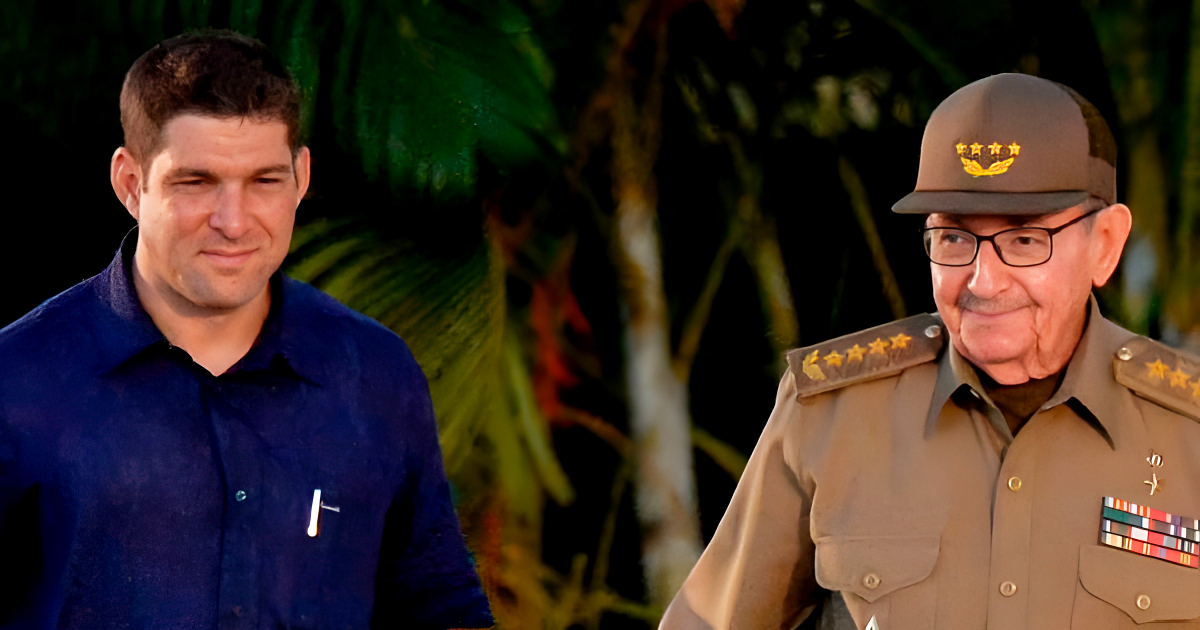
Raúl Guillermo Rodríguez Castro, known as 'El Cangrejo,' didn't outright admit the existence of political prisoners in Cuba.
The grandson of Raúl Castro opted for a more cautious yet revealing approach. He mentioned that the regime might consider freeing individuals "seen as political prisoners" if "appropriate conditions" were met.
This careful wording attempts to maintain a minimal distance from reality. The prisoners are political only to those who "consider" them so, not to the totalitarian state that imprisoned them.
However, the latter part of his statement undermines this caution: if the government can release them as part of a political negotiation, it becomes challenging to argue that their imprisonment lacks a political nature.
The Shift in Official Rhetoric
'El Cangrejo's' comments don't signal a democratic shift or an admission of past wrongs. Instead, they represent a crack in one of the Cuban regime's most persistent denials.
Just three months prior, Miguel Díaz-Canel had told U.S. television that Cuba had no political prisoners. The regime's usual narrative labeled them as individuals jailed for vandalism, violence, or common crimes.
Now, a colonel from the Interior Ministry, known for caring for his nonagenarian grandfather and lacking any official position, is willing to discuss terms for freeing those who "officially" don't exist.
Manipulating the Narrative
The manipulation of the political prisoner category is as old as the regime itself. Fidel Castro built much of his rhetoric on deliberate substitutions: imprisoned opponents weren't political prisoners but “counter-revolutionaries,” “mercenaries,” enemy agents, or individuals punished for crimes against state security.
By changing their labels, the regime aimed to erase the political motivations behind their sentences.
A Persistent Contradiction
Despite this, Fidel Castro wasn't consistent with his denial. In November 1978, during a process of releasing prisoners and dialogue with Jimmy Carter's administration, he acknowledged that the 3,600 prisoners being freed accounted for about 80% of the then-existing political prisoners in Cuba. Most, he added, were classified by the regime as “counter-revolutionaries.”
This contradiction reveals that the Castro regime has never had trouble identifying its political prisoners. Its issue has always been admitting publicly that it imprisons people for political reasons.
When the label implies accountability, it disappears. When prisoners can be released to gain diplomatic advantages, improve international image, or facilitate negotiations, the label reemerges.
Games with Lists and Realities
Human rights organizations like Human Rights Watch (HRW) have long denounced that Cuban authorities play word games to claim the country has no political prisoners, even though its laws punish open opposition and its prisons house dissidents convicted for exercising fundamental rights.
Raúl Castro took this charade to a memorable moment during Barack Obama's visit to Havana in March 2016. When asked by journalist Jim Acosta why Cuba didn't release its political prisoners, Raúl defiantly replied, "Give me the list of political prisoners now, and I'll release them immediately."
He insisted that if given names, those imprisoned would be freed before nightfall. The bravado aimed to create the impression that there was no one to release, putting the onus on the journalist to prove what the state knew perfectly well: the identities of those it had detained, tried, convicted, and imprisoned.
An Evolving Dialogue
A decade later, his grandson alters the family rhetoric. No longer mocking the absence of such prisoners, he talks about the conditions for their release.
This shift doesn't reveal anything unknown. Generations of Cubans have denounced the existence of political prisoners. Families at prison gates, opponents, independent journalists, human rights organizations, former prisoners, artists, religious figures, and ordinary citizens have all demanded reviews of trials, annulments of sentences, or amnesties.
The case of Madelyn Sardiñas Padrón, detained in Camagüey in 2023 for writing on Facebook about political prisoners in Cuba, encapsulates a central paradox: the same truth driving a citizen's protest at a police station now allows a Castro to pose as an international negotiator.
For powerless Cubans, naming political prisoners has meant surveillance, interrogations, job loss, acts of repudiation, imprisonment, or exile. For a member of the ruling family, indirectly acknowledging them can be seen as a pragmatic move.
In Cuba, truth depends not just on facts but also on the surname of the one who speaks it.
What Are "Appropriate Conditions"?
The gravest part of 'El Cangrejo’s' words isn't in "people seen as political prisoners" but in "appropriate conditions."
Appropriate for whom? For the prisoners and their families? For voiding arbitrary sentences? For ending surveillance, harassment, and threats of re-imprisonment? For allowing exiles to return?
Or appropriate for the regime to gain fuel, relief from sanctions, investments, international recognition, or survival guarantees?
'El Cangrejo' didn't speak of reviewing judicial processes, investigating torture, compensating victims, or restoring rights. He spoke of freeing people if certain conditions were met.
He didn't acknowledge that freedom is their right. He implied that the regime might grant it back in exchange for something.
This formulation turns prisoners into bargaining chips. They cease to be officially nonexistent and become potential pieces in a transaction.
The Cracking of a Long-held Narrative
'El Cangrejo's' statement must be seen within the broader crisis of the official narrative.
For decades, the regime managed to maintain that there was no hunger, unemployment, racism, political emigration, or prisoners of conscience in Cuba. The propaganda didn't need to be true; it only needed to ensure that no voice could contradict it publicly without paying a price.
That monopoly has weakened. Economic crises, power outages, mass emigration, access to social media, and growing public distrust have widened the gap between reality and the narrative. The regime continues to repress, but it no longer effectively controls the meaning of events.
Out of this decomposition emerge odd developments. The regime-appointed leader denies political prisoners in April, and his favored grandson talks in July about conditions for their release.
The narrative doesn't open up because the regime has embraced truth but because its different needs are creating contradictions that can no longer be hidden.
'El Cangrejo' needs to appear flexible to Washington without questioning the artifact he intends to inherit, known as the "revolution." To do so, he partially acknowledges a reality the regime still denies. His statement isn't a break from the system but an effort to preserve it through a less rigid and more negotiable language.
But once spoken, the admission cannot be entirely retracted.
Fidel branded prisoners as counter-revolutionaries when he needed to criminalize them and political prisoners when he needed to release them. Raúl demanded a list to pretend they didn't exist. 'El Cangrejo' no longer dares to repeat that denial with the same confidence: he offers their release when "appropriate conditions" arise.
The taboo is broken, albeit obliquely.
And behind the careful wording lies the truth that countless Cubans have paid for with surveillance, imprisonment, and exile: there are political prisoners in Cuba.
They don't need appropriate conditions to be freed. They need the injustice that put them behind bars to end.
Understanding Cuba's Political Prisoner Situation
What did 'El Cangrejo' imply about political prisoners in Cuba?
'El Cangrejo' suggested that the Cuban regime might consider releasing individuals perceived as political prisoners if "appropriate conditions" were met, indicating a potential willingness to negotiate politically motivated imprisonments.
How has the Cuban regime historically classified political prisoners?
Under Fidel Castro, the regime often labeled political prisoners as "counter-revolutionaries," "mercenaries," or "enemy agents," to erase the political motivations behind their imprisonment. This manipulation has persisted to maintain the narrative that Cuba has no political prisoners.
What are the implications of 'El Cangrejo's' statement for the Cuban regime?
'El Cangrejo's' statement indicates a crack in the regime's longstanding denial of political prisoners. By discussing conditions for their release, it acknowledges a reality that the regime has historically tried to suppress, potentially signaling a shift in political strategy.