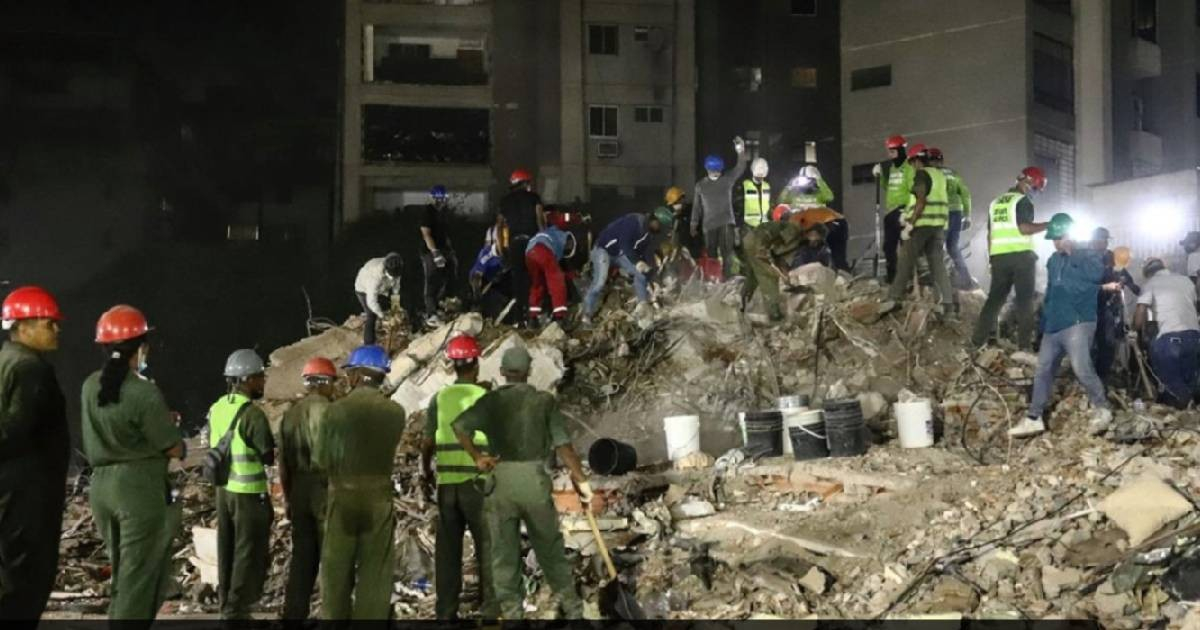
This past Saturday, the Chavista government updated the official death toll from the catastrophic June 24th earthquakes to 4,333. Jorge Rodríguez, the president of the Venezuelan National Assembly, shared the grim update via social media.
The report marks a dramatic increase from the initial 32 deaths reported on June 25th, and it also details 16,740 injuries, 6,462 individuals rescued alive, and assistance provided to 86,794 families following what is now considered Venezuela's most devastating seismic event in over a century.
The twin earthquakes, which registered magnitudes of 7.2 and 7.5 and struck within 39 seconds of each other, had their epicenter between the Carabobo and Yaracuy states. The tremors wreaked havoc on densely populated areas, including Caracas, La Guaira, Valencia, Puerto Cabello, and Miranda.
Official records indicate that 190 buildings collapsed and 856 others were damaged. Additionally, 17,907 people are currently homeless, and 18,437 are housed in 94 temporary shelters set up by the government.
Emergency Response Efforts
Rodríguez emphasized the human resources mobilized to manage the crisis: "At this moment, over 31,837 personnel and 30,197 volunteers are actively engaged across the nation to ensure the well-being of affected residents. We have provided medical care to 31,193 patients and distributed over 9,766 tons of food."
The regime also reported distributing more than 16.6 million liters of water and noted the involvement of 2,422 international rescuers from multiple countries. Since the initial quake, 1,202 aftershocks have been recorded.
However, these official figures stand in stark contrast to international estimates, which suggest a far greater scale of tragedy. The United States Geological Survey issued a Red Alert, indicating a 42% chance that the final death toll could range between 10,000 and 100,000.
Controversy Over Missing Persons
One of the most contentious issues has been the government's lack of any official statistics on those missing. While Venezuelan authorities have remained silent, the United Nations estimates up to 50,000 people are unaccounted for, and the citizen platform "Encuéntralos" reported over 71,000 missing as of June 29th.
The death toll has steadily risen since the initial reports: from 920 on the night of June 25th to 1,430 by June 27th, then 2,645 by July 3rd, 3,342 on July 5th and 6th, and 3,811 by July 9th, culminating in the current count.
Among the international victims are at least 34 deceased Spanish nationals and 140 missing, along with at least eight Cubans confirmed dead and between 20 to 32 missing, predominantly in La Guaira.
The United Nations Development Programme estimates the economic damage at $6.7 billion, equivalent to 6% of Venezuela's GDP, a staggering blow to a nation already mired in a severe economic and institutional crisis under Maduro's rule.
Understanding the Venezuelan Earthquake Impact
How powerful were the earthquakes that hit Venezuela?
The earthquakes that struck Venezuela on June 24th registered magnitudes of 7.2 and 7.5.
What areas were most affected by the Venezuelan earthquakes?
The earthquakes primarily impacted densely populated regions such as Caracas, La Guaira, Valencia, Puerto Cabello, and Miranda.
What is the estimated economic impact of the earthquakes?
The United Nations Development Programme estimates the economic damages at $6.7 billion, representing 6% of Venezuela's GDP.
How many international rescuers have assisted in the earthquake response?
A total of 2,422 international rescuers from various countries have contributed to the earthquake response efforts in Venezuela.