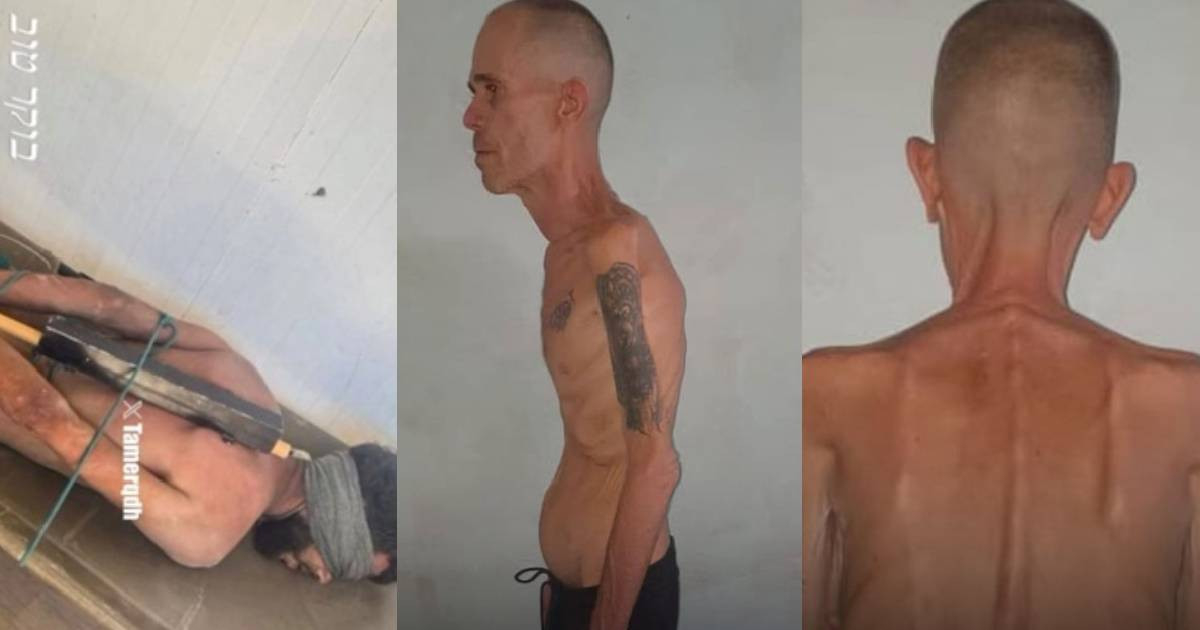
The state-run media outlet Cubadebate recently published an article condemning the torture of Palestinian prisoners in Israeli jails, while the regime it represents has a notorious record of 1,306 political prisoners and numerous allegations of torture in its own facilities.
This reaction was triggered by a viral photograph showing a Palestinian man bound to a board with his eyes blindfolded. Israel acknowledged the image's authenticity but refused to disclose the man's identity or the location of his detention, according to a report by Al Jazeera.
Two mothers claim to recognize their sons in the image: Rana Abu Nasser identified her son Osama, who vanished with her one-year-old grandson near an Israeli army-controlled area, and Joudeh al Ghou stated it is her son Amin: "It's him, his hair and chin. A mother's heart knows her child. I hugged my phone and cried."
The Israeli forces responded that "the publication incident does not conform to the IDF's values and regulations."
Human Rights Violations in Israel and Cuba
The human rights organization B'Tselem accused Israel in August 2024 of systematically mistreating and torturing Palestinian prisoners since October 2023, with actions ranging from arbitrary violence to sexual abuse.
The irony is striking, as the same outlet amplifying these accusations is part of a regime that, according to Prisoners Defenders, holds a record number of verified political prisoners as of June, including 40 minors, 16 of whom are in adult prisons.
Since the protests on July 11, 2021, 2,112 individuals have been detained in Cuba for political reasons.
Dire Conditions in Cuban Prisons
Just this past Saturday, the wife of political prisoner Ulises Reyes Ramís reported extreme conditions at Mar Verde prison in Santiago de Cuba.
"Two months with a rotting arm from bedbug bites and no medical care," said Yanelis Galván Cusa, adding that "the water they're giving him is black as sludge" and that the food consists only of "two bananas with some unidentified water."
At the end of June, the documented situation in Canaleta prison, Ciego de Ávila, was equally dire, with inmates in solitary confinement receiving just one bucket of water every 24 hours for drinking, bathing, washing clothes, and cleaning latrines.
Historical Patterns of Double Standards
This pattern of double standards is not new. In May, Gerardo Hernández Nordelo, a member of Cuba's Communist Party Political Bureau, criticized the deaths of Cubans in U.S. immigration custody while ignoring dozens of deaths in Cuban prisons. The public response was unanimous: "What about the deaths in Cuban prisons?"
The statistics within the island are stark. The Cuban Prisons Documentation Center recorded at least 24 deaths in custody, 45 beatings, 104 cases of denial of medical care, and 11 instances of psycho-emotional torture across 43 prisons in the first half of 2025. Throughout 2024, at least 40 inmates died in Cuban prisons.
The pardon granted by the regime in April, which released 2,010 convicted individuals, explicitly excluded those sentenced for "crimes against authority," the legal figure used to criminalize the 11J protesters who continue serving sentences of up to 25 years.
Frequently Asked Questions about Cuba's Political Prison Situation
How many political prisoners are currently in Cuba?
As of June, there are 1,306 verified political prisoners in Cuba, according to Prisoners Defenders.
What are the conditions like in Cuban prisons?
Cuban prisons are reported to have dire conditions, with issues such as lack of medical care, inadequate food, and limited access to water.
What was the public response to the regime's double standards?
The public response was critical, with many questioning the regime's focus on international issues while ignoring domestic prison abuses.