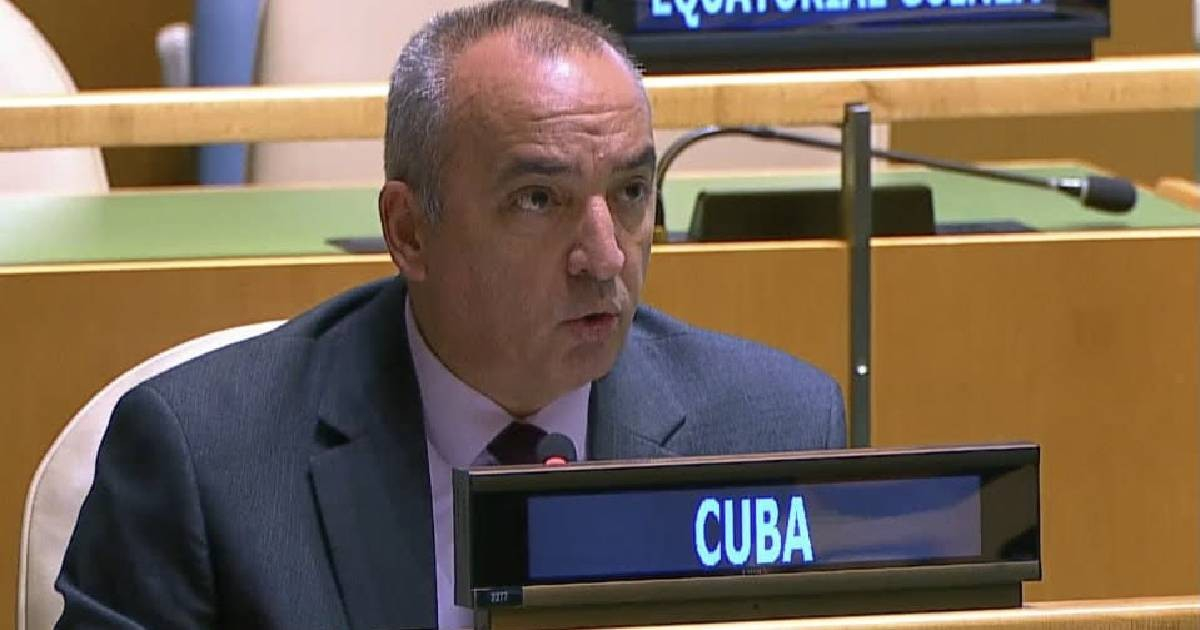
Ernesto Soberón Guzmán, the Cuban ambassador to the United Nations, denounced the Israeli representative as "brazen" during the final day of the General Assembly debate concerning the U.S. embargo on Cuba, which took place on Friday.
The Diplomatic Dispute
In a confrontation typical of Cuba's foreign policy when facing criticism, Soberón exercised the right to reply against the Israeli delegation after it criticized Havana in the discussion titled "The Need to End the Economic, Commercial, and Financial Blockade Imposed by the United States against Cuba."
Cuba's Accusations Against Israel
The Cuban diplomat didn't hold back, stating, "It's quite shameless for the Israeli representative, whose government faces unprecedented international condemnation for genocide and severe violations of International Law and Humanitarian Law against the Palestinian people, to assume the role of critic against Cuba."
Soberón urged Israel to address its own actions before pointing fingers, saying, "Instead of attempting to lecture others, the genocidal state of Israel should first account for the devastation, suffering, and death its actions have caused in Palestine and other Arab territories."
Washington's Influence
The ambassador further accused the Israeli delegation of being a mouthpiece for Washington: "While the world witnesses with horror the systematic destruction of cities, hospitals, schools, and refugee camps, the Israeli delegation parrots, devoid of morality, a script crafted in Washington to justify the economic strangulation against my country."
In a bold statement, Soberón highlighted the connection between Israel and the United States: "Their cynicism, much like that of their master, seems limitless." This speech was notably covered by Cuba's state media.
Global Reactions and Political Dynamics
Soberón mentioned that two other delegations also delivered speeches with "guidelines crafted in Washington," though he refrained from naming them "out of basic decorum."
The urgent debate was approved on July 7 with 136 votes in favor, nine against, and 30 abstentions, using a special mechanism that Cuba employed for the first time, different from the annual October vote.
Israel was among the nine countries opposing the debate's initiation, alongside the United States, Argentina, Costa Rica, Morocco, the Czech Republic, North Macedonia, Paraguay, and Ukraine.
The 30 abstentions in this session indicate a significant decline in international support for Cuba compared to previous years: in the annual October vote of 2025, the regime secured 165 votes in favor and only 12 abstentions, which was already the lowest support in more than three decades.
U.S. Response and Closing Remarks
During the same debate, U.S. ambassador Mike Waltz countered the Cuban regime with a straightforward remark: "The real blockade is the one the Cuban regime imposes on its own people."
Earlier in July, Secretary of State Marco Rubio had signed a diplomatic cable urging allied governments not to support the debate's initiation, as the U.S. informed the Cuban regime directly.
Soberón concluded his speech with a stern warning: "We will never accept that those who try to justify the massacre against the Palestinian people simultaneously legitimize a policy of collective punishment against the Cuban people. Our voice will not be silenced by those who seek to replace International Law with force, impunity, and double standards."
Cuba-UN Debate: Key Questions and Insights
What was the main accusation made by the Cuban ambassador against Israel?
The Cuban ambassador accused Israel of being shameless for criticizing Cuba, while facing international condemnation for its actions against the Palestinian people.
How did the U.S. respond to Cuba's remarks during the debate?
The U.S. ambassador, Mike Waltz, responded by stating that the real blockade is the one imposed by the Cuban regime on its own people.