The Cuban Electric Union announced on Saturday afternoon that Energás Jaruco 6 has been synchronized and reconnected to the western microsystem, joining the CTE Antonio Guiteras and Energás Varadero. This marks a step in the slow recovery process of the National Electric System (SEN) after experiencing the fourth nationwide blackout this year.
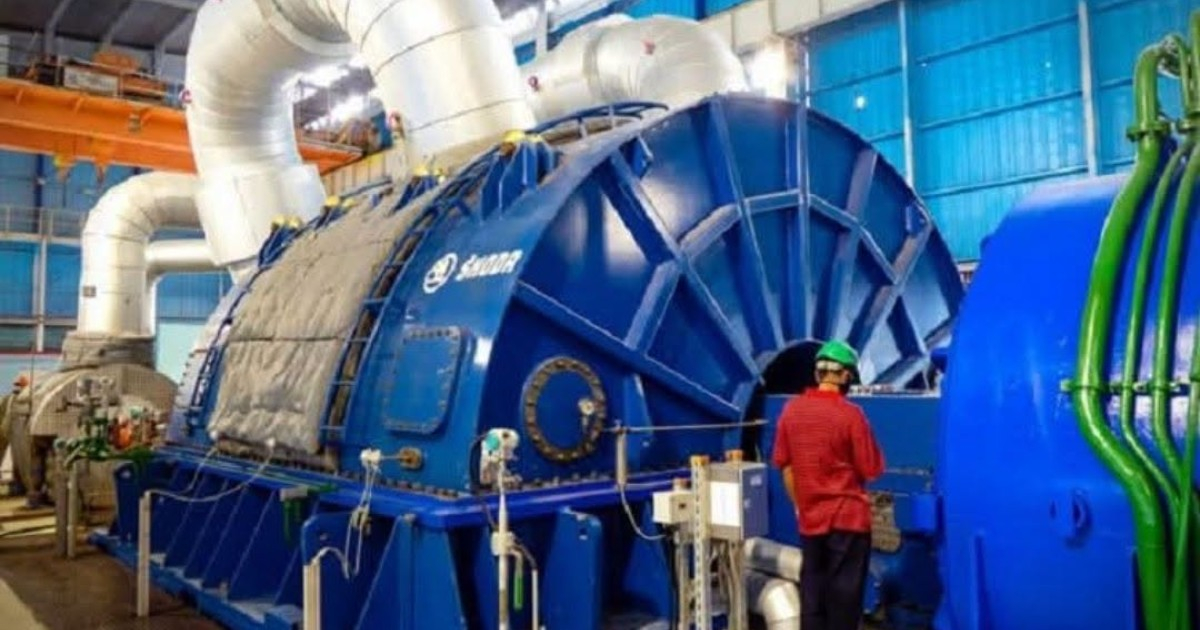
Details of this development were shared on the official OSDE UNE account on X at 7:35 PM, accompanied by the hashtag #CubaNoSeRinde and an image depicting a Chinese-made turbine alongside a worker inside the plant.
The crisis originated on Friday, July 10, at 4:30 PM, when a failure in the 220 kV line between Santa Clara and Sancti Spíritus caused the system to collapse within just 35 minutes, leaving approximately 9.6 million people without power.
Operating under dire conditions, the system had only 935 MW available to meet a demand of 3,100 MW. This was worsened by 11 out of the 16 thermoelectric units in the country being out of service due to breakdowns or maintenance.
Challenges in Power Restoration
Efforts to restore power were further hindered early Saturday morning when another voltage collapse impacted the western microsystem, necessitating a complete restart of the protocol in that area.
Félix Estrada Rodríguez, the head of the National Load Dispatch, oversaw operations from headquarters, providing updates through Canal Caribe. "In the west, we've incorporated all units of Energás Jaruco, the combined cycle is underway, and the 150-megawatt unit is starting up, along with Santa Cruz's Unit 1 and Mariel's Unit 5," Estrada Rodríguez explained.
Power Grid's Fragile State Exposed
In central-eastern areas, CTE Nuevitas Unit 6 synchronized 55 MW to the system, which now spans from Santa Clara to Holguín, with energy reaching CTE Felton to initiate its startup.
The energy storage system in Cotorro, Havana, once again played a critical role in stabilizing the frequency of the western microsystem during the restoration. "This energy storage system in Cotorro is crucial for maintaining stability in the western region," noted the Load Dispatch director.
The recovery process faced significant fuel shortages, compelling authorities to prioritize electricity supply to hospitals, water pumping stations, and food processing centers in areas still disconnected from the national grid. "Despite fuel constraints, we're creating isolated grids in provinces to ensure vital services like hospitals and water pumps remain operational," Estrada Rodríguez acknowledged.
Leadership and Strategic Objectives
Energy and Mines Minister Vicente de la O Levy and Jorge Luis Broche Lorenzo, head of the Communist Party's Economic-Productive Department, stayed at the National Load Dispatch throughout the day. The immediate goal was to reach the CTE Antonio Guiteras and the Units 3 and 4 of CTE Carlos Manuel de Céspedes in Cienfuegos to bolster the country's base generation capacity.
"We will gradually move to the center of the country to start the Guiteras unit and the Céspedes units, which are currently offline," Estrada Rodríguez specified.
This blackout marks the eighth complete collapse of the SEN in roughly 24 months, occurring just four days after the third blackout on July 6. On July 8, Cuba recorded its largest historical energy deficit of 2,341 MW, affecting 73% of the population simultaneously.
Understanding Cuba's Energy Crisis
What caused the recent nationwide blackout in Cuba?
The blackout was triggered by a failure in the 220 kV line between Santa Clara and Sancti Spíritus, which led to the system's collapse within 35 minutes, affecting around 9.6 million people.
How is Cuba addressing the power grid issues?
Cuba is working to synchronize various power units like Energás Jaruco 6 and utilizing energy storage systems in critical areas to stabilize the grid. However, severe fuel shortages continue to hamper recovery efforts.
Who is overseeing the restoration of Cuba's power system?
Félix Estrada Rodríguez, the director of the National Load Dispatch, is leading the restoration efforts, with support from the Minister of Energy and Mines and other government officials.