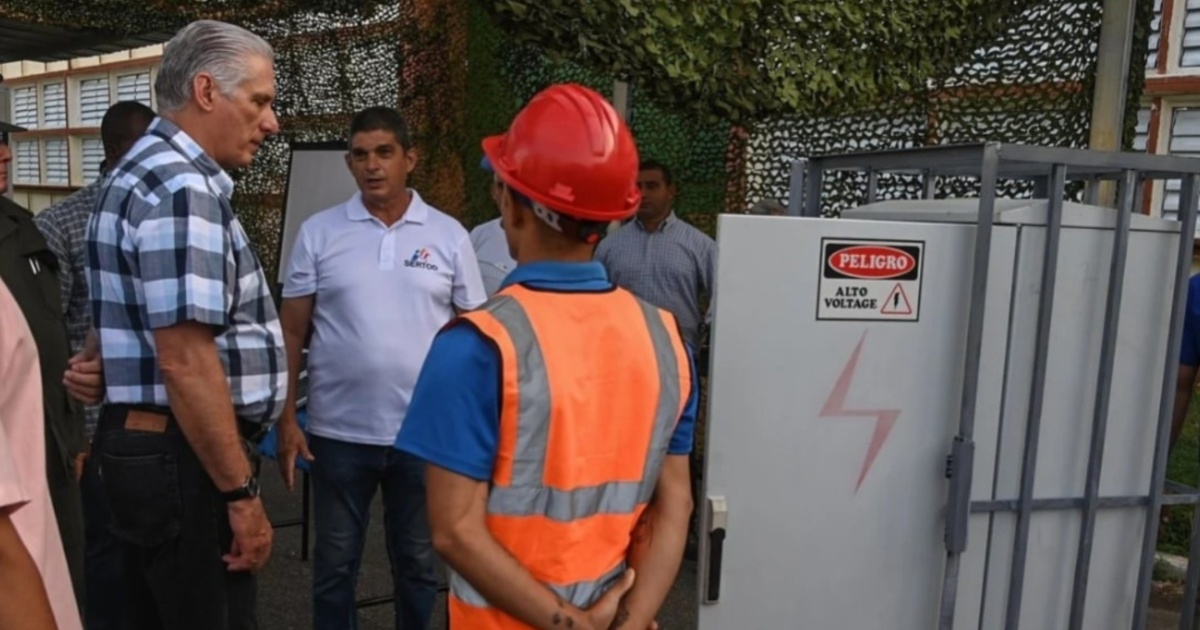
On Saturday, Miguel Díaz-Canel took to Facebook to address the recent collapse of Cuba's National Electric System (SEN), which occurred on Friday. He described the recovery process as "extremely challenging, under the genocidal oil blockade," while hundreds of Cubans flooded the comments section with direct criticisms of the leader.
In his Facebook post, Díaz-Canel stated, "The new SEN failure, occurring just days apart, increases the strain on recovery efforts, but our electrical workers refuse to give up." He also mentioned that some power plants were already starting up, others were syncing, and loads were being increased.
He concluded his message with the hashtag "#CubaIsNotAThreat, the United States is."
The post garnered over 1,000 reactions and 555 comments, most of which were critical. Many questioned why Díaz-Canel had electricity at home while the general population suffered blackouts. One user remarked, "If there's power in your house, everything you say is a lie." Another added, "Pipo, it's easy to endure from your home."
Public Outcry Against Infrastructure Management
Frustration was also directed at the management of infrastructure: "Had there been regular repairs, even with this oil blockade, the power plants wouldn't be in this state... but instead, more hotels were built," a user commented.
Another person encapsulated the sentiment of many: "No one is giving up here, but we do want a government that solves the people's problems and talks less."
Some were more blunt: "Relinquish power and the blockade ends; it's what all of Cuba wants," wrote one user. Another noted, "A new achievement of the revolution: taking Cubans back to the Stone Age. In the third decade of the 21st century, they cook with wood, use animal transport, and have two hours of light for every 48 hours of blackout."
Technical Failures and Widespread Impact
Friday's blackout marked the fourth total collapse of the SEN in 2026 and the eighth in the past 24 months, according to energy crisis monitoring reports. The technical trigger was a failure in the 220 kV transmission line between Santa Clara and Sancti Spíritus, which resulted in a cascading disconnection starting at 3:55 PM, leaving approximately 73% of the country, or around 10 million people, without power.
At the time of the collapse, the energy deficit exceeded 2,100 MW: only 935 MW were available against a demand of 3,100 MW, with 106 distributed generation plants halted due to lack of fuel.
The collapse occurred just four days after the total blackout on July 6, caused by the unexpected shutdown of Unit No. 6 of the Nuevitas power plant in Camagüey. In Matanzas, outages exceeded 87 consecutive hours; in Havana, the average was 15 hours daily without electricity.
Political Blame Game
The Friday blackout also disrupted the synchronization of the Antonio Guiteras Thermal Power Plant in Matanzas, which was undergoing restoration. This plant has not received major maintenance since 2010 and experienced 17 system shutdowns so far in 2026.
Prime Minister Manuel Marrero Cruz blamed the blackouts on the U.S. embargo, labeling the crisis as "genocide," while Foreign Minister Bruno Rodríguez Parrilla dismissed internal causes and reiterated the "energy blockade" narrative.
The blackout coincided with the eve of the fifth anniversary of the July 11, 2021 protests, the largest popular mobilizations in Cuba in decades, which were also partly triggered by blackouts.
June 2026 saw 107 street protests across the island, nearly double the previous high, and on July 9, at least 24 people were detained following a protest in Luyanó, Havana.
Understanding Cuba's Power Crisis
What caused the recent blackout in Cuba?
The blackout was triggered by a failure in the 220 kV transmission line between Santa Clara and Sancti Spíritus, leading to a cascading power disconnection.
How has the Cuban government responded to the blackout?
The Cuban government, led by Díaz-Canel, blamed the situation on a "genocidal oil blockade" and pointed fingers at the U.S. embargo.
How are the Cuban people reacting to the blackouts?
Many Cubans have expressed their frustration and anger on social media, criticizing the government for its handling of the crisis and questioning the prioritization of resources.