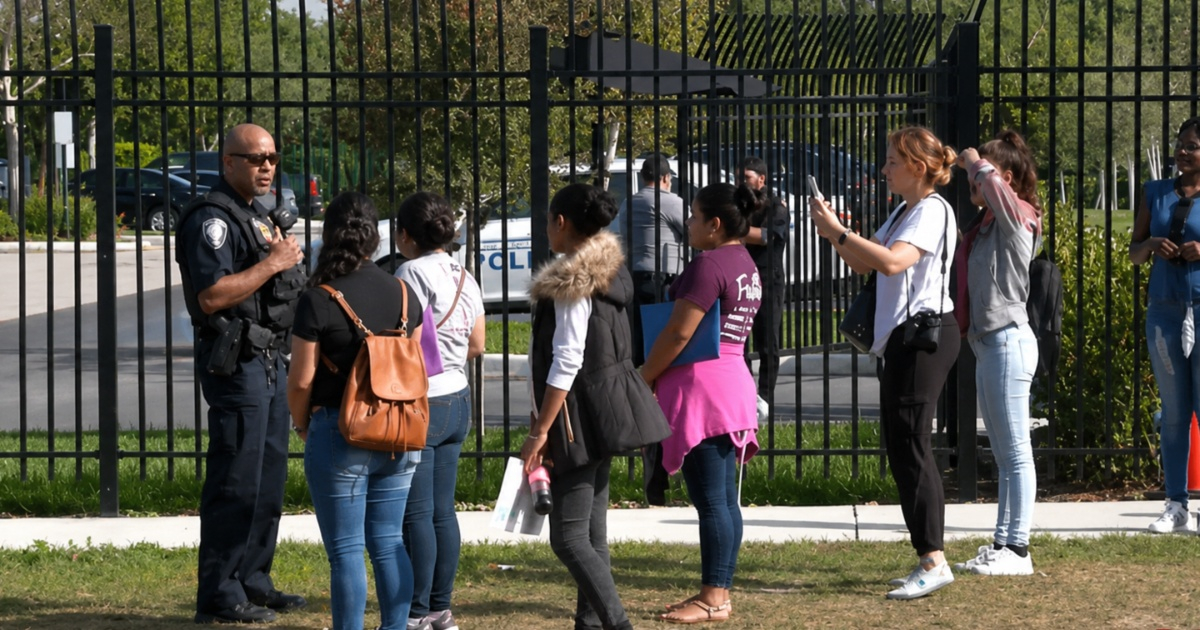
The U.S. Immigration and Customs Enforcement (ICE) claims it has an administrative waiver allowing it to hold detainees for up to 72 hours at its Miramar processing center, situated north of Miami. However, numerous accounts gathered by Telemundo this Saturday reveal that detentions are being prolonged for several days, sometimes up to ten, in conditions that relatives, activists, and lawmakers have condemned as inhumane.
Initially designed for administrative tasks and short-duration immigration appointments, the facility has turned into a temporary holding area due to a capacity crisis in South Florida, as reported by an investigation from El País.
Conditions Inside the Facility Raise Concerns
Democratic Congresswoman Debbie Wasserman Schultz conducted an unannounced visit on July 3rd and discovered over 150 individuals crammed into four rooms, lacking beds, privacy, and access to legal representation or family visits.
“What I witnessed were people packed like sardines, in conditions I wouldn’t wish upon my worst enemy,” Wasserman Schultz stated during a press conference.
Her account described approximately 70 to 75 men confined within a 24 by 24-foot space, while more than 50 women were in a 12 by 12-foot room. All were sleeping on concrete floors with only thermal blankets, and each room had a single toilet with no partitions.
Families of detainees informed Telemundo that migrants were crowded together with another 220 individuals, unable to find seating space.
Migrants Endure Harsh Treatment
The daily provisions are limited to a bottle of water and individual meals weighing 214 grams, with detainees permitted to shower only every two days, according to observations made during the legislative inspection.
Among those affected are Cubans, Salvadorans, and Hondurans, many holding valid humanitarian permits and pending asylum applications.
Marco Rodríguez, a 36-year-old Venezuelan, was detained on June 28 during a routine appointment he had been attending for five years. He spent three days in a room with 70 others and just one toilet available.
Roger Moisés Flores Oviedo, a 19-year-old Honduran with a pending asylum request, was apprehended while exiting a gas station in Pompano Beach. His wife, Koren Noblig, recounted that agents "put him in a van and took him to Miramar, where he was placed with 50 other men in a room, many still in work clothes and shoes, sitting on the floor with their hands behind their backs."
The husband of Elsa, a Salvadoran immigrant with humanitarian permission and U.S. citizen children—one with a heart condition—complained to Univision, "It's been almost ten days, and they've fed her three times in those ten days."
Impact of Other Facilities' Closures
Issues at Miramar worsened following the closure of the Alligator Alcatraz facility in the Everglades in June, which housed up to 1,400 detainees who were redistributed without notice, and the Krome center evacuations due to wildfires.
Activists from the American Friends Service Committee recorded more than 30 unmarked vehicles unloading people in Miramar in just one day.
Detentions of Cubans by ICE in Florida surged by 463% between late 2024 and early 2026, and 15 out of ICE's 45 major detention centers have been operating for over a year without meeting proper standards, according to a report released this month.
A spokesperson from the Department of Homeland Security dismissed all allegations, stating, "Any claim of substandard conditions in ICE detention centers is FALSE." The spokesperson also noted that remaining detained "is a choice," encouraging migrants to use the CBP Home app to self-deport.
Wasserman Schultz has declared her intent to continue monitoring ICE operations in South Florida and will push for measures to enforce stricter oversight of these facilities.
Frequently Asked Questions About Detention in Miramar
What is the official limit for holding detainees at the Miramar center?
The official limit for holding detainees at the Miramar center is 72 hours, according to ICE's administrative waiver.
Why are detentions being extended beyond 72 hours?
Detentions are being extended due to a capacity crisis in South Florida, as the facility has become a temporary holding area.
What are the conditions like inside the Miramar facility?
Conditions inside the Miramar facility have been described as inhumane, with overcrowding, lack of privacy, and inadequate access to legal and family visits.