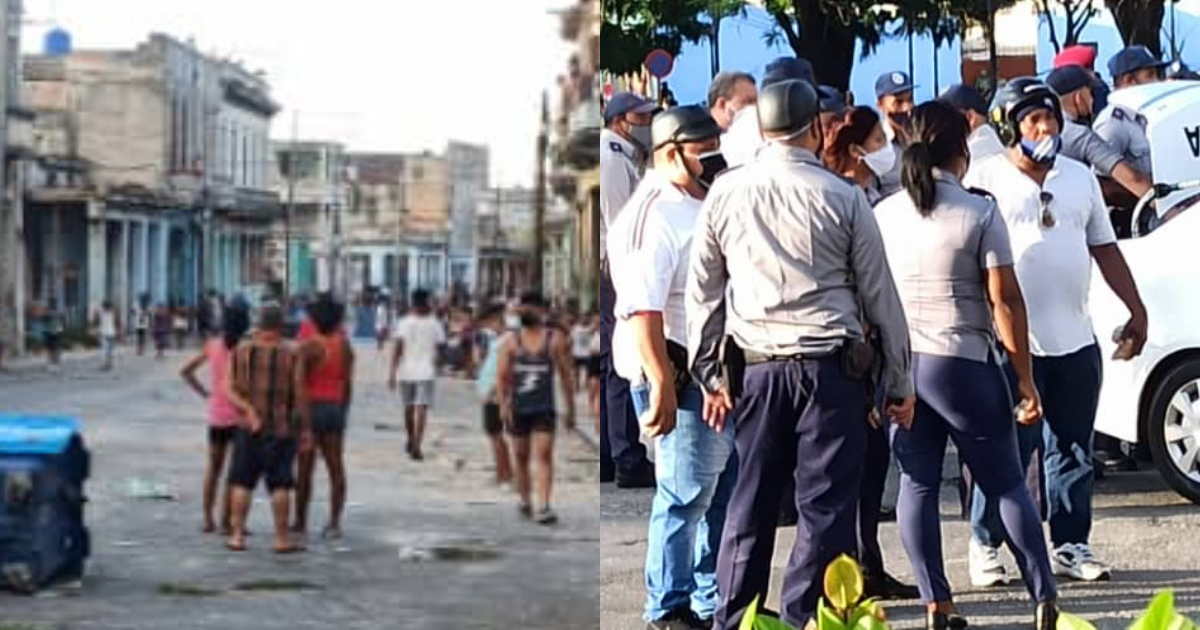
"They killed him! Murderers!" echoed through the streets on July 12, 2021, as Sub-Lieutenant Yoennis Pelegrín emptied his pistol into a crowd of citizens demanding freedom. According to his own testimony, the demonstrators were approximately 30 to 40 meters away when he claimed to have acted in self-defense.
In the Mantilla district of Arroyo Naranjo, this PNR sector chief heard someone shout, "You hit one!" Indeed, one of the eight bullets from his Makarov pistol struck Diubis Laurencio Tejeda in the back, passing through his torso and fatally injuring his pulmonary artery, leading to a deadly internal hemorrhage.
Diubis Laurencio, also known as Pikirí or Piki, was not the only person shot during these widespread protests against the Castro-Communist regime, but he was the only officially acknowledged fatality. Following the assassination, the political police imposed themselves at the funeral, even forcing the family to cremate the body. Predictably, state-controlled media painted him as a common criminal.
Five years have passed, yet justice for Piki remains elusive. A humble Cuban of 36 years, with a love for reggaeton, his crime was recording the public's outrage with his phone in La Güinera, a neighborhood in Arroyo Naranjo, Havana. The officer responsible remains free and reportedly continues to serve in the police force, according to recent sources.
The Start of a Nationwide Uprising
The uprising began the day before in San Antonio de los Baños, Artemisa, where locals took to the streets to protest against the healthcare collapse, extreme poverty, and lack of freedoms. The demonstrations quickly spread across Havana, Santiago de Cuba, Palma Soriano, Holguín, Bayamo, Camagüey, Santa Clara, Cárdenas, and numerous other locations. Hundreds of thousands called out, "Freedom!", "Homeland and Life!", and "Down with the dictatorship!"
Facing the largest protests in six decades, the Castro regime ordered their puppet, Miguel Díaz-Canel, to brutally suppress the dissent. "The order to fight has been given, revolutionaries to the streets," he declared, sending police, special forces, plainclothes military, and paramilitary brigades against the demonstrators. The crackdown resulted in beatings, shootings, injuries, thousands of violent arrests, many temporary disappearances, and internet blackouts.
A Testimony from the Frontlines
That morning, I was engrossed in drafting a document with opposition leaders about the dire crisis and the urgent need for humanitarian aid for the most vulnerable. I went to bed around 7 am, hoping to catch some rest. My wife, Nelva Ortega, woke me up to inform me about the unfolding events, and I decided to join the protests. Soon after, my son José Daniel Ferrer Cantillo and I were detained. For a month, I witnessed the revolving door of detainees, many of whom were severely beaten, at the Versalles political police unit in Santiago de Cuba.
Independent organizations documented over 1,500 detentions, with estimates suggesting numbers between 5,000 and 8,000. The regime's prosecutor's office acknowledged 790 prosecuted. Sentences ranged from 20 to 25 years or more of imprisonment. In those initial days, the fear was palpable on the faces of the repressive forces' agents, which subsided as they realized the storm had passed.
Enduring Consequences
Hundreds of young people, women, and minors faced prison sentences, marking the beginning of a dire new chapter in Cuba's political prison history. Extreme hunger, severe malnutrition, appalling hygiene, high risk of infectious diseases like tuberculosis, bedbugs, scabies, minimal medical care, beatings, physical and psychological torture, prolonged solitary confinement, isolation of the rebellious, and harassment of families became rampant. Six have died, and numerous allegations of death threats and sexual assault have been reported, with at least three confirmed cases.
Five years after the July 11 protests, over 300 of those arbitrarily sentenced remain behind bars in some of the hemisphere's harshest prisons. In total, there are currently around 800 political prisoners in Cuba, with over 1,300 sanctioned individuals. The regime's oppressive rule and severe poverty have driven over 1.3 million Cubans to flee during this period.
Despite the brutal repression and ongoing emigration, the Cuban people's yearning for freedom and dignity remains unquenched. Today, the nation is engulfed in a deeper crisis than the one experienced during the COVID-19 pandemic in the summer of 2021. Persistent blackouts, extreme poverty, hunger, a healthcare crisis, and lack of freedom and opportunities continue to plague the majority of the population. Coupled with the Communist Party leaders' growing credibility crisis, the streets are rife with escalating public protests.
Five years on, Cuba is a powder keg on the brink of explosion. Even some who serve the regime are convinced that profound political and economic reforms are the only salvation for the nation. Most Cubans yearn for an urgent and genuine democratization process, culminating in the free homeland "with all and for the good of all," as envisioned by Martí.
The choice is clear: either the Castros and their cronies relinquish power, or soon we will witness a new and definitive July 11 uprising, from Maisí to San Antonio, and whoever orders the massacre of the people will meet the fate of Nicolás Maduro or Ali Khamenei.
Frequently Asked Questions about Cuba's July 11 Protests
What sparked the July 11 protests in Cuba?
The protests were triggered by widespread discontent over the healthcare collapse, extreme poverty, and lack of freedoms in Cuba. They began in San Antonio de los Baños and quickly spread across the country.
How did the Cuban government respond to the protests?
The Cuban government responded with a brutal crackdown, involving police, special forces, and paramilitary brigades. This led to widespread beatings, shootings, arrests, and internet blackouts.
What has been the impact of these protests five years later?
Five years later, the protests have left a lasting impact with ongoing political repression, economic hardship, and a mass exodus of over 1.3 million Cubans. The yearning for freedom persists, with increasing public protests against the regime.