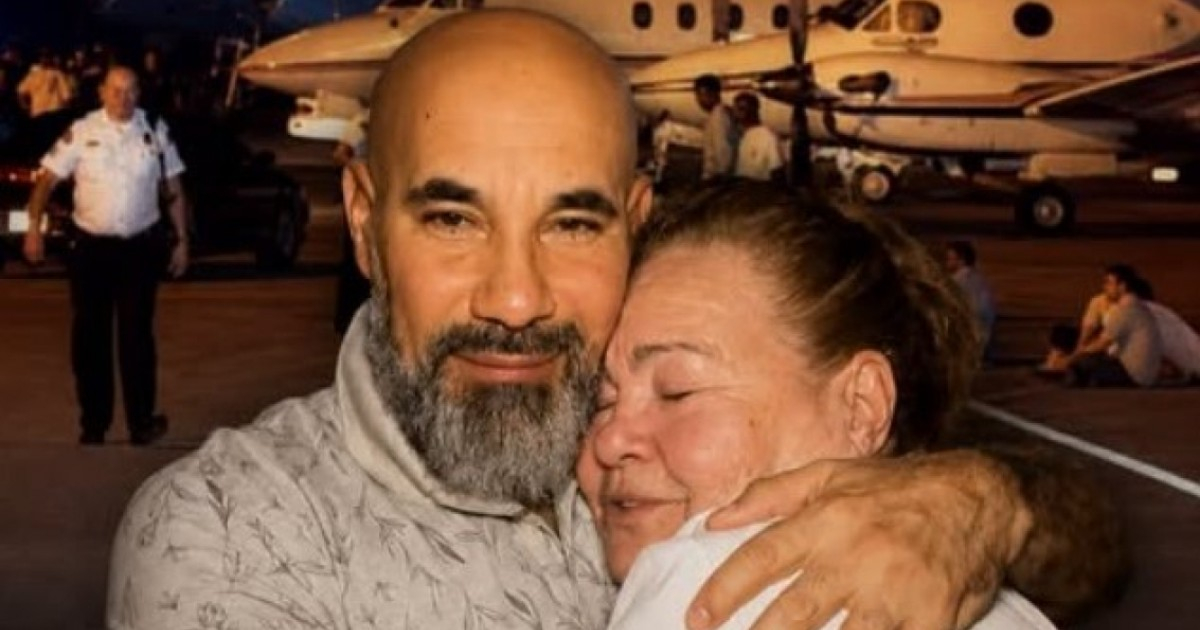
Maikel Guerra Morales, a Cuban national who spent 22 years in a U.S. federal prison for hijacking a plane in Cuba in 2003, was released last Thursday following a court order mandating the Immigration and Customs Enforcement (ICE) to free him within 24 hours, as reported by Telemundo 51.
U.S. District Judge John E. Steele, from the Middle District of Florida, granted a habeas corpus petition filed by Guerra's attorneys, ruling that the government could not detain him indefinitely if deportation was not feasible within a foreseeable timeframe.
Guerra was released with an electronic monitor and under immigration supervision, greeted by his mother and older brother, whom he had not seen since his arrest in December.
"If the judge hadn't been firm, ICE wouldn't have let me go," he remarked upon his release.
The 2003 Hijacking Incident
The incident dates back to March 19, 2003, when Guerra, along with at least 11 other Cubans led by his brother Alexis Norniella Morales, seized control of a DC-3 aircraft from the Cuban state-owned company Aerotaxi shortly after takeoff from Nueva Gerona, Isle of Youth, destined for Havana.
There were 37 individuals on board, including passengers, crew, and a security escort.
The hijackers used knives to demand that the aircraft be diverted to the United States. Florida Air National Guard fighters escorted the plane to Key West Airport, where it landed shortly after 8 p.m. No one was injured, and the hijackers surrendered to authorities.
Guerra received a 22-year federal prison sentence for air piracy and interfering with a flight crew, which he served in full.
Life After Prison
Speaking candidly about his experience, Guerra stated, "I have no regrets about how I arrived because I came for freedom, and that was my dream. But I do regret that my youth was spent this way: over 20 years in prison. It's something I will never forget. It has been a lot of suffering, an experience I carry inside."
After his release, he settled in Texas. In late 2025, he traveled to Sarasota to spend New Year's with his mother, but on December 30, ICE agents detained him at the airport, aiming to deport him to Mexico.
He spent 33 days at the "Alligator Alcatraz" detention center before being transferred to the Krome Processing Center in South Florida.
Legal Challenges and Future Prospects
Judge Steele noted that the government had more than three years since the deportation order and over six months since detention without formulating a concrete plan for removal and failed to provide evidence that Mexico would accept him.
"The law is clear on this matter. The government cannot lock individuals in a cell indefinitely as an alternative solution to a stalled deportation process," the judge wrote in his ruling.
Guerra is protected under the Convention Against Torture, granted in May 2022, preventing his direct deportation to Cuba by acknowledging that he could face inhuman treatment there.
"I should not be deported to a third country. I cannot go to Cuba, nor can I go to a country that has relations with Cuba," he insisted.
His case is not unique. Adermis Wilson González, another participant in the same hijacking, was deported to Mexico in September 2025 after being detained by ICE in Houston, as Cuba refused his repatriation.
Under the Trump administration, the U.S. has deported at least 4,353 Cubans to Mexico between January 2025 and March 2026.
Guerra remains under ICE supervision and could be detained again if the government finds a willing destination to accept him.
For now, he is determined about his next step: "To fight. This is the land of opportunity, and yes, it's possible."
FAQs on Legal Status and Deportation of Cuban Nationals
What conditions led to Maikel Guerra Morales' release from prison?
Guerra was released due to a court order that ruled indefinite detention was not permissible if deportation was not possible within a foreseeable period.
Why can't Maikel Guerra Morales be deported to Cuba?
He is protected by the Convention Against Torture, which recognizes that he could face inhuman treatment in Cuba, thus preventing his deportation there.
What was the outcome for other participants in the 2003 plane hijacking?
Adermis Wilson González, another hijacker, was deported to Mexico in 2025 after being detained by ICE, as Cuba refused his repatriation.