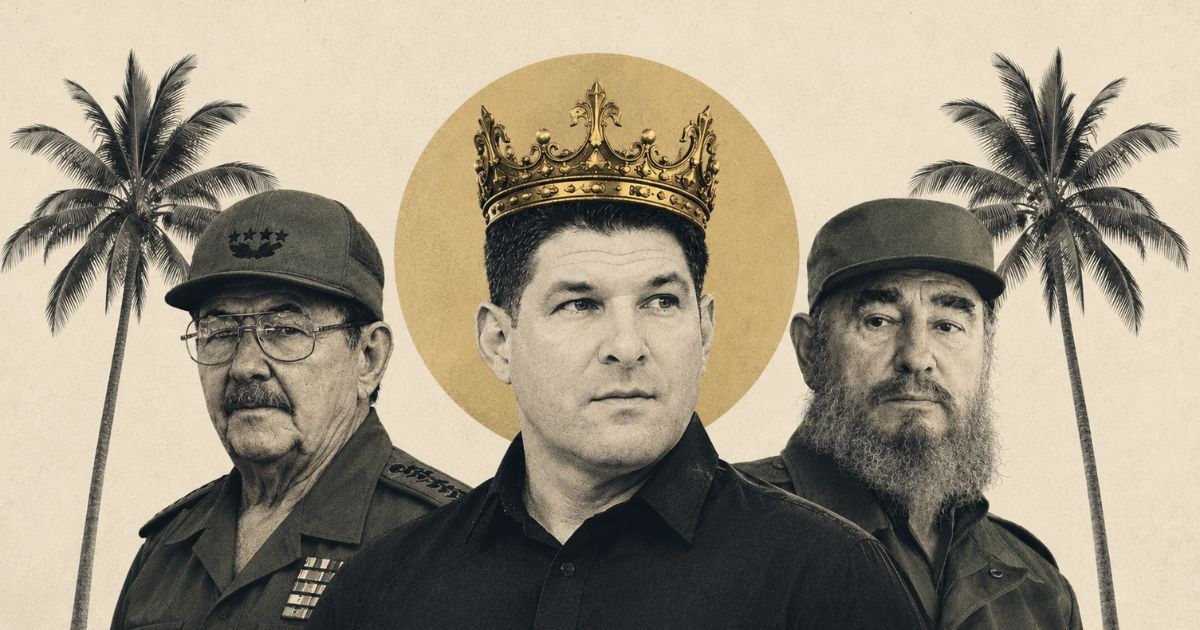
On Friday, Cuban political analyst José Manuel González Rubines published an article in the Spanish newspaper El Debate, examining the figure known as "El Cangrejo." He concludes that Cuba isn't merely a failing state, but rather a "personalist mafia," where no serious investor or businessman can safely operate in an environment where strategic decisions are made by someone with no official role or known qualifications.
The article directly responds to a profile published on July 6 by USA Today about Raúl Guillermo Rodríguez Castro, also known as El Cangrejo, the grandson of Raúl Castro. As a colonel in the Ministry of the Interior, he is responsible for the personal security of his nonagenarian grandfather and has presented himself to the American press as a potential liaison with Washington.
González Rubines, co-director of the think tank Cuba x Cuba and holder of a Master's in Democracy and Good Governance from the University of Salamanca, explains that the interview was intended as a piece of media diplomacy to position Rodríguez Castro in the White House's imagination as a viable Cuban interlocutor. The backdrop for this was his grandfather's former office in Havana's Palace of Conventions.
The stark contrast between Rodríguez Castro's lifestyle and the reality faced by the Cuban people is striking: a Salvatore Ferragamo briefcase for classified reports, a steel Rolex on his wrist, Hermès sneakers, and Hugo Boss shirts, while millions of Cubans scrape by on monthly salaries of $10 to $15 and endure power outages lasting over 30 hours.
The most telling quote from González Rubines is Rodríguez Castro's statement to USA Today journalists: "It pains me that people can't live like I do, but I get up every day to change that." The analyst describes this as "the disdain of an elite condensed into false empathy, the blunder of admitting privilege in the same breath as trying to conceal it."
The Communist Party's own apparatus confirmed Rodríguez Castro's role. Official Elier Ramírez Cañedo publicly acknowledged on July 9 that he acts as the regime's official interlocutor with Washington, "by decision of the country's top leadership," reinforcing the analyst's main thesis: real power in Cuba does not lie with Miguel Díaz-Canel but with Raúl Castro's family circle.
Despite holding no official title in the government or Communist Party, Rodríguez Castro claims to have driven the package of 176 economic reforms approved on June 19 by the National Assembly, engaged in talks with American envoys, and supported fuel supply agreements with private firms in Coral Gables. "Cuba is not a failing state, but a personalist mafia," González Rubines asserts.
Last April, Rodríguez Castro attempted to send a secret letter to Donald Trump via an allied businessman, bypassing Secretary of State Marco Rubio. The letter was intercepted at a border checkpoint, and the emissary was deported, an incident the analyst cites as indicative of the Cuban power structure's informality and unpredictability.
Other voices have joined the debate. Historian Alina Bárbara López Hernández, under house arrest since June 2024, warned in an analysis published Friday that the true aim of this media operation is not negotiation with the United States, but "the legitimization of an inexperienced scion of the power group before Washington... so that when the historic generation soon vanishes, the political exclusion system they created remains unchanged."
Professor Julio César González Pagés also weighed in on social media, noting that Rodríguez Castro sums up his devotion to the revolution with a gold chain bearing the initials of his "idols," and that "the misery and desolation experienced by ordinary Cubans is the backdrop for many creative speeches about homeland, nation, and nationalism."
González Rubines concludes his analysis with an image encapsulating the regime's state: El Cangrejo's office in the Palace of Conventions is dark from lack of power, an institutional building turned into the private office of someone whose only merit is his last name. "The Castro's crownless monarchy hands over Cuba, which they see as their personal estate, to a bodyguard with a Ferragamo briefcase and a Rolex. Who could trust an investment in an environment so insecure, informal, and unpredictable?"
Understanding Cuba's Power Dynamics
Who is Raúl Guillermo Rodríguez Castro?
Raúl Guillermo Rodríguez Castro, also known as El Cangrejo, is a colonel in the Cuban Ministry of the Interior and the grandson of Raúl Castro. He is involved in Cuban politics and has been portrayed as a potential liaison with the United States.
What is the significance of the "personalist mafia" in Cuba?
The term "personalist mafia" refers to the concentration of power within a small, familial circle in Cuba, where strategic decisions are made by individuals without official roles, leading to an unpredictable and insecure environment for business and governance.
How does the lifestyle of Cuban elites contrast with that of ordinary citizens?
Cuban elites, like Rodríguez Castro, enjoy luxurious lifestyles with high-end brands, while ordinary Cubans struggle with meager salaries and frequent power outages, highlighting a deep socioeconomic divide.
What is the role of the Communist Party in Rodríguez Castro's position?
The Communist Party has acknowledged Rodríguez Castro as an official interlocutor with the United States, indicating that real power in Cuba is concentrated within the Castro family rather than with the formal government led by Miguel Díaz-Canel.