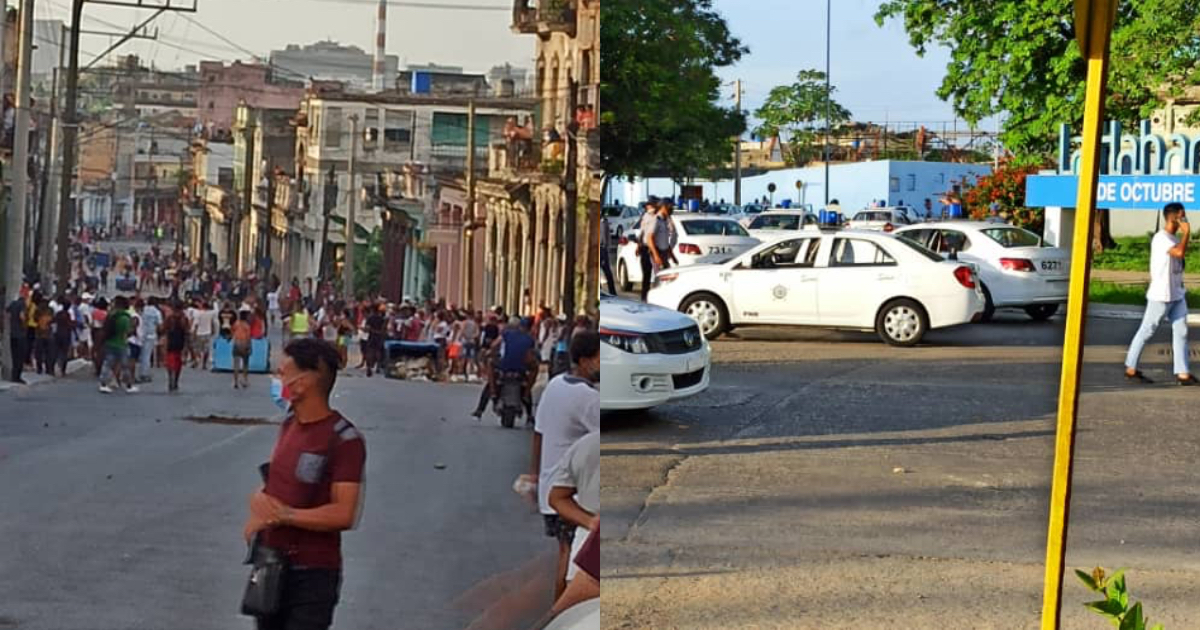
On July 11, 2021, Cuba witnessed the largest demonstrations against its oppressive regime since the Castro brothers seized power in 1959. At 11:00 a.m. on that historic day, Carlos Manuel Pupo, alongside the young Julián Manuel Mazola Beltrán, initiated a protest from the Church of San Antonio de los Baños, located 30 kilometers from Havana.
Pupo and Beltrán are members of the Partido Unión por Cuba Libre (PUNCLI), under the leadership of former political prisoner and ex-guerrilla Roberto Azcuy from Miami. In Cuba, the party is represented by Pupo, José Elías González Agüero, and Moraima Rodríguez Batista, among others, who also promote the Proyecto Emilia by Dr. Oscar Elía Biscet.
On that Sunday, Cubans took to the streets in more than 40 cities, including Palma Soriano, Santiago de Cuba, Havana, Santa Clara, Camagüey, Holguín, and Cárdenas. Chanting "Liberty" and "Patria y Vida," they reclaimed the streets, once "belonging to Fidel," demanding the end of the regime.
Puppet president Miguel Díaz-Canel appeared on television, urging revolutionaries to take to the streets, declaring, "The order to fight has been given." This statement sealed his fate, as violence ensued. The crackdown included cutting off Internet access and cellular services, as cell phones had played a crucial role in spreading the message, turning a spark into a wildfire.
More than 1,400 individuals were imprisoned, including minors, and nearly 700 remained behind bars years later. These protests, the largest since the 1994 Maleconazo, surpassed previous uprisings in both scale and reach, with social media amplifying the voice of dissent alongside traditional media. There was no hiding the truth.
Outrage replaced revolution as images of police brutality circulated, showing the fearsome black berets using batons, especially against children born under the revolution who were experiencing freedom of expression for the first time. These young heroes found their anthem in the song "Patria y Vida," which made the regime so anxious that it arrested people for playing it. The song won two Latin Grammy Awards for Song of the Year and Best Urban Song for Yotuel, Gente de Zona, Descemer Bueno, El Funky, and Maykel Osorbo (still imprisoned and a member of the Movimiento San Isidro).
The protests were fueled by numerous grievances: hunger for food and freedom, scarcity of essential goods and opportunities, power outages and dashed dreams, and poor government management, particularly of the COVID-19 pandemic.
Today, additional reasons for another July 11th uprising have emerged: tourism has vanished, foreign businesses have left, and there's no escape route by air or sea. No oil shipments arrive, and life is increasingly unbearable. While garbage piles up, hope remains elusive.
Key Questions about Cuba's July 11th Protests
What triggered the July 11th protests in Cuba?
The protests were sparked by widespread frustration with the Cuban government's mismanagement, lack of basic goods, and calls for freedom. The COVID-19 pandemic exacerbated these issues, leading to a nationwide outcry.
How did the Cuban government respond to the protests?
The Cuban government responded with repression, including cutting off Internet access, imprisoning over 1,400 people, and deploying security forces to suppress the demonstrations.
What role did social media play in the protests?
Social media was instrumental in organizing and spreading information about the protests, allowing for a coordinated effort that extended beyond traditional media channels.