Cuban scholar and essayist Hilda Landrove published an incisive analysis on Facebook this past Thursday, characterizing Cuba as a "concentration camp" and pointing to the Castro regime as the "primary culprit" behind the island's devastation. Her post resonated deeply with Cubans both inside the country and abroad.
The catalyst for her remarks was an interview with Raúl Guillermo Rodríguez Castro, known as "El Cangrejo," the grandson of Raúl Castro and a colonel in the Ministry of the Interior. The interview was featured in USA Today on July 6, where the official offered to negotiate Cuba's future with Donald Trump and expressed regret that other Cubans couldn't live as he does.
Landrove, who holds a doctorate in Mesoamerican Studies from the National Autonomous University of Mexico, dismantles the official narrative of the revolution as a collective project in her Facebook post. She repositions it bluntly: "The revolution was always the project of a family clan that harnessed the enthusiasm of a nation and, with that same enthusiasm, dismantled it."
The academic draws a direct connection between the Castro clan's enrichment and the people's impoverishment: "As that clan, led by Fidel, grew wealthier, the initially enthusiastic, then resistant, and eventually weary, broken, and desolate populace became poorer and more silenced."
Unveiling the Realities of Power
Regarding "El Cangrejo" as a potential negotiator, Landrove is unsparing in her critique. She describes him as "a bodyguard never elected to such responsibility" and sarcastically points out that some within the regime are offended by his prominence, as if the system required any democratic legitimacy: "If they wish, El Cangrejo could be Cuba's president tomorrow, selling the country to the United States without batting an eye, because the master of the plantation needs no legitimacy for the foreman to execute his wishes."
The public emergence of "El Cangrejo" occurs amidst ongoing negotiations. John Ratcliffe, CIA Director, met with him in Havana on May 14, 2026, and Prime Minister Manuel Marrero Cruz confirmed this Thursday that the regime is in talks with the United States, backed by the "highest leadership." A Communist Party leader also publicly endorsed "El Cangrejo" as an official interlocutor.
Protests Highlighting Cuban Desperation
For Landrove, this charade is intolerable given the magnitude of Cuban suffering. "Cuba is currently a concentration camp, with people protesting nightly against absolute devastation," she writes, portraying the nation as a place "of distances, deaths, separations; wounds so deep that healing seems an unreachable dream."
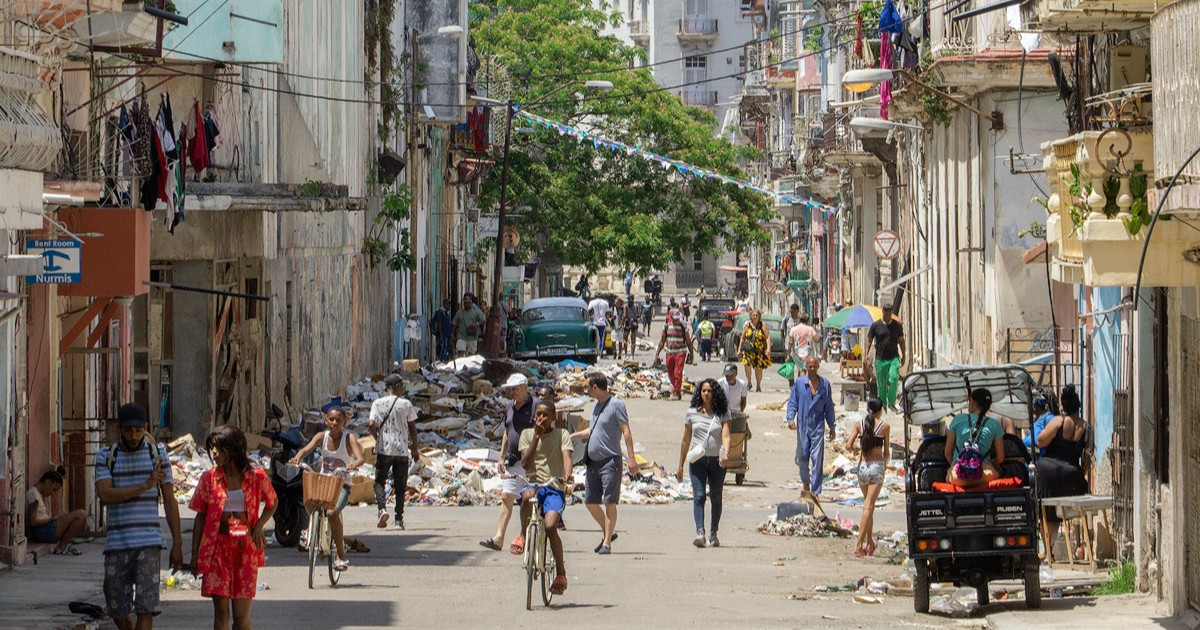
The nighttime protests she references are a well-documented and growing reality. Cuba saw 1,245 demonstrations in March 2026, 1,133 in April, and 1,311 in May, nearing historic monthly records. Cacerolazos and street blockades have spread to over 12 Havana municipalities and other provinces amid power outages lasting up to 22 hours daily, with an electricity generation shortfall exceeding 2,100 MW. Infant mortality has doubled to 9.9 per 1,000 births, food production has plummeted by 60%, and only 30% of usual medications are available.
It’s not the first time Landrove has analyzed the Cuban crisis with such force. Last June, she labeled the economic measures announced by Miguel Díaz-Canel as "empty promises" that are "too little, too late," arguing that the system is beyond reform due to a lack of political will.
In her latest piece, she concludes with a reference to José Martí and his concept of the "infinite pain" of political imprisonment, repurposing it to describe the entire island's plight. She urges intellectuals who continue to support the regime or turn a blind eye to feel shame: "Out of respect for that endless pain, that 'infinite pain' Martí used to describe political imprisonment and which now applies to all of Cuba, they should refrain from posing as organic intellectuals, the offended, and the champions of a 'different' order that never existed."
Understanding Cuba's Crisis: Key Questions Answered
What sparked Hilda Landrove's critical analysis of Cuba?
Hilda Landrove's analysis was triggered by an interview with Raúl Guillermo Rodríguez Castro, where he offered to negotiate with Donald Trump and expressed regret that other Cubans couldn't live as he does.
How does Landrove describe the state of Cuba?
Landrove describes Cuba as a "concentration camp," marked by ongoing protests, severe economic hardship, and a regime that enriches itself at the people's expense.
What are the current living conditions in Cuba?
Cuba is experiencing extreme conditions, including frequent power outages, high infant mortality rates, plummeting food production, and a severe shortage of medications.
Why does Landrove criticize the regime's negotiations with the United States?
Landrove criticizes the negotiations as a charade that ignores the suffering of Cubans, with figures like "El Cangrejo" assuming roles without democratic legitimacy.