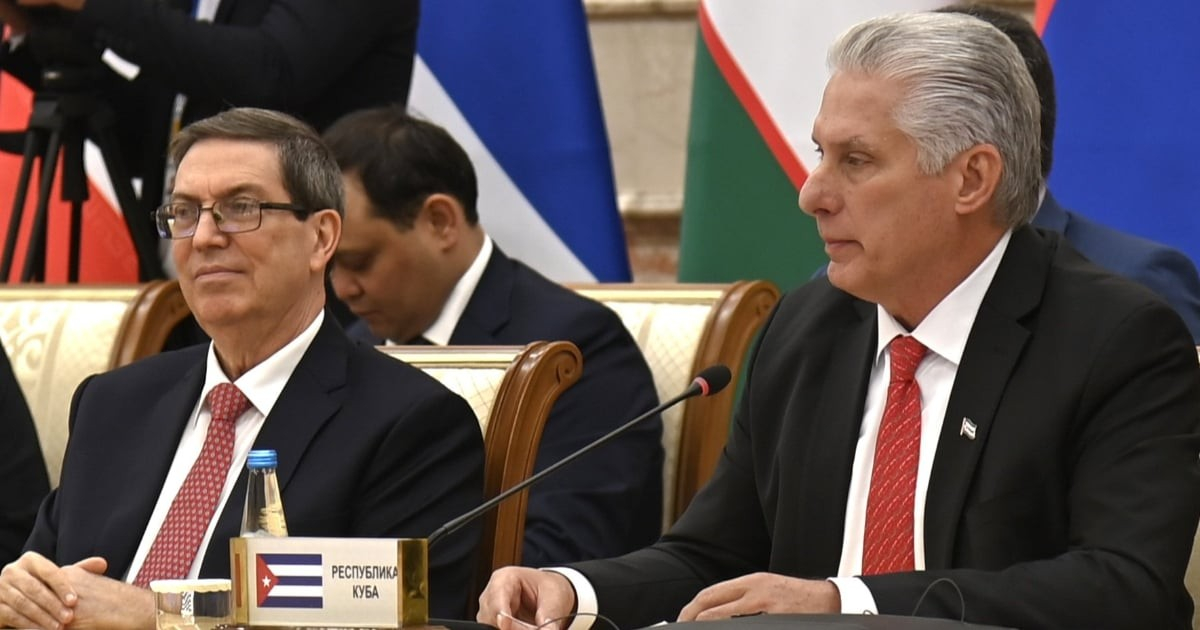
Miguel Díaz-Canel faced a wave of mockery on social media this Friday after he declared on Facebook that Cuba had achieved a "resounding VICTORY at the UN General Assembly," following the return of Foreign Minister Bruno Rodríguez Parrilla from New York.
The public's reaction was swift. In response to the leader's announcement and CiberCuba's coverage of the issue, Cubans met the claim with sarcasm and irony, reflecting their growing frustration.
Comments such as "Let's eat victory," "Where's the food that victory brought?" "The only victory they have is the misery in Cuba," and "They turn setbacks into victories" were among the most repeated.
Some users were even more blunt: "Went for wool and came back shorn," "Resounding defeat, they really got to Bruno," "Just because they let you talk doesn't mean you won," and "Victory... and we're still worse off."
Behind the "Victory"
What the regime touted as a triumph was, in reality, the approval of a six-hour extraordinary debate at the UN about the U.S. embargo, held on Monday, with 136 votes in favor, nine against, and 30 abstentions.
This voting did not lift or alter the embargo; it merely authorized the discussion session. The numbers tell a different story: in October 2025, Cuba received 165 votes in favor with only 12 abstentions. The number of abstentions doubled, marking the worst diplomatic support for the island in over three decades.
The cost of the debate was approximately $168,000, an amount that U.S. Ambassador Mike Waltz noted could have fed thousands of Cuban children or alleviated the energy crisis keeping the country in darkness.
Criticism from the International Community
During the session, Waltz and Representative Jeffrey Bartos dismantled the official narrative with hard facts: over 800 political prisoners, the third nationwide blackout in 2026, and the accusation that the military conglomerate GAESA manages an $18 billion trust fund without a penny reaching the people.
"How is there no fuel for hospitals, but there is for the Castro family's private jet?" Waltz questioned before the General Assembly.
Bruno Rodríguez attempted twice to interrupt the American interventions with points of order, which were dismissed by the Assembly's presidency; in the first attempt, he labeled Waltz a "liar."
The European Union also demanded reforms from the regime. Ambassador Stavros Lambrinidis was clear: "The dire situation of the Cuban people is not solely due to the embargo. Significant political and economic reforms are urgently needed from the Cuban authorities."
A Grim Economic Outlook
This episode occurs during the worst economic downturn Cuba has faced in decades: ECLAC forecasts a 6.5% GDP contraction in 2026, the largest in Latin America and the Caribbean. On June 18, the European Parliament approved individual sanctions against Díaz-Canel and GAESA leaders with 283 votes in favor.
The pattern is not new. Last October, Díaz-Canel also celebrated "two victories" at the UN despite the historic decline in support.
The phrase encapsulating the popular response this Friday says it all: "Nothing has changed, and nothing will change."
Impact of UN Debate on Cuba
What was the result of the UN debate on the U.S. embargo?
The UN debate resulted in the approval of a six-hour discussion on the U.S. embargo against Cuba, with 136 votes in favor, nine against, and 30 abstentions. However, this did not change or lift the embargo.
How did international representatives respond to the Cuban regime's claims?
International representatives, including U.S. Ambassador Mike Waltz and EU Ambassador Stavros Lambrinidis, refuted the Cuban regime's claims by highlighting the need for significant political and economic reforms. They also pointed out the regime's mismanagement and human rights issues.