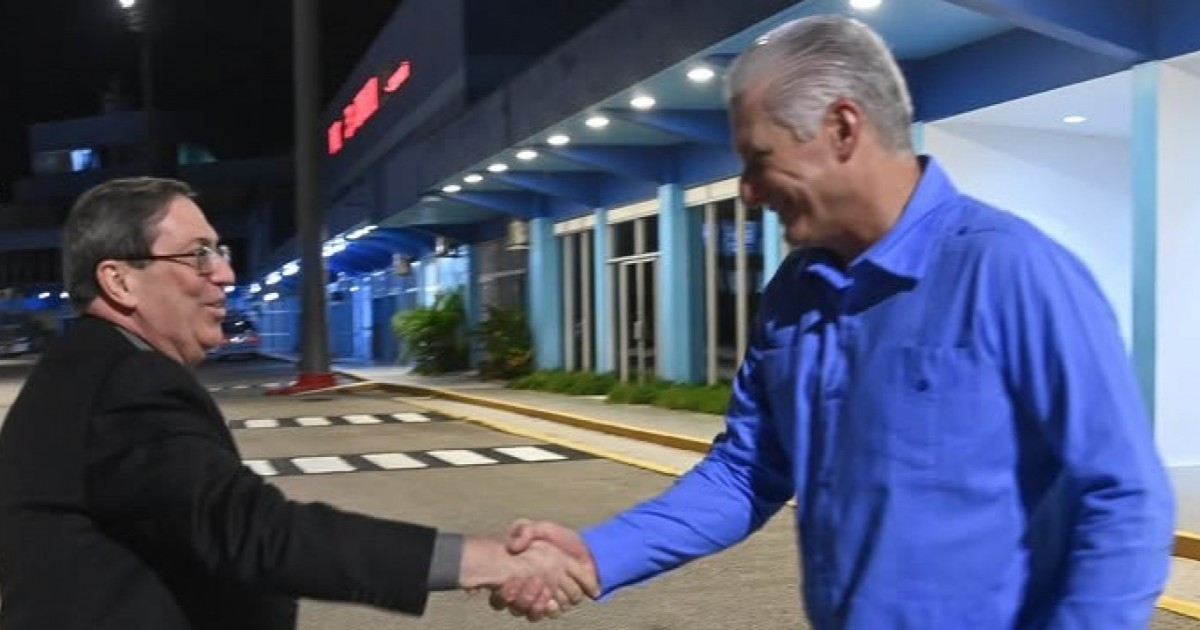
In the early hours, Miguel Díaz-Canel welcomed Foreign Minister Bruno Rodríguez Parrilla back from New York at the airport. Following the extraordinary session on July 7th concerning the U.S. embargo at the United Nations, Díaz-Canel proclaimed on Facebook that Cuba had achieved a "resounding VICTORY" at the General Assembly.
"This demonstrated the overwhelming global support for Cuba in its fight against the United States' genocidal blockade," the leader wrote.
What the regime hails as a victory was simply the approval of a debate with 136 votes in favor, nine against, and 30 abstentions. This vote neither lifts nor alters the embargo; it merely authorized a six-hour discussion session costing $168,000.
The outcome was significantly weaker than the annual vote held in October 2025, where Cuba had garnered 165 favorable votes.
The number of abstentions doubled from 12 to 30, a partial effect of a robust diplomatic campaign led by Washington. According to a leaked cable from Secretary of State Marco Rubio, embassies worldwide were instructed to oppose the debate.
U.S. Ambassador Mike Waltz highlighted the session's cost, noting, "That money could have fed thousands of Cuban children instead of funding another propaganda spectacle by the regime." He shared this sentiment on social media the following day.
Waltz also accused GAESA, the military conglomerate, of managing an $18 billion trust fund that fails to benefit the Cuban populace.
U.S. Diplomats Challenge Cuba's Narrative
During the session, Ambassador Jeffrey Bartos questioned directly whether the over 800 political prisoners had electricity in their cells. His query referenced the third complete collapse of Cuba's electrical system in 2026, which began on July 6th and left 9.6 million people without power.
"This is the real embargo on Cuba," Bartos stated. "It's the embargo the regime imposes on its own people: restricting free speech, faith, entrepreneurship, dissent, political rights, hope, and now, literally, light."
Bruno Rodríguez made two attempts to interrupt the U.S. diplomats' speeches with procedural motions, both rejected by the Assembly President. Waltz responded bluntly, "The truth hurts, and the truth is not disrespect. I'm sorry you don't want to hear it."
International Response
The European Union also withheld support for the regime's narrative. EU Ambassador to the UN, Stavros Lambrinidis, called for urgent political and economic reforms and the release of all arbitrarily detained individuals.
"The severe situation of the Cuban people is not solely due to the embargo," he remarked, adding that the EU regrets Cuba's stance on Russia's war in Ukraine, deeming it incompatible with UN Charter principles.
The debate took place amid a particularly challenging context for Cuba: the country has 1,281 political prisoners, according to the European Parliament, which approved individual sanctions against Díaz-Canel and GAESA leaders just three weeks prior. The ECLAC projects a Cuban GDP contraction of 6.5% in 2026, the worst in the region.
Waltz concluded by urging the participating countries, "Stand with the Cuban people, not with the regime that has ruined that nation. You can't do both at the same time. It's time to make a decision."
Key Insights on Cuba's UN Debate and Diplomatic Reactions
What was the outcome of the UN debate on the U.S. embargo against Cuba?
The debate was approved with 136 votes in favor, nine against, and 30 abstentions, allowing a six-hour discussion session that cost $168,000. However, it did not change the embargo itself.
How did the U.S. and EU respond to the Cuban regime's claims of victory?
U.S. diplomats criticized the regime, highlighting the debate's cost and questioning the conditions of political prisoners. The EU demanded reforms and criticized Cuba's position on Russia's war in Ukraine.
What challenges is Cuba currently facing?
Cuba is dealing with a severe electricity crisis, a contraction of its GDP projected at 6.5% for 2026, and international sanctions. It also has over 1,281 political prisoners, according to the European Parliament.