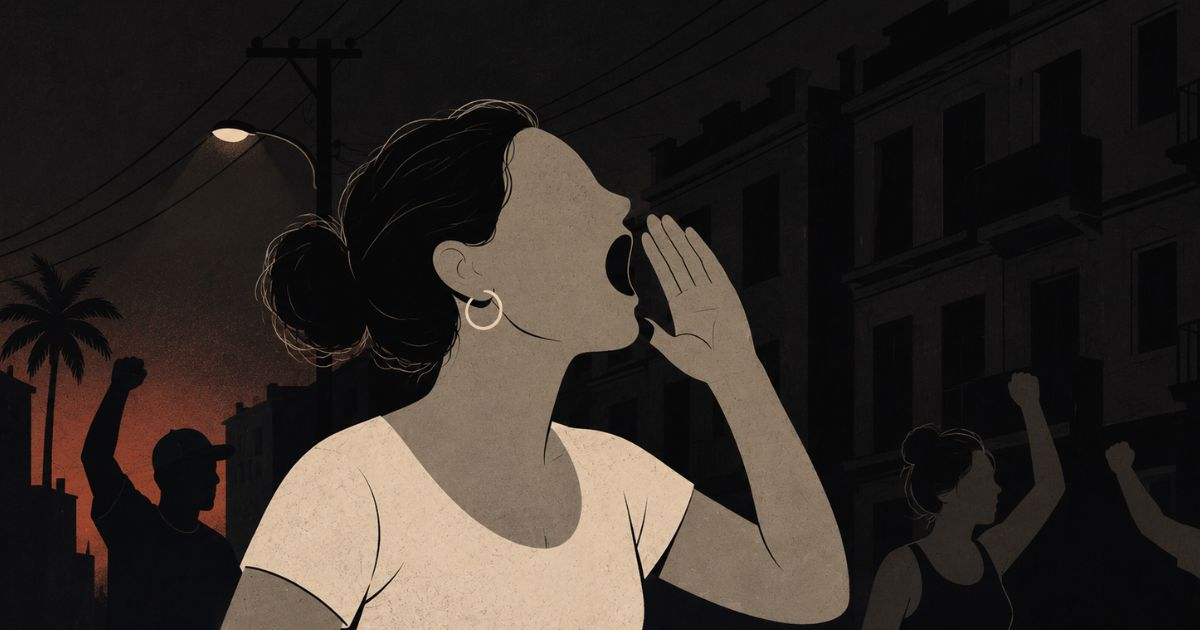
A resident of Centro Habana has shared a heartfelt account on the Facebook group "Madres Cubanas Luchadoras 2," encapsulating the profound exhaustion felt by countless Cuban families due to relentless power outages. In despair, she took to the streets to voice her frustration outside the headquarters of the Central de Trabajadores de Cuba (CTC).
Ninfa Bosques penned her message at 3:13 a.m., battling a fever, headache, and sleeplessness.
Her words convey a breaking point, both emotionally and physically, beyond any further endurance.
"Last night I went out and stood there, shouting outside the CTC, but once the power was restored, people left," she recounted.
The CTC is the official trade union of the Cuban regime, making her chosen venue for protest highly symbolic.
In her post, Ninfa describes an unbearable night: mosquitoes, flying cockroaches from the street, stifling heat, and her daughters unable to sleep.
"Here in Centro Habana, my girls can't sleep; the mosquitoes and flying cockroaches from the street make it unbearable," she wrote.
The exhaustion she conveys transcends the physical realm.
"I write to you from the depths of my headache, with a fever, mentally drained, unable to cool even a bottle of water or sleep," she noted.
Her daughters question when this will end.
"My girls ask me, 'Mom, how long will this last? Our vacation is unbearable; children are born to be happy,'" she shared.
The mother also listed, with stark honesty, what her home lacks: "An empty coldness with no hope of filling it due to the cursed blackouts. Irreparable sleep... mentally disturbing tranquility... no food... no milk for our children."
Concluding her message, Ninfa warned that fear of repression prevents her from expressing her true thoughts, a sentiment shared by many.
"I can't continue writing because if I truly express my thoughts, I might be imprisoned, and my girls need me. I only say, PATRIA Y VIDA," she ended.
The testimony surfaces days after the massive blackout on July 6, when an unexpected shutdown of a unit at the Nuevitas thermoelectric plant left around 9.6 million Cubans without power. This was the third complete collapse of the National Electric System in 2026 and the seventh in the past 18 months.
The frustration in Havana, as in the rest of the country, is not new. On June 30, residents of Salud Street in Centro Habana staged a cacerolazo in broad daylight after more than 28 hours without electricity, gas, or water.
On Tuesday, residents of the Cayo Hueso neighborhood protested outside the Lázaro Peña theater with cacerolazos that continued even after the power returned, chanting slogans such as "We want freedom, not electricity!"
According to the Cuban Observatory of Conflicts, June 2026 saw 107 protests in Cuba—a historic record, nearly double the previous high—with 82 occurring in Havana.
The demands have escalated from calls for electricity to pleas for freedom and regime change, as Energy Minister Vicente de la O Levy acknowledged that blackouts in the capital exceeded 20-22 hours daily and warned that 2026 would be a challenging year.
Understanding the Cuban Power Outages
What are the main reasons for the frequent blackouts in Cuba?
The frequent blackouts in Cuba are primarily due to the aging and inefficient infrastructure of the national electric system, compounded by economic challenges and a lack of investment in energy sector improvements.
How have the Cuban people reacted to these power outages?
The Cuban people have responded with increasing frustration and protests, including cacerolazos and demands for systemic change. The outages have heightened public discontent and calls for freedom and better living conditions.