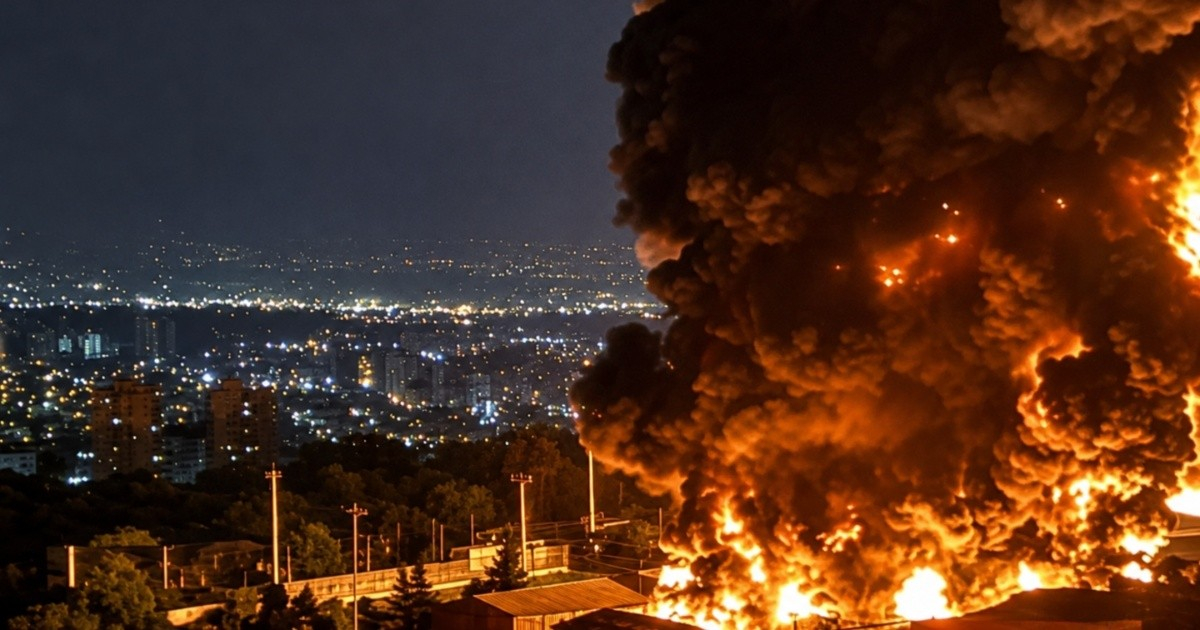
The United States Central Command (CENTCOM) declared on Wednesday the commencement of a new series of airstrikes targeting Iran. This action was sanctioned by President Donald Trump, in his role as Commander-in-Chief, in retaliation for Iranian assaults on merchant vessels in the Strait of Hormuz.
In an official statement shared on its X account, CENTCOM stated, "Under the direction of the Commander-in-Chief, U.S. Central Command forces have initiated additional strikes against Iran to further diminish its capacity to threaten free navigation in the Strait of Hormuz. The United States holds Iran accountable for the recent unwarranted aggression against commercial ships and civilian crews navigating an essential international maritime route."
The immediate trigger was an attack executed on Tuesday by the Islamic Revolutionary Guard Corps (IRGC), which fired missiles at no less than three merchant ships in the Strait of Hormuz.
Among those struck were the Al Rekayyat, a liquefied natural gas tanker from Qatar, which sustained an impact on its port side, resulting in a fire, and the Saudi oil tanker Wedyan.
Although Tehran has not officially claimed responsibility for the action, a U.S. official and the Qatari government directly blamed Iran.
Trump responded decisively, stating, "This is in retaliation for Iran's bombing of ships yesterday. If it happens again, the consequences will be far worse," he posted on his X account.
On Wednesday, the president formally declared the end of the ceasefire to NATO, labeled Iran as "deceitful," and revoked the waiver that permitted the sale of Iranian oil.
The airstrikes on Wednesday targeted over 80 military sites in southern Iran, including the islands of Kharg and Jark, air defense systems, coastal radars, anti-ship missiles, and more than 60 small IRGC vessels.
Iranian state television confirmed at least eight military personnel were killed — described by Tehran as "brave members of the air and naval forces" — and condemned the attacks as a "criminal aggression" and a "clear violation" of the ceasefire agreement signed on June 17 in Switzerland.
In retaliation, the IRGC struck 85 U.S. military installations in Kuwait and Bahrain on the same day.
This latest surge in violence shatters the fragile ceasefire established in June, known as the "Islamabad Memorandum," which included the cessation of hostilities, the reopening of the Strait, and a $300 billion fund for Iran's reconstruction.
The ceasefire had already shown signs of unraveling on June 26, when Iran launched four drones against ships in Hormuz, with one impacting a merchant freighter, prompting CENTCOM airstrikes that same day.
The conflict initially began on February 28, 2026, with "Operation Epic Fury," coordinated U.S. and Israeli attacks on Iranian nuclear facilities. In response, Iran closed the Strait of Hormuz in March, collapsing 97% of naval traffic and driving the Brent crude price from $67 to over $126 per barrel.
Following Wednesday's airstrikes, the Iranian military announced the complete closure of the Strait of Hormuz to all vessels, warning that it would fire upon any ship attempting to pass through — a corridor through which approximately 20% of the world's oil supply transits.
Key Events in the U.S.-Iran Tension
What prompted the recent U.S. airstrikes on Iran?
The recent U.S. airstrikes on Iran were prompted by Iranian missile attacks on merchant vessels in the Strait of Hormuz, leading the U.S. to respond militarily under the orders of President Trump.
Which vessels were attacked by Iran?
The vessels attacked by Iran included the Al Rekayyat, a Qatari liquefied natural gas tanker, and the Saudi oil tanker Wedyan.
How has the Strait of Hormuz been affected?
The Iranian military has announced the complete closure of the Strait of Hormuz to all shipping, threatening to fire on any vessel attempting to pass through this vital corridor.