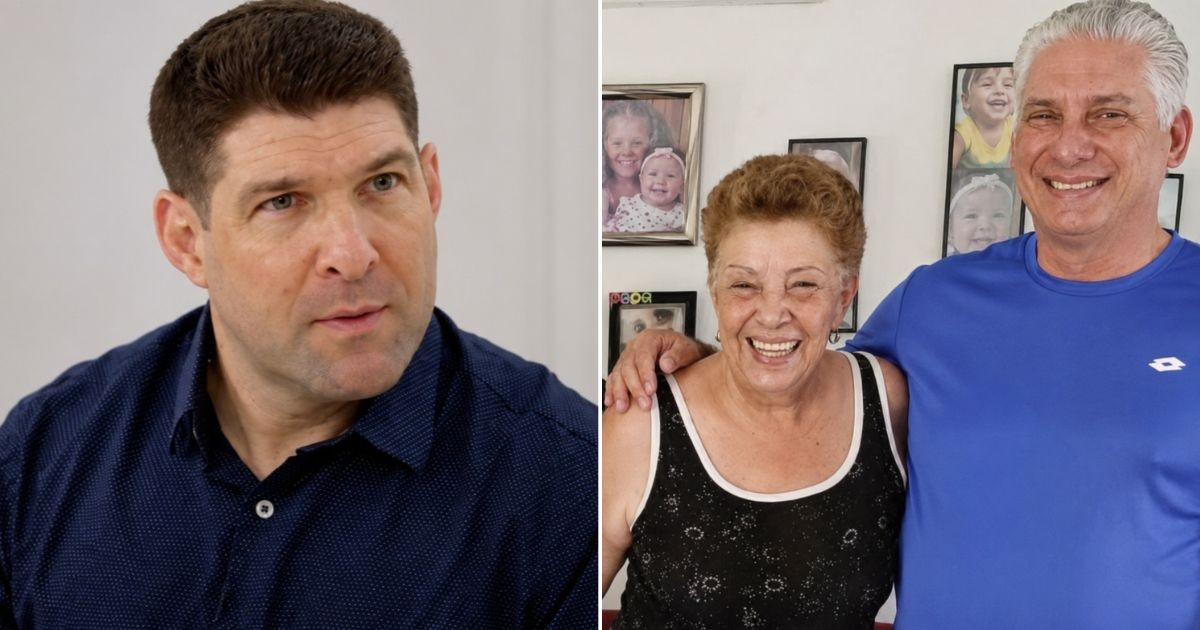
On Wednesday, María del Carmen Hernández Carús, mother of the head of Communication for the Palace of the Revolution, Leticia Martínez Hernández, took to Facebook to deliver a scathing critique of Raúl Guillermo Rodríguez Castro, known as "El Cangrejo." She demanded that he step down from the self-appointed role of negotiator, for which he holds no official position.
The catalyst for her post was an interview given by Raúl Castro's grandson to the American newspaper USA Today, where he stated, "I can negotiate with anyone designated by the U.S. If given the opportunity, of course with Trump."
Identifying herself simply as "a citizen of this country," Hernández Carús posed a series of pointed questions: "Why is Raúl Guillermo being interviewed about Cuba? Why does this young man accept interviews and assume a role that is not his?"
Her critique sharpened as she highlighted Rodríguez Castro's lack of qualifications for such responsibilities: "Can someone bring this boy back to reality? Can someone tell him to be quiet? Can someone inform him that this is not the job of a bodyguard?"
She added with irony, "Can someone tell him that you don't buy bullets for these negotiations at a farmers' market?"
This post is particularly striking given that its author is the mother of one of the key spokespeople for Miguel Díaz-Canel's regime, known for defending the government on social media and for labeling U.S. Secretary of State Marco Rubio a "bandit" last June.
Hernández Carús also suggested a deeper political implication: "I don't know if this is the work of Cuba's enemies, to say that only the Castro family can have a voice in Cuba, thus ignoring the president and other foreign affairs colleagues."
Rodríguez Castro, aged 42, is the son of Débora Castro Espín—Raúl Castro's eldest daughter—and the late General Luis Alberto Rodríguez López-Calleja, former head of the military enterprise conglomerate GAESA. His nickname, "El Cangrejo," originates from being born with polydactyly.
Despite holding no official government position, he has served for over two decades as a bodyguard and personal assistant to his grandfather. However, since early 2026, he has emerged as an informal channel between the regime's leadership and the Trump administration.
Reports indicate that he met with Rubio in January and February 2026, sent Trump a letter with economic proposals in April—which Customs agents intercepted in Miami—and welcomed CIA Director John Ratcliffe to Havana last May.
The USA Today interview marked his first public appearance in an American media outlet, sparking outrage in Cuba. Many questioned how the nation's future could hinge on someone without popular mandate or diplomatic training, living in luxury while the populace endures blackouts and shortages.
In the interview, Rodríguez Castro mentioned Díaz-Canel only three times, referring to him as "Miguelito," a detail interpreted as indicative of where the real power lies on the island.
Hernández Carús has previously stirred controversy on social media: she protested against blackouts in December 2024, criticized ETECSA's rates in May 2025, and defended her daughter after a dispute with singer-songwriter Silvio Rodríguez in March 2025.
This occasion, however, marks one of the rare instances where she directly confronts a member of the Castro elite.
She concluded her post with a phrase that encapsulates her stance: "I dare to say it here openly because I was, am, and will be a free spirit; many people say it on the street. Stick to your trade!"
Key Insights into María del Carmen Hernández Carús's Critique
Who is Raúl Guillermo Rodríguez Castro?
Raúl Guillermo Rodríguez Castro, known as "El Cangrejo," is the grandson of Raúl Castro and serves as a bodyguard and personal assistant to his grandfather. He has acted as an informal negotiator between the Cuban regime and the Trump administration, despite holding no official government position.
Why did María del Carmen Hernández Carús criticize Rodríguez Castro?
Hernández Carús criticized Rodríguez Castro for assuming a role as a negotiator without any official capacity or appropriate qualifications. She questioned his involvement in negotiations and expressed discontent over his media presence, highlighting his lack of diplomatic training.
What was the response to Rodríguez Castro's interview with USA Today?
The interview triggered a wave of indignation in Cuba. Many criticized the idea that the country's future could depend on someone without official mandate or diplomatic credentials, while highlighting the contrast between Rodríguez Castro's lifestyle and the hardships faced by ordinary Cubans.