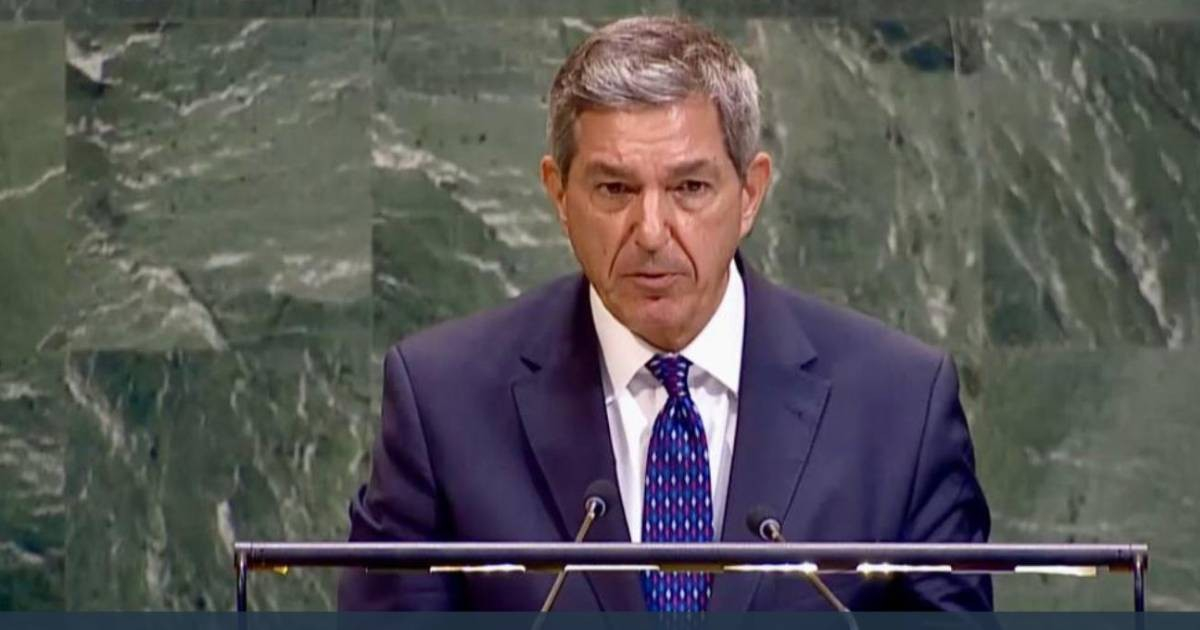
On Tuesday, the European Union seized the opportunity during a debate called by Cuba at the United Nations General Assembly regarding the U.S. embargo to deliver an unusually stern message to Miguel Díaz-Canel's regime. Beyond calling for an end to Washington's sanctions, the EU demanded that Havana cease its support for Russia's invasion of Ukraine and implement political and economic reforms to tackle the crisis on the island.
This statement was delivered by Stavros Lambrinidis, the head of the EU delegation to the UN, representing the 27 member states and several associated countries, including Montenegro, Albania, Moldova, Bosnia and Herzegovina, Norway, Andorra, San Marino, and the United Kingdom.
“While we reaffirm the importance of respecting international law in all contexts, we deeply regret that Cuba's stance on Russia's illegal war of aggression against Ukraine has not aligned with the principles of the United Nations Charter,” the diplomat stated.
EU Criticizes Cuba's Support for Moscow
Lambrinidis reminded the assembly that on February 24, 2026, Cuba voted against a UN resolution calling for a ceasefire and lasting peace in Ukraine, siding with Russia, Iran, Belarus, and Nicaragua.
The European Union further urged the Cuban government to “refrain from providing any form of support to Russian aggression” and to prevent Cuban citizens from joining Russian military forces.
According to various estimates cited by Western governments and human rights organizations, between 1,000 and 20,000 Cubans have fought or are currently fighting alongside Russian forces, with at least 54 identified casualties.
Embargo Not Solely to Blame for Crisis
Although the EU reiterated its traditional opposition to the U.S. embargo and noted that the sanctions, particularly the extraterritorial provisions of the Helms-Burton Act, have humanitarian consequences and impact European economic interests, it made clear that this is not the sole cause of Cuba's deteriorating situation.
“The severe condition of the Cuban people is not solely due to the embargo. Urgent and significant political and economic reforms are needed from the Cuban authorities,” emphasized Lambrinidis.
The European representative described an island plagued by daily power outages, food and medicine shortages, hospitals on the brink of collapse, and difficulties accessing transportation and fuel.
“Humanitarian aid alone will not resolve Cuba's crisis. Important sovereign decisions can no longer be postponed,” he stated.
Human Rights and Political Prisoners
The declaration also called for concrete progress on human rights issues. The European Union urged the release of all political prisoners, respect for fundamental freedoms, and greater openness to dialogue with civil society.
This statement comes weeks after the EU's High Representative for Foreign Affairs, Kaja Kallas, acknowledged that the Political Dialogue and Cooperation Agreement with Cuba has not yielded the expected results after nearly a decade of implementation.
This shift was also evident on June 18, when the European Parliament approved a resolution calling for individual sanctions against Miguel Díaz-Canel under the EU's sanctions regime for human rights violations and proposed suspending the cooperation agreement with Havana.
The European intervention took place during the extraordinary session requested by the Cuban regime to debate the U.S. embargo, an exceptional mechanism used by Havana for the first time.
The General Assembly approved the debate with 136 votes in favor, nine against, and 30 abstentions, a notably lower support than the 165 votes Cuba received in the annual vote held in October 2025.
Frequently Asked Questions about EU's Stance on Cuba-Russia Relations
Why is the EU urging Cuba to cut ties with Russia?
The EU is urging Cuba to cut ties with Russia because Cuba's support for Russia's invasion of Ukraine contradicts the principles of the United Nations Charter and international law.
What did the EU say about the U.S. embargo on Cuba?
The EU reiterated its opposition to the U.S. embargo, acknowledging its humanitarian impact and effects on European economic interests, but emphasized that Cuba's crisis is not solely due to the embargo.
What specific actions did the EU call for from the Cuban regime?
The EU called for Cuba to stop supporting Russian aggression, enact political and economic reforms, release political prisoners, respect fundamental freedoms, and engage in dialogue with civil society.