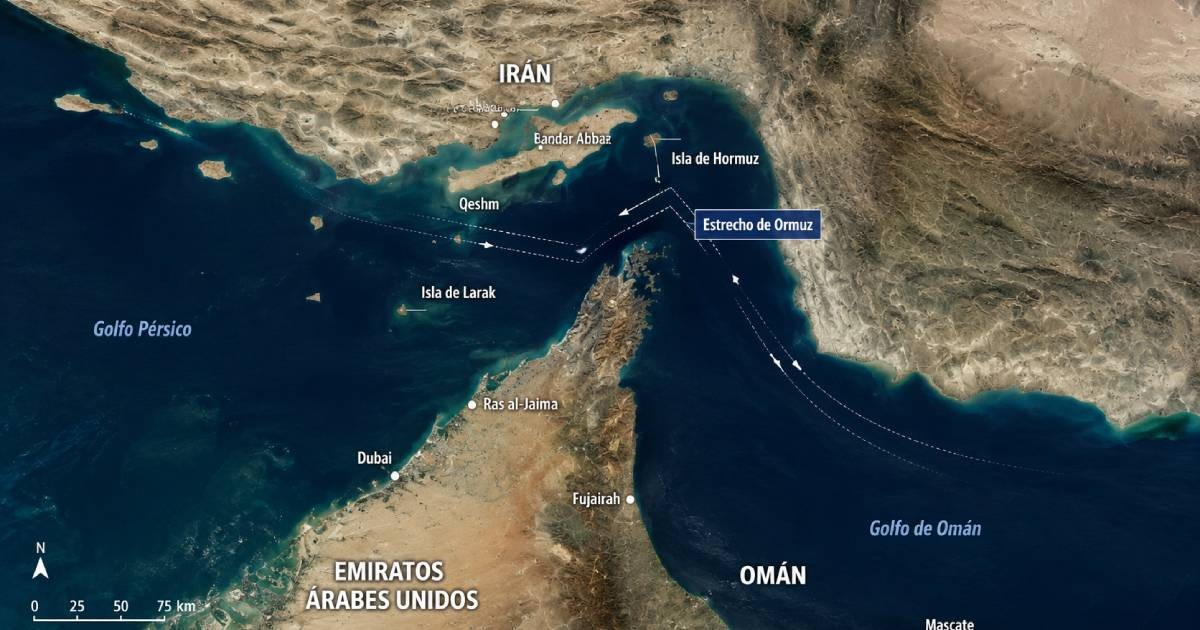
A tanker caught fire on Monday after being hit by a projectile while navigating through the Strait of Hormuz, off the coast of Oman. This incident was reported by the Associated Press (AP), referencing the United Kingdom Maritime Trade Operations (UKMTO).
According to the UKMTO, the projectile struck the port side of the vessel near Limah, Oman, as the tanker was heading south to exit the strait towards the Gulf of Oman.
Authorities confirmed that the incident did not result in environmental pollution, and an investigation has been launched to determine the details of the attack.
No group has claimed responsibility for the attack yet, but suspicions point towards Iran, which has been blamed for several assaults on commercial ships navigating this strategic maritime corridor since the armed conflict began on February 28, 2026.
Escalating Tensions in a Critical Maritime Route
This incident occurs amid heightened tensions in the Strait of Hormuz. On July 3, the Iranian joint military command issued a warning that all tankers passing through the area must adhere to the navigation routes authorized by Tehran.
The official statement declared, "Any violation, deviation from the designated route, or disregard for the navigation protocols of the Islamic Republic of Iran in the Strait of Hormuz will be met with an immediate and strong response from the armed forces." The statement also cautioned that any intervention by U.S. forces in the region would trigger a "swift and decisive reaction."
The Strait of Hormuz is a pivotal energy corridor globally. Under normal circumstances, about a fifth of the world’s traded oil and natural gas flows through its waters, making any incident there immediately impactful on energy markets.
Impact on Maritime Traffic and Global Energy Markets
Since the outbreak of the conflict, maritime transit has faced repeated disruptions. Iran has temporarily closed the passage several times, detaining numerous tankers and causing significant spikes in international crude prices.
Monday’s attack adds to a series of incidents recorded in recent months. Notable among these is the attack on the tanker Skylight on March 1, which resulted in two crew members' deaths, and the June 11 drone strike on the M/T Kiku, which was carrying over two million barrels of oil.
Diplomatic Strains and Future Negotiations
The latest aggression increases pressure on ongoing negotiations between Washington and Tehran regarding navigation in the strait. While both sides reached a temporary memorandum of understanding in June allowing free passage for vessels for 60 days without fees, significant differences remain over the future of the maritime corridor.
Iran is pushing for a permanent system of control and toll collection for vessel passage, whereas the United States and Gulf Arab states oppose any measures that would restrict free navigation in one of the planet’s most strategic commercial routes.
Additionally, these talks have been influenced by the state funeral of Ayatollah Ali Khamenei, who passed away on February 28 during the initial attacks of Operation Epic Fury. His body was transported to the city of Qom on Monday for official honors before the burial scheduled for July 9 in Mashhad.
Analysts warn that a surge in attacks in the Strait of Hormuz could lead to a broader military escalation, once again disturbing global oil supplies and directly impacting international markets and global energy stability.
Understanding the Recent Tensions in the Strait of Hormuz
Why is the Strait of Hormuz significant for global energy?
The Strait of Hormuz is a crucial energy corridor through which about 20% of the world’s traded oil and natural gas flows, making it pivotal for global energy markets.
What are the consequences of increased attacks in the Strait of Hormuz?
Increased attacks could lead to disruptions in global oil supplies, causing significant impacts on international markets and global energy stability.
What is Iran’s stance on navigation in the Strait of Hormuz?
Iran insists on establishing a permanent control and toll system for vessel passage, a measure opposed by the United States and Gulf Arab states.