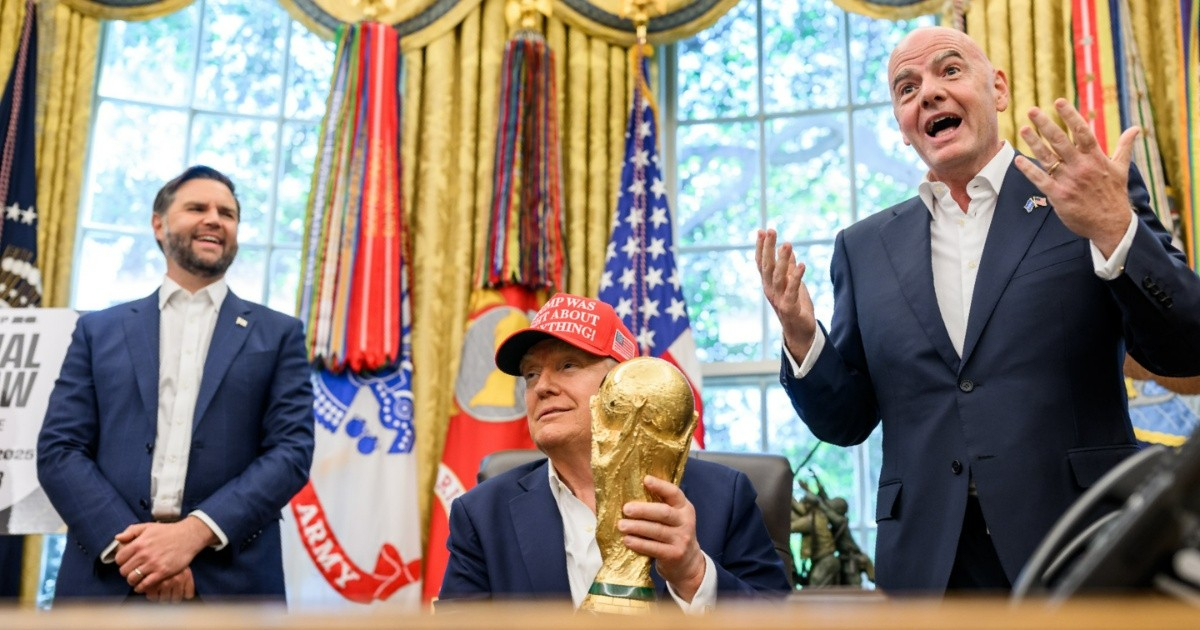
Gianni Infantino, the president of FIFA, acknowledged on Monday that he received a personal call from President Donald Trump concerning the expulsion of U.S. forward Folarin Balogun. However, he emphasized that the decision to overturn the ban was solely made by FIFA's independent judicial bodies, as reported by Marca.
Controversy erupted when it was revealed that FIFA had applied Article 27 of its Disciplinary Code to suspend the automatic sanction resulting from the direct red card shown to Balogun by Brazilian referee Raphael Claus on July 1st during the round of 16 match between the United States and Bosnia and Herzegovina in Santa Clara, California.
Infantino's Stance on Judicial Independence
While Infantino admitted to having a conversation with Trump, he sought to dissociate it from the disciplinary outcome: “Yes, I regularly discuss matters related to the FIFA World Cup with the President of the United States. In this case, I did receive a call from President Donald Trump, just as I receive calls from heads of state, government officials, football stakeholders, and business executives worldwide on various topics.”
Infantino assured that during the call, he explained to Trump that a legal process was underway: “I explained that there was an ongoing legal process involving FIFA’s independent judicial bodies and that the case would be decided by the competent bodies in due course. This is how the FIFA system operates, and it is a principle I will always uphold.”
He further emphasized the autonomy of FIFA’s disciplinary committees: “FIFA’s judicial bodies are independent. They operate autonomously, apply the FIFA Disciplinary Code, and adjudicate cases based on applicable regulations and specific facts presented to them. Their independence is crucial for the credibility and integrity of football, and this must always be respected.”
Global Reactions and Criticism
Trump, on his part, acknowledged during a press conference from the Oval Office that he had requested a review, labeling the referee's decision as “horrible” and asserting that “it was not a foul.” On Saturday, he had already celebrated FIFA’s decision on Truth Social with the message: “Thank you to FIFA for doing the right thing and overturning a great injustice!”
The move sparked a wave of international criticism. Belgium expressed being “astonished” and lodged a formal appeal with FIFA, citing Article 66.4 of the Disciplinary Code, as Balogun was cleared to play in the upcoming knockout match between the two teams scheduled for Tuesday.
UEFA was even more vocal, describing the decision as “unprecedented, incomprehensible, and unjustifiable,” warning that FIFA had “crossed a red line.”
Former FIFA President Joseph Blatter also voiced his opinion with a direct statement: “Red cards are not overturned by political phone calls.”
This incident marks the first documented occurrence in World Cup history where a U.S. president has directly intervened with FIFA to overturn a sanction against a player from his national team, setting a significant precedent for global football governance.
FAQs on FIFA's Decision and Trump's Involvement
Why did FIFA reverse Folarin Balogun's red card?
FIFA reversed the red card by applying Article 27 of its Disciplinary Code, which allows for suspension of automatic sanctions. The decision was made by FIFA’s independent judicial bodies, not influenced by external political pressure.
What was President Trump's role in the decision?
President Trump called FIFA President Gianni Infantino concerning the matter. However, Infantino stressed that the decision was made independently by FIFA’s judicial bodies, following a legal process.
How did the international community react to FIFA's decision?
The decision sparked international criticism, with Belgium and UEFA expressing strong opposition. Belgium filed a formal appeal, and UEFA described the decision as unprecedented and unjustifiable.