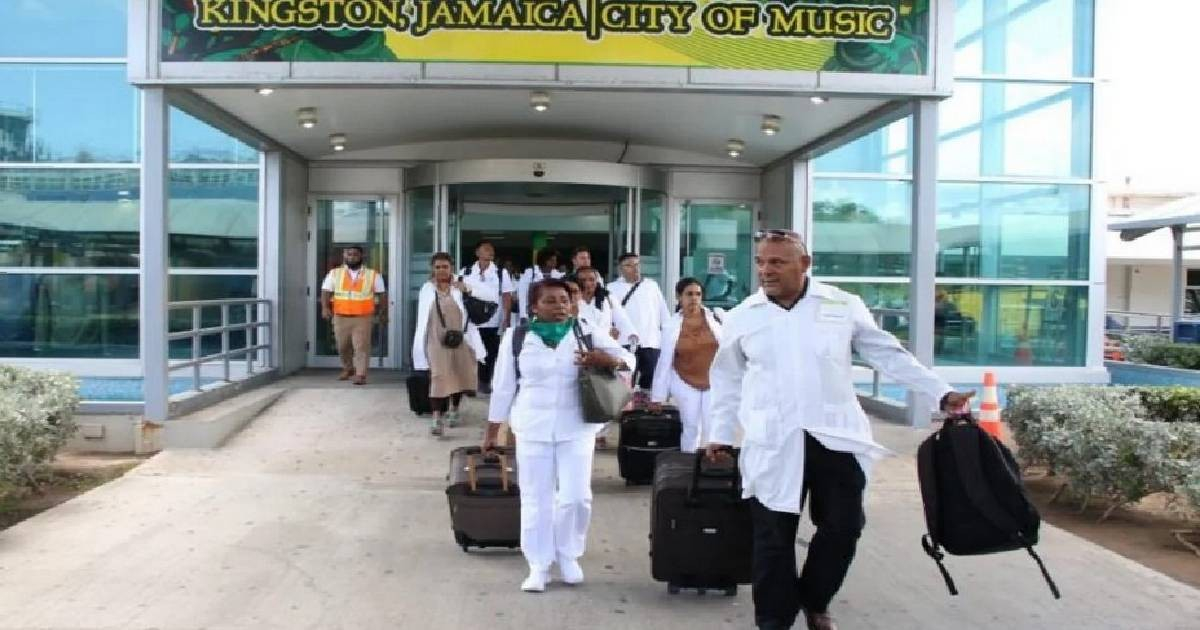
Jamaica's Minister of Health, Chris Tufton, revealed on Sunday that the country will reintegrate over 50 Cuban nurses into its public health system through individual contracts. This approach replaces the previous state agreement with Havana, which was terminated just four months ago due to allegations concerning the working conditions of Cuban health professionals.
The announcement, made during an interview with Radio Jamaica and reported by Caribbean National Weekly, addresses the increasing shortage of nursing staff in the Caribbean nation. This shortage is exacerbated by the emigration of healthcare workers, retirements, rising demand for healthcare services, and challenges in filling vacant positions.
Unlike the former medical cooperation program, these nurses will be hired directly by Jamaican authorities under the country's labor laws, eliminating the involvement of the Cuban government.
This shift aims to address the issues that led the Jamaican government to end the bilateral agreement with Cuba in March 2026, an agreement that had been in place since 1976.
Under the previous arrangement, the salaries of these professionals were reportedly transferred to the Cuban government, and many workers lacked control over their own passports—a practice criticized by the United States, which views Cuban medical missions as a form of forced labor.
Following the termination of the agreement, Cuba withdrew a brigade of 277 health professionals from Jamaica, although around 40 nurses chose to remain in the country.
The new system is now in effect, with more than 40 Cuban professionals opting to stay in Jamaica after the agreement ended, signing individual contracts with local authorities. Some have even begun the process of obtaining permanent residency after living in the country for five or more years.
In May, Tufton stated that the government had sent letters to Cuban professionals, offering them the chance to continue working in Jamaica under this new framework.
"If they were interested, we would be willing to reach out to them based on their own interests, but under the premise of individual contracts," he said at the time.
Unsuccessful Negotiations with Havana
The Jamaican Ministry of Foreign Affairs previously noted that it proposed renegotiating the agreement with Cuba in July, October, and December 2025, but claimed it never received a substantial response from Havana.
The Cuban government, in response, attributed the program's cancellation to pressure from Washington, accusing Jamaica of yielding to U.S. policy against international Cuban medical missions.
In addition to bringing back Cuban professionals, Jamaica has broadened its recruitment strategy to reduce reliance on a single country.
The health authorities have interviewed candidates from Ghana and the Jamaican diaspora and signed memorandums of understanding with Nigeria and India.
Tufton also mentioned that a technical delegation from the Philippines would visit Jamaica next month to explore a potential cooperation agreement in healthcare staffing.
With this new model, the Jamaican government aims to strengthen its healthcare system by continuing to hire Cuban professionals but under a framework that ensures direct salary payments and respects workers' labor rights.
FAQs on Jamaica's New Healthcare Staffing Strategy
Why did Jamaica end its previous agreement with Cuba?
Jamaica ended its previous agreement with Cuba due to concerns about the working conditions of Cuban professionals, including issues related to salary control and passport retention.
How will the new individual contracts benefit the Cuban nurses?
The new individual contracts will allow Cuban nurses to be hired directly by Jamaican authorities, ensuring they receive their salaries directly and have full control over their work conditions and personal documents.
What are the broader implications of Jamaica's new recruitment strategy?
Jamaica's expanded recruitment strategy aims to diversify its healthcare workforce by reducing dependency on Cuba and exploring staffing partnerships with countries like Ghana, Nigeria, India, and the Philippines.