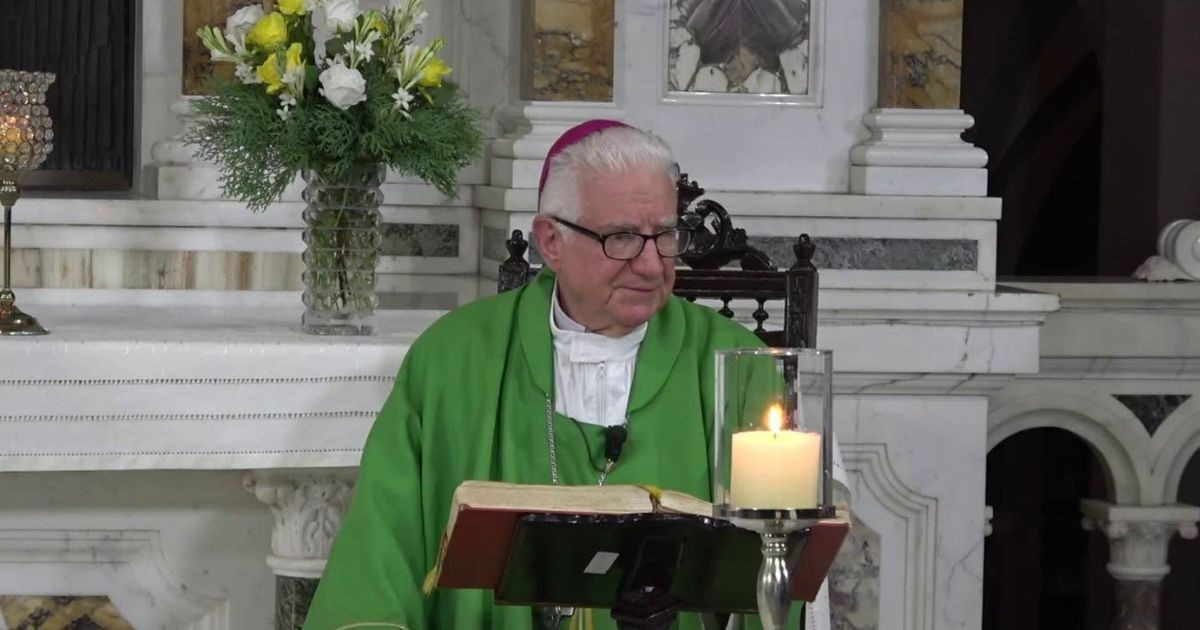
During a Sunday homily at the Basilica Shrine of Our Lady of Charity, Archbishop Dionisio G. García Ibáñez, leader of Santiago de Cuba, openly acknowledged the profound hardships facing the Cuban people. "There are so many people seeking assistance. And the assistance that arrives simply isn’t sufficient," he stated.
The archbishop utilized the verse from Matthew 11:28 — "Come to me, all you who are weary and burdened, and I will give you rest" — as a framework to connect the gospel's message with the harsh realities facing Cubans today.
García Ibáñez portrayed the dilemma of those eager to help others but hindered by insufficient resources: "Often, we want to give and assist, yet we're left questioning if we should, because our own family might suffer, but still, we know we must act."
In a particularly poignant segment of his address, the archbishop urged reliance on spiritual strength as a means to endure the current crisis: "The Lord comforts me with the Spirit of God, granting me the strength to persevere, to hope, and to fight."
Concluding his sermon, García Ibáñez encouraged his congregation to hold fast to the gospel amidst adversity: "In these challenging times, let us keep this gospel in our minds, on our foreheads, and in our eyes. Life often burdens us heavily."
This homily came just two days after the U.S. Department of State officially confirmed a $100 million humanitarian aid package to Cuba, allocating $60 million through the Catholic Church and $40 million via non-governmental organizations.
The scale of the crisis outlined by the archbishop is supported by international figures: the UN has requested $94 million to assist two million Cubans, while over 100,000 patients — including 11,000 children — are awaiting surgeries postponed due to power outages and shortages of medical supplies.
García Ibáñez's statement is part of a series of increasingly assertive declarations. On May 17, he contended that "Cuba must change" and demanded concrete actions; on May 24, he urged leaders not to act as if they "own the world"; and on June 28, he warned against those who believe power entitles them to act recklessly.
In January, the Conference of Catholic Bishops of Cuba warned of the "risk of social chaos" and demanded "no more bloodshed or mourning," reinforcing the Church as the primary voice of civil society amid an unprecedented crisis in recent decades.
Cáritas Cuba had already distributed 82% of an initial $3 million donation, aiding 8,800 households of elderly, single mothers, and individuals with disabilities, although fuel shortages have hampered even this logistical effort.
Understanding the Humanitarian Crisis in Cuba
What did Archbishop Dionisio G. García Ibáñez emphasize in his homily?
Archbishop García Ibáñez highlighted the severe hardships faced by Cubans, acknowledging that the aid reaching the country is not sufficient to meet the needs of the people.
What is the significance of the recent U.S. aid package to Cuba?
The U.S. Department of State has allocated $100 million in humanitarian aid to Cuba, with $60 million distributed through the Catholic Church and $40 million via NGOs, to address the urgent needs of the Cuban population.
How has the Catholic Church responded to the crisis in Cuba?
The Catholic Church, through its leaders and organizations like Cáritas Cuba, has been vocal in calling for change and providing aid, despite challenges such as fuel shortages that affect distribution efforts.